Double anneal?

Joined
Aug 31, 2010
Messages
726
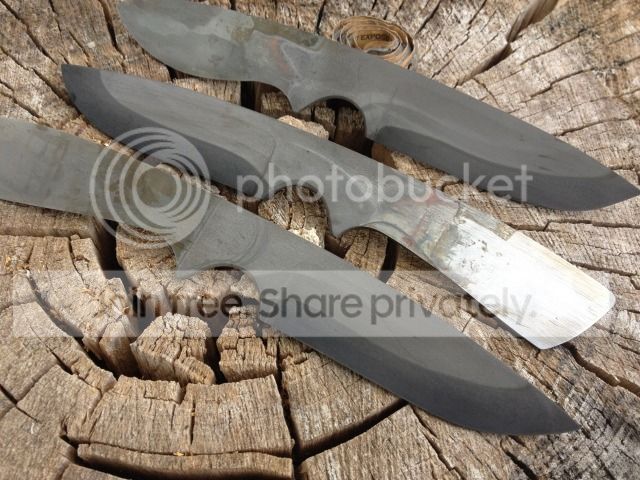
abanaknives009.jpg


I had a batch of blades similar to these crack at the top of the first finger choil. It happened to a batch that I didn't anneal. I just normalized them, and they seemed soft enough to grind.

Apparently this type of choil creates a big stress riser in a forged blank of 52100?

Now, I anneal by holding at 1250 for two hours, then oven cool to 800 and quench in Houghton 11 second oil. I grind the profile from a surface ground blank.

The steel might get a little blue when I grind in the choil, but I grind wet, so it's not getting very hot.

What would be the best thermal cycle to relax the steel, and prepare it for hardening?

Thank you for your consideration.
 
Thanks Matt. I've read quite a little about 52100, but this seems like something I haven't heard about before.

I don't know why the blades cracked where they did, when they did, or why they did. I haven't had this problem before, but I sure as heck don't want it again.

So once a guy anneals and grinds, is there sometimes supposed to be another thermal cycle to relieve the stresses induced by grinding? If so, what level would be most appropriate? Black heat and quench? Full normalization in calm air?

I'm not sure what the optimal condition of the steel should be, right before hardening. It seems like the steel would take hardening better after a normalization rather than being annealed, but don't remember seeing this in the stickies.
 
I think I found enough information to get in the right direction.

Sometimes the stickies need some serious studying for someone new to the game.
 
52100 needs some different treatment to get the most out of it. It has both a lot of alloy and a lot of hyper-eutectiod carbon to deal with. It does well with Kevin's parameters. It definitely isn't a get it red and dunk it steel.

As you probably have read now, the type of structure you start with may have a big effect on what happens in the quench. All 52100 steel is not the same. There are thermal cycling procedures that will aid this problem. Kevin has done some intensive research and metallography on this exact problem. Getting it ready for the quench is crucial to having the max results. In some cases the as quenched hardness is four points low because it was not structured right for the quench.
 
Back
Top