Dovetail Handle Inserts

Joined
Nov 23, 2013
Messages
306
Ok, so I finally got my TSP and used it per Mr. Niro's suggestion in this thread: http://www.bladeforums.com/forums/showthread.php/1432676-Bone-Handle-Tutorial-Please?p=16511975#post16511975
The bone cleaned up to a lovely ivory color, and is very nice (but the shop reeks of bone powder for days after working it :barf:). My current dilemma is that after grinding the bone flat enough for scales, most of it is a bit too thin to make a good handle. I suppose I could just get some liners to thicken it up a bit, but I have never used the stuff before and I prefer natural materials for my knives.
So, I have this idea to make wooden scales with dovetailed bone inserts. This is probably pushing my skills quite a bit, but I kinda want to try just to see if I can pull it off. The tools at my disposal are: Esteem belt grinder/w flat platen, drill press, table saw, scroll saw, pencil grinder/w assorted bits and burrs, files, sand paper, and many other hand tools. Basically most of a mid level knifemakers shop. Notably what I don't have that I wish I did for this project is a mill of some sort. The questions that I have now are: Is this reasonably possible with the tools I have? Any suggestions for cutting and fitting the dove tails?

Have any of you tried this sort of handle design? Any of you have any tips, suggestions or preferred methods for doing this?
 
I think you could do it if you basically take a handle scale, cut it in half length wise, use a scroll saw & files to carve out the area for the insert (which would be right in the middle of the handle, then grind the edges at an angle so the outer scale material has an undercut bevel (larger surface area on top of the scale, less surface on bottom), and the insert has a bevel that has less surface area on top and more surface area on bottom, then you could theoretically slide the insert into the scale and epoxy it all in place. Does that make any sense? Just to note - this is just an idea of how it could work, I've never actually done this before.


Sent from my iPhone using Tapatalk
 
I think you could do it if you basically take a handle scale, cut it in half length wise, use a scroll saw & files to carve out the area for the insert (which would be right in the middle of the handle, then grind the edges at an angle so the outer scale material has an undercut bevel (larger surface area on top of the scale, less surface on bottom), and the insert has a bevel that has less surface area on top and more surface area on bottom, then you could theoretically slide the insert into the scale and epoxy it all in place. Does that make any sense? Just to note - this is just an idea of how it could work, I've never actually done this before.

I think I'm following, but a scroll saw stinks at a precision cut when I'm the one running it. I am actually thinking of cutting the female side of the dovetail with a table saw set on an angle and cleaning it up with hand files or sandpaper, and the male side I should be able to do on my belt grinder by setting my angle on the work rest. I also should note that I'm planning on using three pins in the handle, with one in the center of the dovetail and g-flex epoxy for assembly.
 
I think I'm following, but a scroll saw stinks at a precision cut when I'm the one running it. I am actually thinking of cutting the female side of the dovetail with a table saw set on an angle and cleaning it up with hand files or sandpaper, and the male side I should be able to do on my belt grinder by setting my angle on the work rest. I also should note that I'm planning on using three pins in the handle, with one in the center of the dovetail and g-flex epoxy for assembly.

That sounds like it'll work. Let me know how it turns out!
Good luck!


Sent from my iPhone using Tapatalk
 
There is a router table attachment for a dremel.


Sent from my iPhone using Tapatalk
 
I made a knife using buffalo horn. I knew the material would've been too thin on its own so I took some slabs of ebony and used them like liners. I radiused the leading edge of the bone and made the ebony kinda like an integral bolster.
Kinda hard to see as this knife has been living in the wife's kitchen.
82933B47-AE8A-4461-8796-B3EA73867A38_zpsb81q2ilj.jpg

FD44E18D-4FB9-4CCD-8DF0-731722A37B79_zps5ter19hj.jpg
 
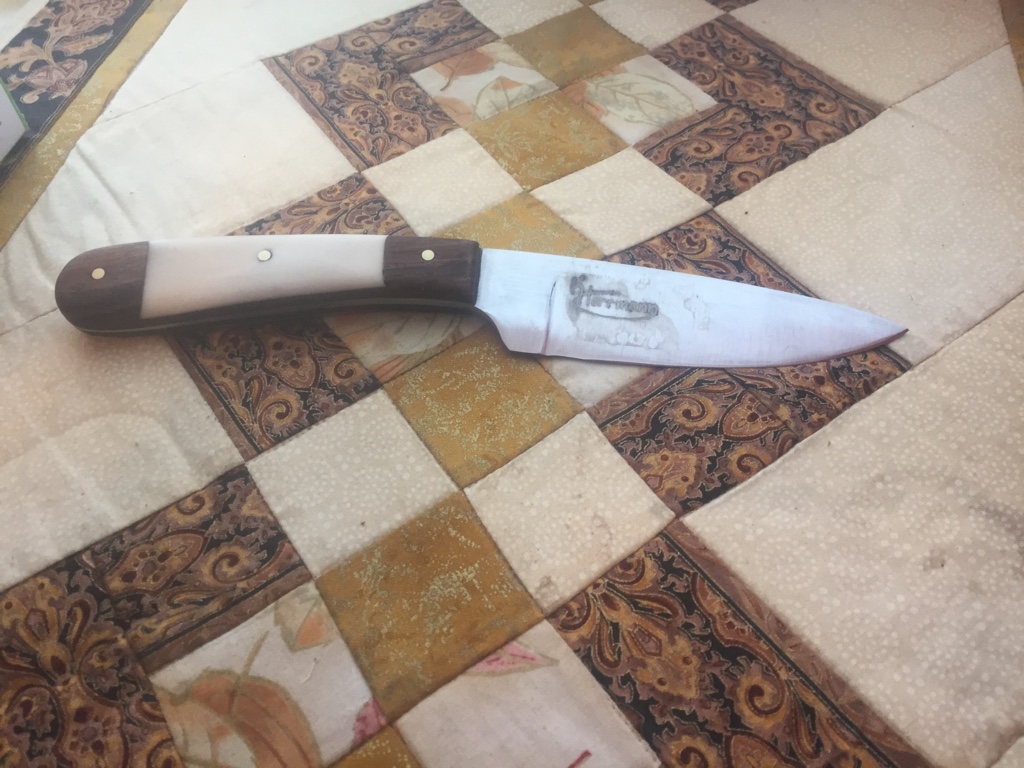
Well, not sure if this turned out better or worse than I'd hoped. I love the overall look, but I fought to get the fit right. It still turned out pretty good, but I think routering the dovetails is better than the method the method I ended up using (grind recess with 2x72 and undercut with a file).
I'm beginning to wonder if I'm making it unnecessarily difficult for myself. Do I need dovetail the insets or is the epoxy and pin enough? Does the dovetail add enough visual interest to merit keeping it even if it's unnecessary?
e5e7853fbed7a731211b85bf8df27af4.jpg

578316dbb8aaad362e72ccb37aa4c1c3.jpg

This is my second knife using my etcher (a personalizer plus kit SCE-1 electrolyte and AMC cleaner), and I'm having issues with a dark stain instantly when I remove my stencil. My method is to clean, mask with blue painters tape, etch (3 swipes of 4 seconds each), mark (2 swipes of 1-2 seconds each), quick flush with warm water, remove stencil and masking, neutralize with the cleaner, and oil (olive oil). The stain is usually present when I remove the stencil. Any ideas what I'm doing wrong?


Sent from my iPhone using Tapatalk
 
Mine always stains after etching and I think it's common. Being that the only knives that get an etch logo are hand sanded I just re sand lightly and cleans right up.
 
Custom Knives are scrutinized for details and the addition of the dovetail as pains taking as it may be shows higher level of craftsmanship. Now that you have completed one the next will be easier and you will probably acquire the tooling to make it go faster with better detail. Looks good keep it up.
 
Well, not sure if this turned out better or worse than I'd hoped. I love the overall look, but I fought to get the fit right. It still turned out pretty good, but I think routering the dovetails is better than the method the method I ended up using (grind recess with 2x72 and undercut with a file).
I'm beginning to wonder if I'm making it unnecessarily difficult for myself. Do I need dovetail the insets or is the epoxy and pin enough? Does the dovetail add enough visual interest to merit keeping it even if it's unnecessary?
e5e7853fbed7a731211b85bf8df27af4.jpg

578316dbb8aaad362e72ccb37aa4c1c3.jpg

This is my second knife using my etcher (a personalizer plus kit SCE-1 electrolyte and AMC cleaner), and I'm having issues with a dark stain instantly when I remove my stencil. My method is to clean, mask with blue painters tape, etch (3 swipes of 4 seconds each), mark (2 swipes of 1-2 seconds each), quick flush with warm water, remove stencil and masking, neutralize with the cleaner, and oil (olive oil). The stain is usually present when I remove the stencil. Any ideas what I'm doing wrong?


Sent from my iPhone using Tapatalk

I think it turned out pretty good, especially for your first try!
 
My method is to clean, mask with blue painters tape, etch (3 swipes of 4 seconds each), mark (2 swipes of 1-2 seconds each), quick flush with warm water, remove stencil and masking, neutralize with the cleaner, and oil (olive oil). The stain is usually present when I remove the stencil. Any ideas what I'm doing wrong?

I have two ideas for you:

Forget the blue painters tape. For masking and most everything else. It is a constant source of trouble when applied to cleaned/polished carbon steel for many makers (I didn't find what alloy you used for this particular blade). Marks and latent stains being the biggest issues I see. Maybe something in the adhesives or a pH issue. Doesn't matter, just find an alternate. I use Scotch tape if I need to mask or to stabilize a stencil on a small surface area. Never stains and lets you see what's underneath.

Also, if it was carbon steel, take some hardened and polished scrap and try this for yourself. Forget the cleaner, just wipe down area with EtOH or rubbing alcohol and pat dry, then use just a light spray of Windex on area to be marked. Don't let this dry. Just drop and position your stencil right on wetted area and mark as usual with the SCE-1. If your stencil's flange is wide enough, surface tension alone will keep it in place. Then just a wipe down with more Windex on a swab afterwards for cleanup. Yeah I know, sounds like a fools joke, but ever since I learned this trick here from Brian Fellhoelter, I no longer see halos or other weirdness -- ever -- on steels including 1075, 1084, 1095, 52100, W2, or CPM-10V. My finished marks are deep and crisp using 12V X 1.0 mA even when there is little opportunity for surface cleanup like after marking hellishly hard belt-finished stuff like 10V (such as the bottom pic in post #39 of this recent thread: http://www.bladeforums.com/forums/showthread.php/1442757-Perfect-meat-steel-need-advice

You have a solid knife there. Hope this helps you make the next one even better. Attention to ALL these details is what will get you where you want to go.
 
I do believe your handle progress is great ! A lot of the "extra" things that can be found on knives are specialty items. Usually they add to the knife and are appreciated by viewers.
Frank
 
Looks like a lot of work to get the bone inset exactly. I would suggest do your 45 degree mating angles on all 3 separate pieces, scales a bit over sized, mate them and epoxy them to a liner. Same material as the non-bone if you want it to match, contrasting if not. If you used white g10/micarta as the inset (or end caps) and liner it might look interesting . You did a great job from what I can see, but it had to be time intensive. Hope this helps.
 
Back
Top