draw filing - tips and tricks

Joined
Oct 2, 2007
Messages
72
I have nowhere near the level of knowledge/experience that most of you guys on here seem to have, but i wanted to share a little trick that might help you guys that don't have fancy belt grinders!

After forging, I use a combination of angle grinding and draw filing on all my blades (cause i don't have a kmg!), and I've found that the fastest way to get the hammer marks and pits off and get the surfaces flat relatively fast is a combination of angle grinding/draw filing.

First, i get the scale off with some pretty rough/heavy use of the angle grinder. Then I'll start to draw file. At first the file cuts really well...you can really feel it digging in, taking off steel. I'll draw file till I can just start to feel the file lose some of its bite (maybe you know what i'm talking about? it's like after awhile it keeps cutting into the same grooves or something...not sure what causes this). Then, I'll go back to the angle grinder, but this time use reallllly light, even passes...just basically roughing up the surface. Go back to the draw file, and you'll feel it really start biting again. It's like the roughing up of the surface and the slight bumps/unevenness produced by the angle grinder help the file slice in...like it gives it a good 'angle of attack' on the steel, if that makes sense. I do this...back and forth between grinder and file till i'm happy with the surface. I can actually get it done this way much much faster than just using draw files, and the surface seems to be just as nice and flat when I'm done.

Also, I don't know about you guys, but I actually enjoy draw filing...I get in a sort of trance-like rhythm...

Hey, it's not a kmg, but...

Alright, maybe this is all obvious stuff...do you guys have any draw filing tips you can share?
 
Sounds good. I'm not sure I could be that steady with an angle grinder though. You might know all this stuff, its from the newbie sticky, http://www.bladeforums.com/forums/showpost.php?p=3009481&postcount=5.

I wish I could understand the support description from Primos's tutorial, but the photos are missing and I don't quite get it. What do you use to clamp up your blade in? And how do you support it so it doesn't bend when you draw file it?

I'm also having a dickens of a time figuring out how to forge, grind and file the transitions from blade - to ricasso - to tang. Anyone got any suggestions

Thanks, Phil
 

Attachments

  • DrawFiling.jpg
    DrawFiling.jpg
    50.2 KB · Views: 380
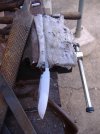
I think the draw filing jig was a piece of angle iron. Drill and tap six or eight holes maybe 1/4" on one end. Clamp the blade tang on the opposite end with scrap leather padding it against the angle iron. Then screw a few bolts up through the angle iron to support the blade from springing or flexing while you work on it. The other 'L' of the angle iron can be held in a regular bench vise. Thanks to Terry Primos for a simple hugely helpful jig.

Best of luck with the project, Craig
 
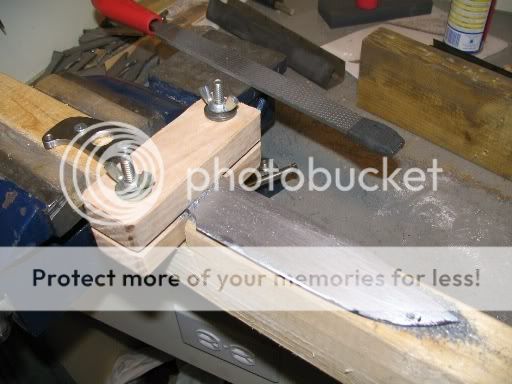
I do a lot of draw filing as I have a very primitive work space, and I use a 2x4 cut to the basic shape of the blade and clamped to the work bench to support it so it does not bend and to clamp the blade I use a "C" clamp with a smaller piece of wood between it and the blade and tighten it down, so far I have not had any problems with the blade bending or sliding as I am filing.


Tim
 
I've got a basic 4" bench vise on my workbench. I took one of those "suction cup" mount vises that has a ball joint so you can move the vise head around, and broke the bottom half off of the ball with my forging hammer.

Now I tighten the ball into my regular bench vise, and... Voila! any angle I need between the two vises! This gives me incredible versatility in securing the blade at any angle and / oir height I may need.

I use a piece of flat stock (1084, as that's what I happened to have on hand) under the workpiece to help make sure it is sufficiently stiff for draw filing.
 
I do the same as others for draw filing and hand sanding. I have a 2" wide piece of mild steel that I have bolted through my bench, then I c-clamp the tang to that and draw file the blade that way.

22.jpg
 
A piece of 3" x 5" x 3/16" square tubing with a slot on both sides plasma-cut out, and a $4 visegrip:

Image-F5E74B9CE15811DB.jpg
 
Last edited:
Very interesting thread!
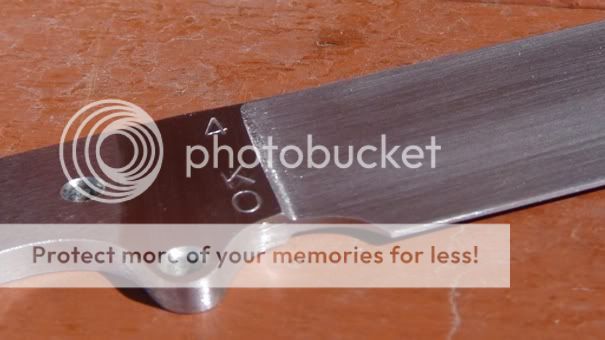
...and a closeup of the result:
FilingJig_Result.jpg

Holly crap! You did that without a belt sander? Just hand filing? Oh well... then I guess you are the MAN who is going to help me out here. Congrats btw!

Listen. I am making my first blade. Instead of perfetly flat ground stock I started with an almost-flat piece of leaf spring (250 x 63 x 5mm). I got four of them at the same time and after annealing I just chosed the one that was flatter.

I don't have a belt sander (all I have is an angle grinder and a drill) so people here in BF suggested me to start making a scandi grind knife. I just made some rigs like the ones Greenpete shows in his videos and started working on it. I shaped the knife with my angle grinder and then with a file. Then I made the bevels starting with the angle grinder eyeing the angle and then with a file (and the rigs I just made). They came out even (same width I mean) and with 12,5º per side. Not a chopper as you can see

The turorial I am following suggest to finish the blade as much as possible before HT (even sharpening the knife to get rid of the file scratches on the bevels) because later on it is a much tougher job. I started doing so and I realised that not only I have the slight bend I suspected, but uneven surfaces. I tried to file it off but the file (new one) doesn't bite it and I fear that instead of keeping it perfectly flat on the blade I will start rocking it back and forth... geting a not so flat surface. I tried to put a sheet of 220 on a table and rubbing the whole blade on it but I think it is going to take like two months straight to make it nice and even. I have a lot of black scale as well (I didn't forge it at all but looks like scale or some kind of coating).

Any clues of what can I do here? I guess I need a perfectly flat surface for gluing on the handles... (they will be pinned as well with two or three 6mm brass rods). I don't want them to pop off.

Thanks in advance.
Mikel
 
Dang. Impressive stuff. Any tips for draw sanding, or whatever you would call it when you draw "file" with sandpaper?

This is called hand sanding...its almost exactly the same process as draw filing except you can push AND pull and apply as much force as you want up to about 400 grit. After that, you should be going from ricasso to tip only to avoid fish-hooks in your finish. Hand sanding can be relaxing or the worst possible process on earth depending on your mood, the steel, and what tunes you have on in the background!
 
"Hand sanding can be relaxing or the worst possible process on earth depending on your mood, the steel, and what tunes you have on in the background!"

Man, is that the truth. When I first started I just held sandpaper in my hand and rubbed the blade. It took forever, left valleys in the blade and I just hated it.

Eventually, I clamped down the blade and wrapped the sandpaper in a piece of wood and started draw sanding. Now I almost look forward to it, depending on my mood, the steel, and what tunes I have on in the background.
 
I've started copying what Don Fogg uses: a bar of 1/4 inch mild steel about 20" long with
sandpaper glued to the middle section. I use an 11" x 2" strip torn from a full sheet and
3M feather adhesive to hold it on. Just press a strip down, use it up, rip it off and replace it.
One coating of adhesive lasts for several strips.

The nice thing about this approach is that you can bear down as hard as you want with two
hands. I find that two hands also make it easier to keep it flat on the blade.

I've added a layer of 8oz leather to one side as a semi-soft sanding surface. I'm thinking about
getting some 1" wide steel to make a narrower bar, but generally like the 2" one.
 
I've started copying what Don Fogg uses: a bar of 1/4 inch mild steel about 20" long with
sandpaper glued to the middle section. I use an 11" x 2" strip torn from a full sheet and
3M feather adhesive to hold it on. Just press a strip down, use it up, rip it off and replace it.
One coating of adhesive lasts for several strips.

The nice thing about this approach is that you can bear down as hard as you want with two
hands. I find that two hands also make it easier to keep it flat on the blade.

I've added a layer of 8oz leather to one side as a semi-soft sanding surface. I'm thinking about
getting some 1" wide steel to make a narrower bar, but generally like the 2" one.

I usually just wrap the paper around the bar, but have found myself only using about half the sheet lately and have thought about using that model. I use a 22"X1.5" bar that i've cord wrapped handles onto. I bear down as hard as I want and I am comfortable doing....one side of my bar has a sharp edge, the other has a 1/8" radius that slips nicely into the plunge lines.

Once you get a blade hand sanded to 400 grit, the rest is cake. Toughest and longest step is from grinder finish to 200 grit. Its amazing how crappy a beautiful 400 grit grinder finish really is once you start working by hand. Grinder finishes hide so much its not even funny....
 
David, you need to change yours for one like the other guys have. Yours is dangerous from the standpoint that you or someone could trip and fall into the blade, or at least you could slice a finger open, or worse. The type the other guys have, even the 2 x 4 has wood or metal completly under the whole blade, including the tip, and it would be hard to get stabbed to death falling on it. Also, if you ever have children in your shop, even once a year, someone could walk by and poke an eye out.
 
This is called hand sanding...its almost exactly the same process as draw filing except you can push AND pull and apply as much force as you want up to about 400 grit. After that, you should be going from ricasso to tip only to avoid fish-hooks in your finish. Hand sanding can be relaxing or the worst possible process on earth depending on your mood, the steel, and what tunes you have on in the background!

I have some slightly dull 180 grit belts on hand, would a piece of that work for sanding it out?
 
David, you need to change yours for one like the other guys have. Yours is dangerous from the standpoint that you or someone could trip and fall into the blade, or at least you could slice a finger open, or worse. The type the other guys have, even the 2 x 4 has wood or metal completly under the whole blade, including the tip, and it would be hard to get stabbed to death falling on it. Also, if you ever have children in your shop, even once a year, someone could walk by and poke an eye out.

Agreed. I never leave blades like that, the pic was taken while I was working on it. I only overhang the tip on rare occasions, and usually support the whole blade to avoid flex anyways. Thanks for the heads-up, though!
 
David, you need to change yours for one like the other guys have. Yours is dangerous from the standpoint that you or someone could trip and fall into the blade, or at least you could slice a finger open, or worse. The type the other guys have, even the 2 x 4 has wood or metal completly under the whole blade, including the tip, and it would be hard to get stabbed to death falling on it. Also, if you ever have children in your shop, even once a year, someone could walk by and poke an eye out.

I have acted this one out... Decided to do a quick shop-vac around a blade that was clamped with blade totally exposed. Went to get at some crap under the table and almost knocked myself out slamming my forehead into the tip of the blade (this was post-HT:eek:) I have now confirmed that the RC of my head is woefully inadequate to that of a knife. I was so dazed that when I first realized what must have happened I was concerned that I might have damaged the tip of the knife! Then the blood brought my attention back to reality. I was VERY lucky not to have slammed an eye into the blade. Guess this is the only time I can think of that being a short bastard has ever got me anything more than grief:D And keep in mind, I had always unclamped the blade when done with sanding. This is just one of those things that can happen with the wrong setup regardless of how careful you think you are:o

P.S. If you want a really simple setup, just cut out a 2X4 in the shape of a wiener and C-clamp it to your workbench, then C-clamp the blade to that. (add protection as necessary!:p)

Regards,

Dave
 
Dang, Dave! That made my head hurt just thinking about it! My drawfiling setup is just a 2x4 nailed to two 2x6s (shaped kind of like this --H )and those are nailed to the bench (it's not my nice bench) so the blade is entirely supported by the 2x4. And I thank Jesus, Buddha, Allah and Zeus that I did that because I have done the same exact thing, only I just whacked my head on the board (which hurt plenty, believe me).
 
Back
Top