Dyed stabilization question

Joined
Feb 17, 2016
Messages
1,527
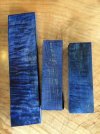
I have always bought my handle material but had some quilted maple sitting around the shop for a few years and wanted to get it dyed and stabilized. Well I sent it off and got it back today, I sanded the blocks and scales on a disc sander with 180 grit and then buffed to see what they looked like. The black and blue look black and blue outside but on the inside the blue looks almost like the black. Is it normal to have mixed results with the straight grain wood? Do the burl sections dye better than straight grain sections? I had several colors done, Orange, Red, Green , Brown which I really like but the blue and black just did'nt hit the home run. Thanks for all the help it is much appreciated!
 
I had some blue dyed figured maple that I sanded to 200 and it looked okay. When I sprayed some lacquer on it the grain and figuring really popped and I was surprised to have blues and greens showing up. Try wetting it our putting some mineral spirits on it to get the grain to pop and see what shows then.
 

Attachments

  • IMG_4826.jpg
    IMG_4826.jpg
    43.2 KB · Views: 34
Last edited:
Dont use spirits. Use a wax or a lacquer. Just about every pro stabalizer uses methyl methacrelate, which a polymer with a degree of solubility in alcohol. It wont remove the stabilizer, but it will soften it.
 
Just use water to wet for a quick look. It should be fine if it is actually stable. Some woods do not take the solution well. Some woods don't take the dye well. Some parts of wood don't take the dye at all which can make for some interesting results, some good, some bad. Also if the grain is so so the result will be the same.

Are you shire it was maple and not myrtle??
 
I sent the wood to Wood Dynamics in PA. The only thing is the blue don't really look blue like those in Randy's photo, I sanded to 180 and buffed on loose muslin with white compound. Wood Dynamics are really good people and I want to say they did a good job on all the wood I sent them, Maybe I should sand on down like Randy stated and buff again or try some furniture wax to see what happens?
 
It's weird how things take though. I had a piece of spalted maple dyed brown and stabilized that turned out like a brown turd with little to no contrast. A couple other pieces of the same wood were just stabilized and they are beautiful. I am just starting out with all this knife making stuff and have had about 35 pieces total stabilized and about half of them dyed. It seems like it may be a bit of an educated crap shoot with dying. Some stuff may be more likely to turn out nice but exactly what you will get is unpredictable. I had some maple burl dyed blue and some dyed brown. The blue has really cool contrast, but the brown is quite dark and the contrast is not as easy to see. My strategy was to have the majority of my pieces stabilized only and then to test about a third of my pieces with dye. I figured some would turn out nice and others would be fails. But when I am finding my own wood the fails are only costing a few bucks a fail.

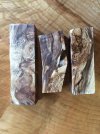
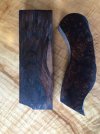
The dark block on the left is from the same piece of wood as the three pieces in the other picture. The piece of burl is dyed.
IMG_4829.jpgIMG_4834.jpg
 
Yeah, The brown really took away from the figure in the wood. I have spotted quite a few different species of burl around my area and will be putting a bunch away to dry. I guess I may have expected too much out of the dyeing process but oh well it will still make nice handles. Thanks guys for all the replies and advice.
 
In my limited experience it seems that the dye process works better on things like burl and figured wood that had grains going in different directions and different hardnesses of wood in them.
 
Now that you have tried wood dynamics, why not try K&G for your next batch.
Then you can compare to see which you like best.
Some places mix the dye into the stabilizer and in my opinion that does not look as good as the other way.
K&G dyes the wood first and then stabilizes it afterwards. The colors seem more vivid that way.
Dying spalted woods will often result in muddy colors if the spalting has gone to the point where the wood is becoming punky.
Otherwise, when you dye wood there will often be surprises. For me the weirdest looking pieces have been the most popular.
 
I'm not sure how to tell if the wood was dyed before or during stabilization but when I got it back it was covered in powdered dye so I assume it was dyed and stabilized at the same time. I am sending some of the same type maple this coming week to K&G to see what they can do with it, I sure like the customer service at Wood Dynamics, Mel is one super nice guy!
 
Yoiu can drive yourself crazy trying to figure why some wood and leather won't evenly accept dye. I have a lot of professionly figured dyed and stabilized maple that looks great. Some of my sheaths have had varied results but are satisisfactory.

And yes, Mel is certainly a fine guy. He doesn't know me but his reputation proceeds him.
 
I just boxed up a batch of maple will be sent out tomorrow to K&G, It will be several weeks before I get it back but I know the wait will be worth it. When the results are back then I will have to decide where to send all the spalted maple burl.
 
Back
Top