
-
The BladeForums.com 2024 Traditional Knife is available! Price is $250 ea (shipped within CONUS).
Order here: https://www.bladeforums.com/help/2024-traditional/
You are using an out of date browser. It may not display this or other websites correctly.
You should upgrade or use an alternative browser.
You should upgrade or use an alternative browser.
Dymondwood
- Thread starter Walt2
- Start date

Brian.Evans
Registered Member
- Joined
- Aug 20, 2011
- Messages
- 3,267
My feeling is its the "flea market effect." Lots of cheap knives use it, so now no one will touch it for good knives. I'd like to try some, and there is some that looks decent, but some of it is just hideous.
I have used it occasionally when a specific color or combination of colors was requested, but as was stated I feel it's the flea market effect. It works easy, polished nice and holds up well, but so many Pakistani and Chinese knives have been using it that it has become associated with low quality import knives of poor quality. I feel it has less to do with the material itself than the perceived image of it.

james terrio
Sharpest Knife in the Light Socket
- Joined
- Apr 15, 2010
- Messages
- 22,618
It's very chippy compared to other synthetics/semi-synthetics (micarta, G10, stabilized wood, even carbon fiber). You must use a backing block when drilling it or the bit is very likely to blow out big chunks when coming through. You do not want any sharp corners on the finished handle.
If you can get past the "flea market effect" and use a little care working with it, it makes a very strong and durable handle. It's also dirt cheap... which can be good or bad. If you're selling lots of $70-150 knives made of old files and sawblades at gun shows and whatnot, Dymondwood can go over like hotcakes. If you're trying to move $200-300+ knives made of top-shelf steel... not so much.
If you can get past the "flea market effect" and use a little care working with it, it makes a very strong and durable handle. It's also dirt cheap... which can be good or bad. If you're selling lots of $70-150 knives made of old files and sawblades at gun shows and whatnot, Dymondwood can go over like hotcakes. If you're trying to move $200-300+ knives made of top-shelf steel... not so much.
- Joined
- Dec 5, 2009
- Messages
- 1,528
Agreed with James. It is extremely chippy and works best when drilled with a brad point bit. I use a piece of painters tape and a backing board and will still get a little chip every now and then, but usually can be sanded out with shaping. I like the colors available except those generic tri-color versions that SCREAM flea market.

daizee
Knifemaker / Craftsman / Service Provider
- Joined
- Dec 30, 2009
- Messages
- 11,177
Once again, I agree with James.
I've used it three times on paring knives and it's alright, but be careful about your intended audience. IMO the subdued colors are best. The most recent piece took the most amazing buffed-looking finish with a file - it just cut so smoothly I couldn't believe it. Turned out better than sanding, so I filed and then hit it with 600. Weird. Anyway, I'd been asked for a 'Mexi-Cali' color scheme so that's where I turned.
-Daizee
I've used it three times on paring knives and it's alright, but be careful about your intended audience. IMO the subdued colors are best. The most recent piece took the most amazing buffed-looking finish with a file - it just cut so smoothly I couldn't believe it. Turned out better than sanding, so I filed and then hit it with 600. Weird. Anyway, I'd been asked for a 'Mexi-Cali' color scheme so that's where I turned.
-Daizee

- Joined
- Aug 24, 2012
- Messages
- 214
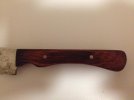
Ive used it for a few handles and it looks good IMHO. I only hand sanded to 400 and oiled it. It gives it a nice antiqued/distressed look. The more you sand/buff the shinier it gets.It could end up looking like plastic.I havent chipped any drilling it,but it did a little when I cut it on the miter saw. Heres a pic of one I did in it.
- Joined
- Dec 5, 2009
- Messages
- 1,528
Oiling it is unnecessary due to the make up of the material.
- Joined
- Aug 24, 2012
- Messages
- 214
Definitely not necessary,but it does change the look. 


- Joined
- Nov 29, 2010
- Messages
- 1,320
The stuff makes good knife handles and comes in a wide range of colors. I find it's a little easier to work with than other materials. In general, knife makers tend to shy away from it but non-knife people love the stuff. I've always received more compliments from non-knife peeps on the two and three colored versions than any wood handles I've ever done, including Desert Ironwood. Weird, just weird.


SBuzek
Basic Member
- Joined
- Dec 7, 2006
- Messages
- 3,609
Tom, you mentioned women, something I found out a long time ago is that women will buy a knife solely on them liking the looks of the handle material.
Absolute Truth
Stan

- Joined
- Aug 19, 2011
- Messages
- 925
I like it if cleans up well, finishes very well and is durable it is chippy I use a sharp bet, keep the bit cool and some times back it with sacrifice wood. Like pepole have said the down side is it is associated with cheep knives so it can hurt work on the marketing side