Early Lock-up: knife-makers, fans, advocates please help me understand WHY??

Joined
Feb 24, 2011
Messages
1,340
I realize that in the world of knives, preferences will vary as much as the people who are actively in and participating in it. Given the nature of the Internet, marketing, and general hive-mind mentality, sometimes these preferences will evolve into trends.

Ideally these trends are based in some kind of perceived or scientifically backed mechanical improvement or material advantage (perhaps you could put the craze for M390 in this category?).

Other times (and in my opinion, more often than is ideal) these trends are based on misinformation, ignorance, or simply misperception- I am of the opinion that this fixation on "early-lockup" we in the knife community are currently suffering through is one of these ignorance-based trends.

Before I go any further, I will confess: I am NOT a knife designer. While I may have some mechanical understanding, I know just about nothing about making knives, other than what I have learned through my time on forums, talking to makers, other knife nuts, and from having used a knife for over 20 of my 32 years on this earth. So I acknowledge that I could be looking at things through entirely the wrong perspective. But basically I see no real reasons why any well designed and well built knife, whether frame lock or liner lock would ever benefit from only contacting 5-25% of the blade tang itself.

I know, I know people will say, it's related to giving the knife more life as the titanium wears against the steel, but in my (admittedly limited) experience, I can't remember ever seeing any of my knives' locks migrate more than 5-10% during initial break in. Migration of the lock beyond break-in has never been considerable, even after a couple years of use as my primary EDC.

I would like to hear reasons other than that.

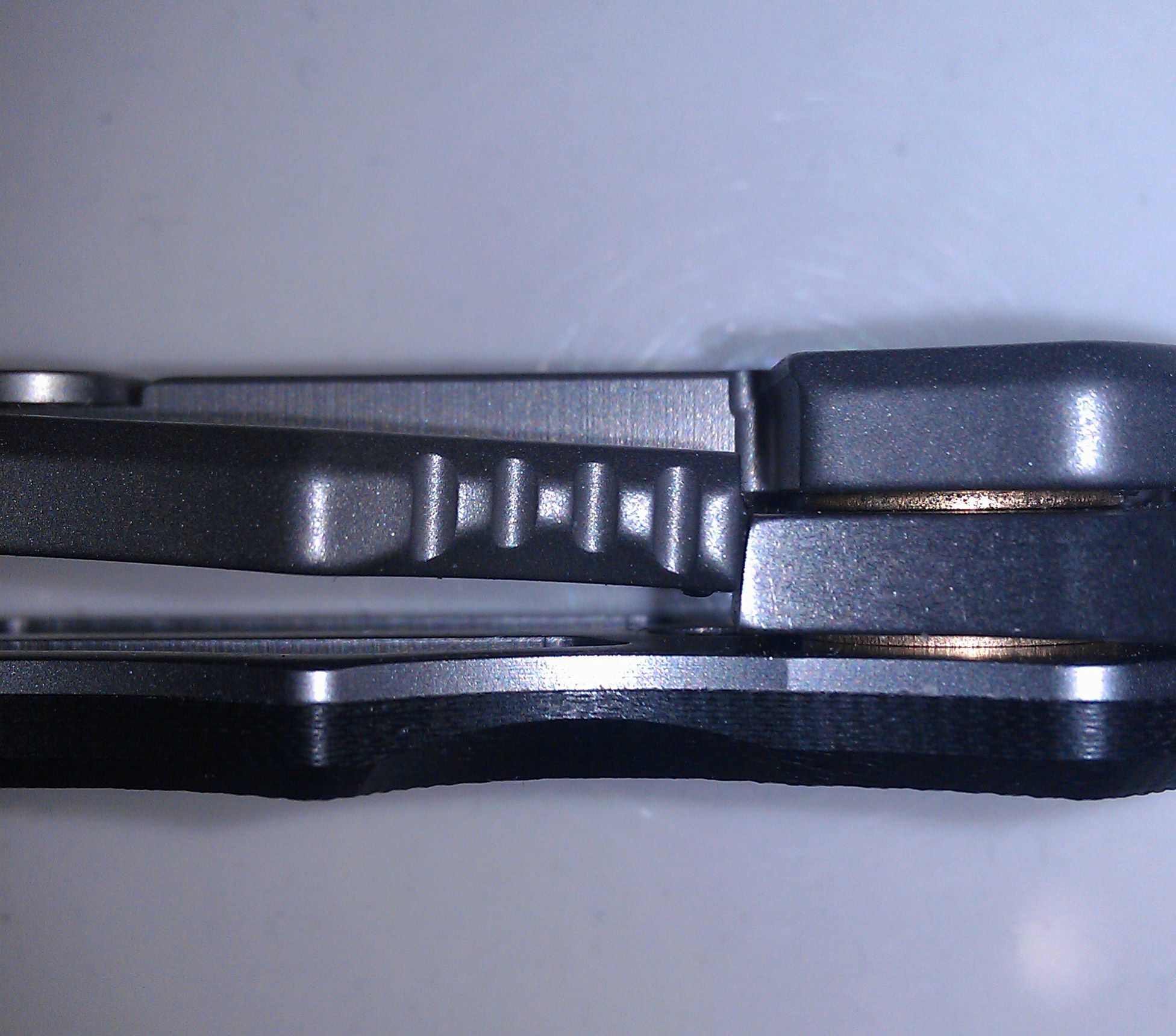
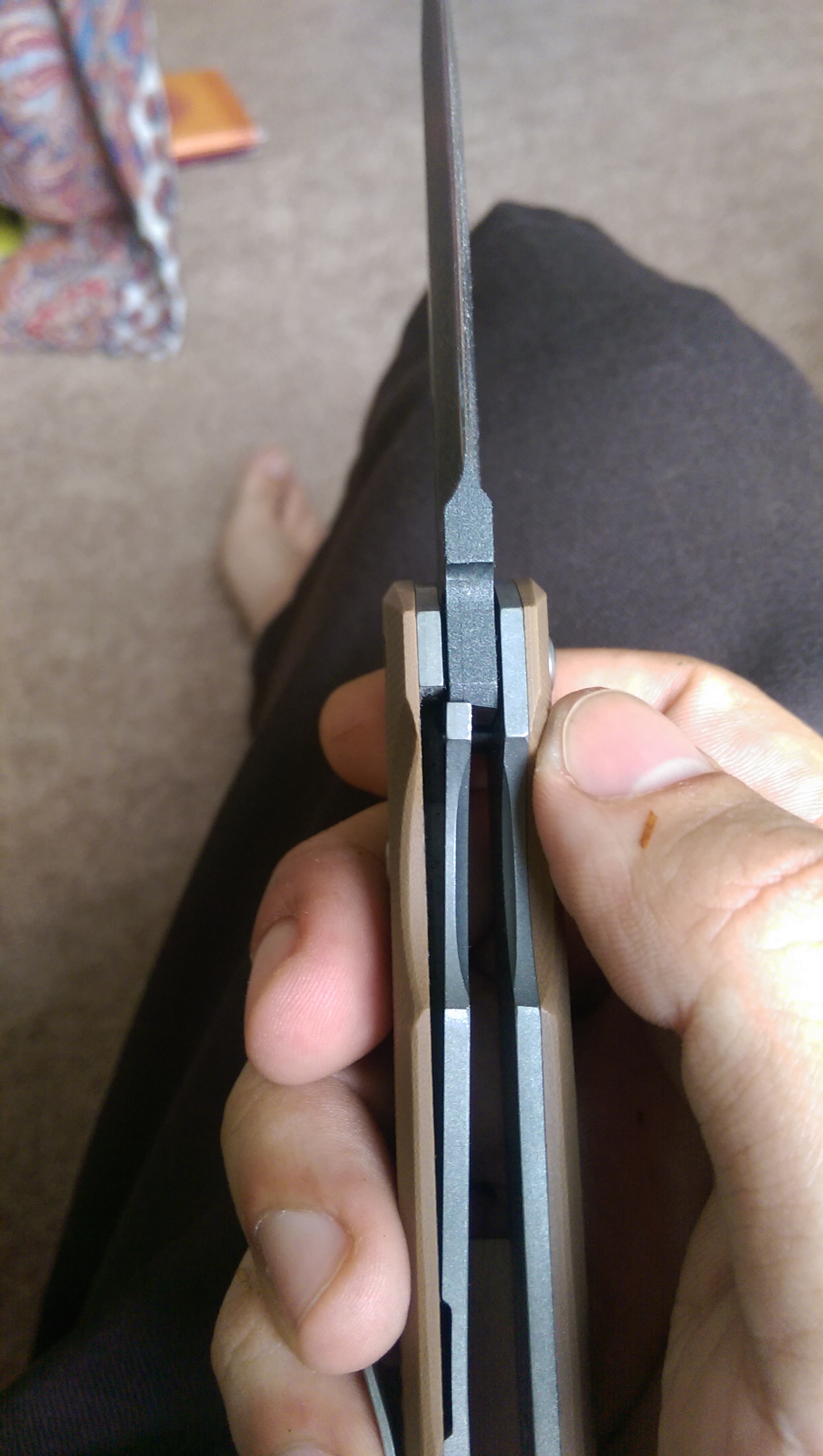
Why am I posting this right now? A week or two ago I was looking through the exchange and came upon a pretty nice looking custom knife for sale and as I scrolled down through the pics, I saw this photo:
***I've zoomed in as much as possible and waited a while before posting this so as to not single out the knife or the maker that this knife is attached to. I am not trying to flame, disrespect, or troll anyone. I do not want to start any problems, so please if you do somehow recognize this knife, do not publicly identify the maker***

This knife was described as "very early lockup" and IIRC "solid" was used to describe its lock up as well. This pic instantly killed any chances of me even considering the knife. The thought of this being acceptable, safe, and even called a locking knife bothered me and conflicted with my understanding or what's "right" in a knife to the point that I even had a physical response to this photo - mildly nauseous and accelerated heart rate for a few minutes.

How is this safe? How is this desirable by anyone who builds or uses knives?


I realize some makers must feel obligated to go with early lock up in order to satisfy their buying market. Others continue to build knives however they think is best, regardless of what people want. Other than just hive-mind and (what I believe to be unnecessary) concerns about longevity, why is lock up earlier than 25% so desirable?

As I said, I'm not trying to troll or start problems. If there are real answers to the question of why early lock up, I would love to understand them. I love knives of all kinds and I love everything about them - continued learning about designs, steels, heat treatment, and all the factors that go into a knife is a great source of pleasure and I only ever want to learn more. So having said that, I'm ready to be schooled on early lock up.

And if there are no reasons based on the mechanics of knife design, then so be it. But here I openly invite anyone with helpful information to contribute :)

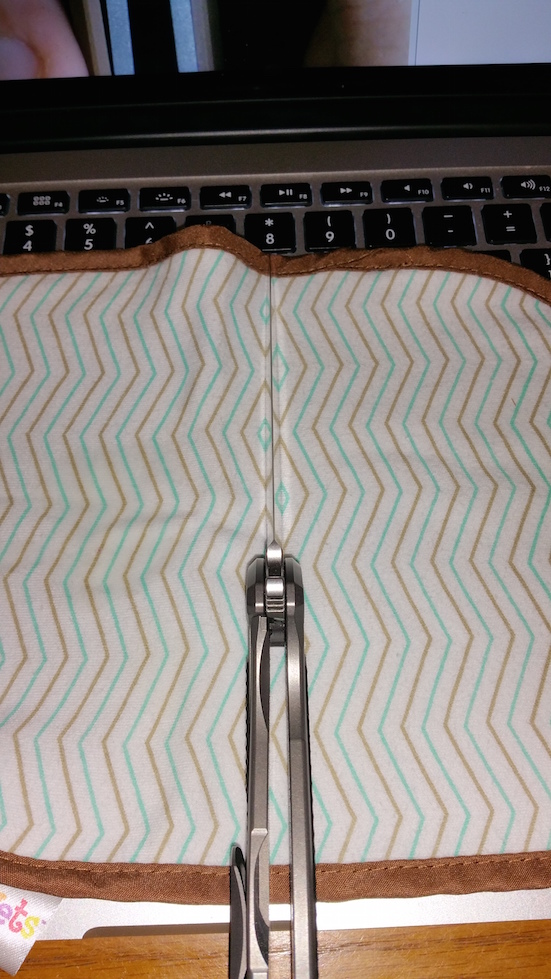
For the purposes of clarity, here is an example of what I think is excellent lock-up:
Those liners are .1" thick and the amount of engagement looks perfect to my eyes. This is a lock a absolutely trust and while it still is relatively new, the lock face hasn't migrated at all since the first week of ownership, where it moved over less than 10%. It has not failed me yet...I would be surprised if it did. I also am confident that I will get many years of use out of this knife before I ever have to worry about the lock contacting the opposite linger.

Thanks for hearing me out. I am thankful for you taking your time to read this and I look forward to hearing your opinions on this :)
 
I am away from my SolidWorks computer so I can't properly illustrate, but let me try to explain. Based on the way the lock is cut, the entirety of the lock face is NOT able to come in contact with the blade tang. As such, there is no benefit to moving the interaction across the tang closer to the center. In fact, by doing so you are increasing the angle that the lock bar makes and thus reducing the structural integrity of the lock. I think Emerson knives released an explanation for this a while ago, but I can't seem to find it right now. Either way, the reason is that you are shooting for one point of contact and moving the point along the lock face will not increase the surface area in contact, but will reduce the effective strength of the lock bar.
 
I didn't read your post, just FYI.

Early lockup shows that there is plenty of room for wear, and represents the lifespan of a knife to some people. Low-quality knives often lockup very late, with inconsistent lockbar positioning on the tang. I feel like most people that have a strong preference towards early lockup are people who associate late lockup with either extended use or poor craftsmanship.

True ideal lockup, in my opinion, is very much along the lines of the picture of your knife. Full contact with the tang, but with little or no tang to the left of the lockbar. Maximum surface contact, maximum remaining potential wear.

It's very much like the overbuilt fixation that many (including myself) have - an unnecessary stipulation or preference, often devoid of sound reason or practical application, which is just something you'll encounter in any hobby.

Weird little nitpicky things like that are also what allow for the success and variety of Knifemakers and designs, to some degree. If it weren't for picky crazy people, everyone would just have a PM2, grip, or Sebenza.
 
For the purposes of clarity, here is an example of what I think is excellent lock-up:

Those liners are .1" thick and the amount of engagement looks perfect to my eyes. This is a lock a absolutely trust and while it still is relatively new, the lock face hasn't migrated at all since the first week of ownership, where it moved over less than 10%. It has not failed me yet...I would be surprised if it did. I also am confident that I will get many years of use out of this knife before I ever have to worry about the lock contacting the opposite linger.

Thanks for hearing me out. I am thankful for you taking your time to read this and I look forward to hearing your opinions on this :)

Honestly, you're not alone. I prefer when 100% of the lockbar is contacting the tang.
 
Very well written post OP! I too would be interested in hearing about the mechanical side of this debate, because apparently there might be a reason behind it after all.


Just FYI, I'm not obsessed with early lockup either. But as long as it's not TOO early, I definitely prefer it over extremely late lockup.
 
This knife was described as "very early lockup" and IIRC "solid" was used to describe its lock up as well. This pic instantly killed any chances of me even considering the knife. The thought of this being acceptable, safe, and even called a locking knife bothered me and conflicted with my understanding or what's "right" in a knife to the point that I even had a physical response to this photo - mildly nauseous and accelerated heart rate for a few minutes.

How is this safe? How is this desirable by anyone who builds or uses knives?

The picture you show isn't early lockup, the blade must not be fully extended and obviously is not engaging the lock. Poster just didn't lock it.

Not that I disagree with you about lockup...
 
I am away from my SolidWorks computer so I can't properly illustrate, but let me try to explain. Based on the way the lock is cut, the entirety of the lock face is NOT able to come in contact with the blade tang. As such, there is no benefit to moving the interaction across the tang closer to the center. In fact, by doing so you are increasing the angle that the lock bar makes and thus reducing the structural integrity of the lock. I think Emerson knives released an explanation for this a while ago, but I can't seem to find it right now. Either way, the reason is that you are shooting for one point of contact and moving the point along the lock face will not increase the surface area in contact, but will reduce the effective strength of the lock bar.

Solidworks isn't going to help you with this discussion unless you are going to input the data for FEA. It's all about surface area and the early lockup doesn't have that, especially the first pic posted. There simply isn't enough material behind the engaged material mated to the blade.

I will take all mine at a minimum of 40% lockup. My fingers are worth more than some cyclic life flicking a knife open.
 
You mentioned you weren't posting this as a troll thread, or to start an argument - Your post was well thought out and articulate, so I doubt anyone will take it as such.

My personal preference is in the 20-30% range, but if the lock is cut properly, I can trust less. I confirmed my thoughts a couple days ago when we were talking about spine whacking and framelocks closing when dropped. My shirogorov is probably 3-4% lockup, but it's incredibly solid and I trust it, carry and use it every day.

My interest was peeked after that thread, so I decided to give it a try - I spine whacked it extremely hard, as well as trying to close it by putting steady pressure on it - It never budged. To me that indicates it's all about the lock geometry. You also have to remember that a lot more is touching than just what you see. If done properly, it's the entire length of the lockbar/lockface. If I use this knife for its intended purpose, I don't believe it will ever fail on me because it has early lockup.

As far as why people gravitate towards earlier lockup, as it does add life to the lock, and I believe it is also aesthetics for most people. Besides adding longevity to the lock, the angle of the lock face changes the farther it moves inward, increasing the chance of lock rock.

BCroJ8j.jpg


Think of it this way - If 50% of the lockbar face is hanging over the left side of the tang, than on a proper lock, as it wears in, the tang and lock face will still be completely flush (for the width of the tang) after it's moved to the point in your picture above. If they start out at that same point, as it wears, they will no longer be completely flush - A small gap will form at the edge of the lock face closest to the opposite side, since it is moving in a downward angle as it travels further - In most cases.
 
Thanks for the comments everyone :thumbup:

I am away from my SolidWorks computer so I can't properly illustrate, but let me try to explain. Based on the way the lock is cut, the entirety of the lock face is NOT able to come in contact with the blade tang. As such, there is no benefit to moving the interaction across the tang closer to the center. In fact, by doing so you are increasing the angle that the lock bar makes and thus reducing the structural integrity of the lock. I think Emerson knives released an explanation for this a while ago, but I can't seem to find it right now. Either way, the reason is that you are shooting for one point of contact and moving the point along the lock face will not increase the surface area in contact, but will reduce the effective strength of the lock bar.

I'm not familiar with SolidWorks - I like the idea of an illustrated explanation though. I think I understand what you're saying in regards to the lock face contact point, but not exactly why this results in a more stable and secure lock.


The picture you show isn't early lockup, the blade must not be fully extended and obviously is not engaging the lock. Poster just didn't lock it.

Not that I disagree with you about lockup...

I originally thought that was the case and the blade wasn't actually locked open, but after looking over the text again I came to the deduction that this pic was demonstrating the "very early lockup." It is totally possible that you're right though...I will try to go back and find the ad that I got this pic from to see if I somehow missed another pic (there were quite a few pics in the ad)


You mentioned you weren't posting this as a troll thread, or to start an argument - Your post was well thought out and articulate, so I doubt anyone will take it as such.

My personal preference is in the 20-30% range, but if the lock is cut properly, I can trust less. I confirmed my thoughts a couple days ago when we were talking about spine whacking and framelocks closing when dropped. My shirogorov is probably 3-4% lockup, but it's incredibly solid and I trust it, carry and use it every day.

My interest was peeked after that thread, so I decided to give it a try - I spine whacked it extremely hard, as well as trying to close it by putting steady pressure on it - It never budged. To me that indicates it's all about the lock geometry. You also have to remember that a lot more is touching than just what you see. If done properly, it's the entire length of the lockbar/lockface. If I use this knife for its intended purpose, I don't believe it will ever fail on me because it has early lockup.

As far as why people gravitate towards earlier lockup, as it does add life to the lock, and I believe it is also aesthetics for most people. Besides adding longevity to the lock, the angle of the lock face changes the farther it moves inward, increasing the chance of lock rock.

Think of it this way - If 50% of the lockbar face is hanging over the left side of the tang, than on a proper lock, as it wears in, the tang and lock face will still be completely flush (for the width of the tang) after it's moved to the point in your picture above. If they start out at that same point, as it wears, they will no longer be completely flush - A small gap will form at the edge of the lock face closest to the opposite side, since it is moving in a downward angle as it travels further - In most cases.

Thanks for recognizing my intentions eagally08...I wanted to be cautious about making anyone angry since knives are so personal and this seemed like a topic that could go either way with the discussiob. I figured I would err on the side of clarity and caution. thanks again :) :thumbup:

You bring up some good points - Thank you. I do agree with you in that using correct lock geometry is probably the most important factor, and by the sound of it your Shirogorov is a good example of it. Whether a spine-whack test is "relevant" to real world knife use or not, it does seem to be a reliable indicator of lock strength. I honestly would have been really nervous to spine-whack your Shiro with that little contact :eek: - I'm impressed that it holds up under that kind of stress :cool:

What I'd really like to know is if Shirogorov intentionally let that knife up to have such early lock-up. And if so, why? Would be awesome to hear a knife maker's perspective on this :)
 
I didn't read your post, just FYI.

Early lockup shows that there is plenty of room for wear, and represents the lifespan of a knife to some people. Low-quality knives often lockup very late, with inconsistent lockbar positioning on the tang. I feel like most people that have a strong preference towards early lockup are people who associate late lockup with either extended use or poor craftsmanship.

True ideal lockup, in my opinion, is very much along the lines of the picture of your knife. Full contact with the tang, but with little or no tang to the left of the lockbar. Maximum surface contact, maximum remaining potential wear.

It's very much like the overbuilt fixation that many (including myself) have - an unnecessary stipulation or preference, often devoid of sound reason or practical application, which is just something you'll encounter in any hobby.

Weird little nitpicky things like that are also what allow for the success and variety of Knifemakers and designs, to some degree. If it weren't for picky crazy people, everyone would just have a PM2, grip, or Sebenza.

The counter argument to this is that only knife nakers who can't cut a lockface properly are worried about early lockup so the lock bar has plenty of space to wear. Most properly designed framelocks can lock up around 40-50% and barely move in their lifespan unless someone is compulsively flicking it.
 
I am away from my SolidWorks computer so I can't properly illustrate, but let me try to explain. Based on the way the lock is cut, the entirety of the lock face is NOT able to come in contact with the blade tang. As such, there is no benefit to moving the interaction across the tang closer to the center. In fact, by doing so you are increasing the angle that the lock bar makes and thus reducing the structural integrity of the lock. I think Emerson knives released an explanation for this a while ago, but I can't seem to find it right now. Either way, the reason is that you are shooting for one point of contact and moving the point along the lock face will not increase the surface area in contact, but will reduce the effective strength of the lock bar.

Not sure how you would illustrate it but this is also true. If you look at your blade tang, no matter how fat the lock bar is or how late the lock up is, there is usually oy one tiny small point of contact between the two. If the who lock face came in contact with the tang, you run the risk of the lock being so sticky, you can't unlock it.

I've owned exactly one knife that was designed where the entire lock face touched the tang and I've had makers tell me this was the wrong way to do it. The knife was made by John W. Smith who most people know is probably the best of the best when it comes to fit and finish. He's not the flashiest maker(unless he's making art knives) and he Intentionally avoids having an internet presence so his knives will speak for themselves but they're technically perfection. I've never seen another maker get that kind of engagement without inducing play or lock stick so he's kind of an outlier.
 
Solidworks isn't going to help you with this discussion unless you are going to input the data for FEA. It's all about surface area and the early lockup doesn't have that, especially the first pic posted. There simply isn't enough material behind the engaged material mated to the blade.

I will take all mine at a minimum of 40% lockup. My fingers are worth more than some cyclic life flicking a knife open.

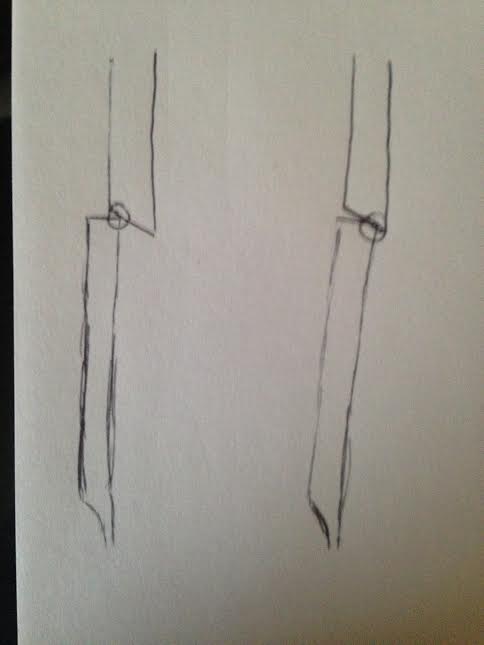
My point was that, theoretically, location of lockup has nothing to do with surface area in contact. Because of the way the lock face and blade tang are cut, there will only be essentially one point (not a true perfect point, but good enough for our discussion) of contact. To truly contact across the entire surface area of the lock face, you would have to be ludicrously precise in the manufacturing process. The blade tang would not only have to be rounded with a radius equal to the exact distance to the bending point of the lock bar, but the inside face of the lock bar would also have to be ground to match this radius precisely.

I have drawn a crude and somewhat exaggerated image to illustrate the point I am trying to make.

EtTddgc.jpg


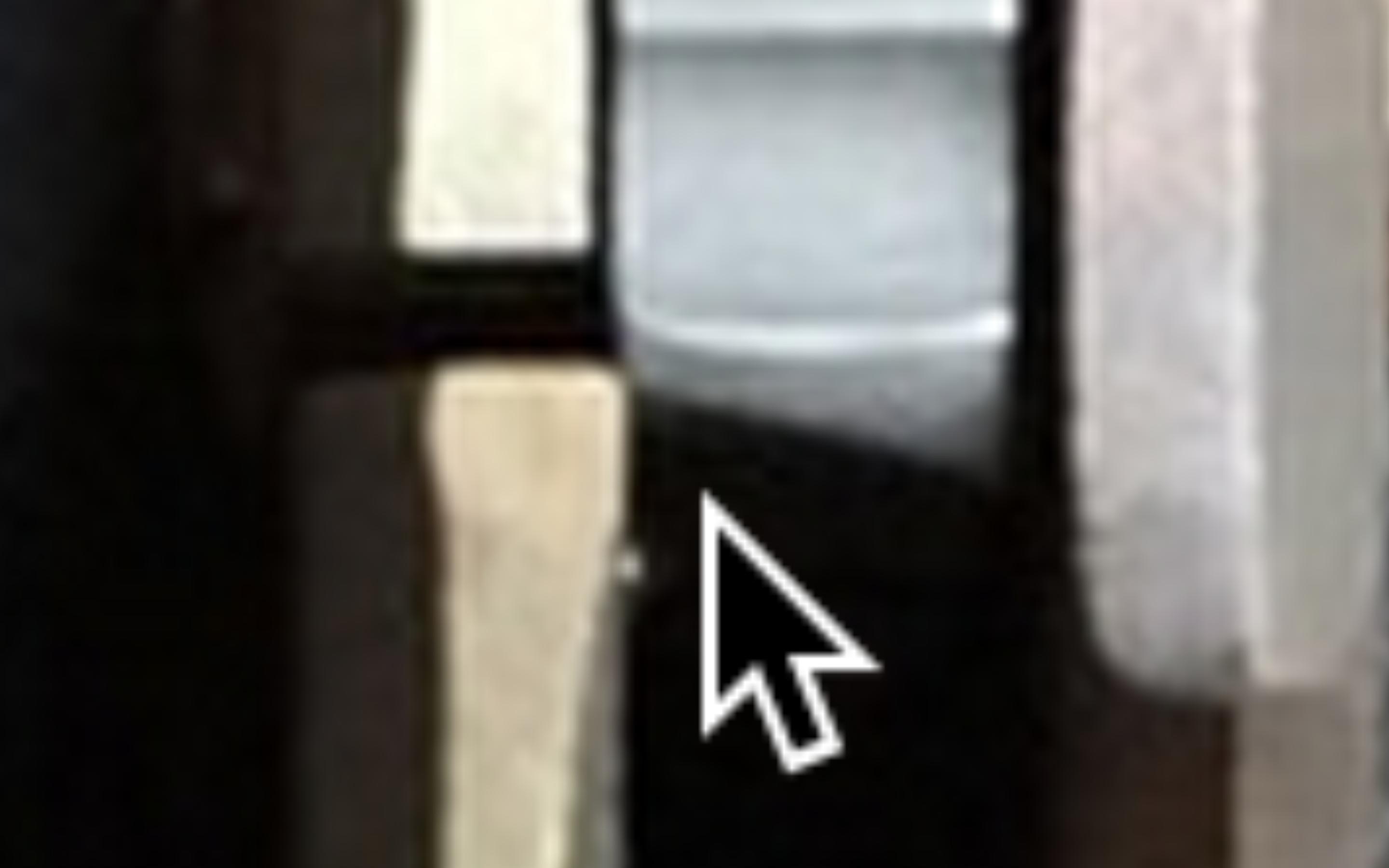
A better illustration is an actual knife. I googled "knife lockup" and took the first image (which happens to be from bladeforums :)). You should be able to see here that only the very corner of the lock bar is in contact with the blade tang. Hope this helps.

D3jwmZm.jpg
 
As long as the geometry is good and there's good engagement between the lock faces, the lock up percentage shouldn't really matter. However, the only problem I see with early lock ups is the the ease of unlocking is a little too easy. The hand is rather dynamic during use.

Here are some drawings from Mr. Terzuola from The Tactical Folding Knife. You might not trust any of us, but I think you can trust the father of tactical knives.

Untitled by Hairlesstwinkie, on Flickr
 
I'm kinda with you, OP. I prefer lockup to be in the 30%-50% range. When it's <15% it makes me a bit worried that it will fail (even though it definitely won't)
 
Part of the problem is you are comparing a liner lock, which should absolutely engage 100% of the lock face to the blade tang, to a framelock which are safe with "early lockup". I would say that I agree with your assessment of the example picture, it doesn't seem right at all. But on a frame lock, 20% or so is fine. To me, 75%-100% engagement on a framelock would make me believe something is wrong (the only exception to this is the ceramic ball interface CRKs like the Umnumzaan and Sebenza 25). It would also more than likely be an absolute bear to unlock.
 
My point was that, theoretically, location of lockup has nothing to do with surface area in contact. Because of the way the lock face and blade tang are cut, there will only be essentially one point (not a true perfect point, but good enough for our discussion) of contact. To truly contact across the entire surface area of the lock face, you would have to be ludicrously precise in the manufacturing process. The blade tang would not only have to be rounded with a radius equal to the exact distance to the bending point of the lock bar, but the inside face of the lock bar would also have to be ground to match this radius precisely.

I have drawn a crude and somewhat exaggerated image to illustrate the point I am trying to make.


A better illustration is an actual knife. I googled "knife lockup" and took the first image (which happens to be from bladeforums :)). You should be able to see here that only the very corner of the lock bar is in contact with the blade tang. Hope this helps.

I snipped the pics out..Not that they are not helpful, but no point in repetition.
You probably are misunderstanding the surface area that I am speaking of. It's the surface of the TANG that I want more engagement to, regardless of the geometry of the lockbar.

First, yes,. Depending on who the maker is, you are going to see varying geometries as well as contact point widths. Some have more engagement than others. The the pic the OP posted for example. Do you think that the lockbar itself will never slip in this position? If so, is it the faith that you have in the bend/spring force on the tang that gives you such faith? If this is the faith that you have,..what do you think about applying a force perpendicular to the axis of the blade, either intentional or unintentional? Something like a spine whack, or even batoning? Probably won't even take this much force depending on the pivot, the thickness of the ti and a few other factors. This is saying absolutely nothing about material fatigue or improper heat treats of the lockbar face.

And one last question; Ever wonder why Chris Reeve and a whole host of others target having the center of the tang as the optimum spot for the lockbar? If the center was causing them issues, either with returns or failures, do you think that they would have moved the position to a lower percentage of lockup?

Some things to think about..

My observations are not without experience, especially in the field of machining and tool making as well as design. I must be doing something right after 25yrs in this field. All my fingers are accounted for.. One poor decision is all it takes ;)
 
If the angles and surfaces of the lock in question are of precise tolerances and the lock bar (spring) has the proper tension to ensure enough engaged force to not fail and slip out under force (especially peak impacts) the proper theoretical lockup is going to be the width of the bar. More is useless and less would theoretically be "weaker".

Weak in the above case is not that important because the weak point of this lock type is not forces between contact area and thus material strength between blade and lock bar. The critical points are rotational mating surface as well as shearing (slipping) forces and the force of the spring toward the middle of the knife.

Basically like a cars front wheels. You have a contact patch on the ground that should stay in place. The springs and dampers give it control even in times of impact against the system. If the shocks are too weak for the springs and weight of the tire/rim/hub/brake/axle combo the tire will get air time. During braking or accelerating this means the rotational force will exeed the tires capability of grip very fast and thus the bounce leads to a skid or burnout where no acceleration or deceleration can take place.

A knife has no shock absorber. So to make it very strong you need:

-Angles of contact that have a 0 degree angle to each other when engages (blade to lock bar).
-Very high spring force combined with a thick lockbar that also cannot compressed or deformed.
-edit: High friction between blade and lock bar (Sandblasted)
-Very hard surfaces to ensure least possible wear and resulting loss of tolerances.
-A very strong and perfect pivot that ensures zero (as in 0.001 degrees) blade play in x,y,x.

The problem with this knife? Nobody would want it. A bitch to open, not very smooth, needs enough force when flicking open to even lockup at all and to close it you would need Arnold Schwarzenegger fingers.


tl;dr
So, shortcuts are taken until a nice balance between strength for the task and useability is reached. Cheaper knifes need early lockup that can "wear in" because money was saved hardening the mating surfaces and non-precise tolerances in lots will lead to less knifes not passing QA because of lock rock or locks swinging freely.
Expensive knifes can have early lockup because if done properly it is just as strong as anything else.

10 to 70 percent, doesn't matter if the other variables (Lock angles, precision, spring strength) are right because due to the nature of the lock geometry the amount of metal contacing in the lengthwise direction is strong enough to park a truck on. even with 5 percent lockup.

The difference (Lock bar length) between 20 and 90 percent lockup is pretty damn small. So in the end, a good lock is due to great tolerances and proper engineering.
 
Last edited:
Two points of fact. My Sebenza 25 has a 65% lockup which hasn't t moved in 2years of moderate carry and use. It remains solid. All of the Shirogorovs
I saw at Blade 2years ago had about a 3% lockup and were tight.
 
Thanks for the responses guys. I appreciate the explanations and photos and contributions in general

As long as the geometry is good and there's good engagement between the lock faces, the lock up percentage shouldn't really matter. However, the only problem I see with early lock ups is the the ease of unlocking is a little too easy. The hand is rather dynamic during use.

Here are some drawings from Mr. Terzuola from The Tactical Folding Knife. You might not trust any of us, but I think you can trust the father of tactical knives.

I like your style bro ;) Hard to disagree with what the Godfather, Mr. Terzuola has to say about the topic! Thanks for those pics :cool: :thumbup: I feel like I'll have to dive into Terzuola's book sometime soon...


First, yes,. Depending on who the maker is, you are going to see varying geometries as well as contact point widths. Some have more engagement than others. The the pic the OP posted for example. Do you think that the lockbar itself will never slip in this position? If so, is it the faith that you have in the bend/spring force on the tang that gives you such faith? If this is the faith that you have,..what do you think about applying a force perpendicular to the axis of the blade, either intentional or unintentional? Something like a spine whack, or even batoning? Probably won't even take this much force depending on the pivot, the thickness of the ti and a few other factors. This is saying absolutely nothing about material fatigue or improper heat treats of the lockbar face.

To answer your question I posted that pic as an example to contrast with the absurdly early lock up in the other pic that I posted.

Do I think that the lock I posted will NEVER slip in its current position? No, but I do believe it is secure, and like I said I trust it. I trust it because I have used this knife and intentionally applied heavy forces on it in various directions and ways in the attempt to stress the lock out of position and it has remained solid. Just for the purposes of testing it out and satisfying my curiosity, I have also spine-wacked it pretty hard with no failures. I have used it to chop, just to see what happens and the lock didn't move any noticeable amount after that...I don't regularly spine-wack or intentionally beat on the majority of my folders, but this knife conveyed such a sense of solidity upon first getting it that I felt the need to test it, stress it, and wail on it so as to see if it really was as solid as I initially believed it to be. Forgive me for not being able to present you with more scientific data in response to your questions - all I really have are my experiences and associated anecdotal evidence.

Basically up to this point the knife I pictured has satisfied all expectations (and then some!) and based on my knowledge of the knife maker (and assumptions about his level of skill) as well as my personal experiences with the knife, I will continue to trust it...
 
Back
Top