Edge Stability Part 2 - Experiments

Once again, thank you for presenting this work. I had long wondered about Dr. Landes thesis, and again I find myself wondering...

Perhaps you can help me with a few specific questions:
1) What "controls" are included, positive or negative, to give context to the values?
2) What was the reasoning behind 20' inclusive vs 10' or 30'?
3) What was the reasoning behind the selection of steel-types and HT-parameters tested?
4) Crucible estimates the carbide volume of 154CM (version of ATS34, iirc) at 17.5% but your charts place it at ~12.5%?
5) How does a value of 0.02 vs 0.04 translate to observed edge performance? Do these results themselves have any real-world application? Is there a specific real-world use in which applied stress to a knife edge is likely to compromise a 0.02-scoring knife but remain below what is required to compromise a 0.04-scoring knife, or is the laboratory the only place where one may ever encounter such distinction between applied forces? I do not have a good sense of how much more force a 0.04-edge can endure vs a 0.02-edge.
6) How does Landes justify his bias against the high ATS34 results? If he tested over 1 cm of edge and the average result surpassed his expectations and presented a low CV, how can he question it without holding the rest of his tests to the same standard? For example, if the ATS34 results are suspect, are not also the result of the 1.174 steel?

My conclusion from these results would be that, contrary to rumor from some circles, carbide volumes between 0 & 20% is likely to have no discernible impact on edge-performance in terms of edge-stability.
Based on your attestation of Landes' bias against high-carbide steels, I assume that the results surprised him. Once again, I woul dbe very interested to see the experiment repeated using tungsten-carbide diatome blades...
 
Once again, thank you for presenting this work. I had long wondered about Dr. Landes thesis, and again I find myself wondering...

Perhaps you can help me with a few specific questions:
1) What "controls" are included, positive or negative, to give context to the values?
I'm not sure that anything he used could be called a control, but to be fair I'm not sure what a valid control would be.
2) What was the reasoning behind 20' inclusive vs 10' or 30'?
3) What was the reasoning behind the selection of steel-types and HT-parameters tested?
I don't have answers to those questions other than he apparently did do some tests with 10 degree edges that were not published.
4) Crucible estimates the carbide volume of 154CM (version of ATS34, iirc) at 17.5% but your charts place it at ~12.5%?
The values are different for a few reasons:
a) I have to assume an austenitizing temperature as Crucible did not publish one for their result.
b) The thermodynamic software assumes equilibrium (infinite hold time) while in reality we have kinetics (speed of transformation)
c) Models and simulations are never perfect, even the very good ones
d) There are other factors that make kinetics slower such as large primary carbides that are sluggish to dissolve
5) How does a value of 0.02 vs 0.04 translate to observed edge performance? Do these results themselves have any real-world application? Is there a specific real-world use in which applied stress to a knife edge is likely to compromise a 0.02-scoring knife but remain below what is required to compromise a 0.04-scoring knife, or is the laboratory the only place where one may ever encounter such distinction between applied forces? I do not have a good sense of how much more force a 0.04-edge can endure vs a 0.02-edge.
I do not have answers to those questions.
6) How does Landes justify his bias against the high ATS34 results? If he tested over 1 cm of edge and the average result surpassed his expectations and presented a low CV, how can he question it without holding the rest of his tests to the same standard? For example, if the ATS34 results are suspect, are not also the result of the 1.174 steel?
I provided some of Roman's own answers to questions I posed in the article. Some answers are more satisfying than others. I think it is better to let him defend himself.

My conclusion from these results would be that, contrary to rumor from some circles, carbide volumes between 0 & 20% is likely to have no discernible impact on edge-performance in terms of edge-stability.
Based on your attestation of Landes' bias against high-carbide steels, I assume that the results surprised him. Once again, I woul dbe very interested to see the experiment repeated using tungsten-carbide diatome blades...
As I said in the article there was no clear trend with carbide volume in terms of the edge stability test. If we are generous I would say that Roman's "edge stability test" and "edge stability theory" are not necessarily one and the same. The theory was developed after the thesis so the results wouldn't have surprised him in terms of discounting his theory. Along with Roman we decided that the best approach was to have an article summarizing his theory and then to have the second article analyzing the original experiments. My plan is to perform impact testing of edges and come to my own conclusions.
 
Edge stability -- when not including edge wear -- is the ability of the edge to resist damage, either by rolling or denting or by breaking or chipping.

Hardness is a pretty good proxy for strength (resistance to rolling or denting [Edited]), but it is not perfect. Juhan presented evidence of large differences in toughness (resistance to chipping or breaking) in 80CrV2, all at the same hardness but with differences in heat treating.

Damage can come from steady pressure, as you have shown, or from lateral forces or from impact, either head on to the edge or at an angle to the edge.

Super steels, which to my mind are high-tech powder steels, can offer a lot more wear resistance, but also better toughness, as seen in CPM 3V or Vanadis 4 Extra. Super steels can also give the steel a huge advantage in the balance of qualities, such as Vanax ExtraClean, which is super stainless, fine grained, very tough and very strong and with excellent wear resistance. What's not super about that?

The best testing will have to come from standardized tests which run through a range of potential destructive forces; and those tests will have to be specific to the actual blade, as heat treated and ground by the maker.
 
Last edited:
Strength isn’t really a resistance to breaking as much as it is a resistance to deformation.

I don’t think I’ve ever argued that there aren’t differences in toughness (resistance to fracture) due to steel type and heat treatment. Such tests can be seen on my website, particularly for z-wear and CruforgeV.
 
Thank you veyr much for the reply, Larrin. :thumbsup:
I'm not sure that anything he used could be called a control, but to be fair I'm not sure what a valid control would be.
To my mind, one obvious control would be a W-Co blade - this is exceedingly common in cutting tools and can present a much higher Rc value than steel as well as much higher carbide content with very low impact toughness at low Co concentrations. Because W-Co can achieve apex-diameters well below anything attainable with steel, it is an obvious choice as a control for extreme edge-stability, imho.

On the opposite end of the spectrum, perhaps he DID give us a control in the low-Rc Krupp 1.4110 blade, but perhaps a blade of another metal would have been a better choice...
One could argue that drifting away from steel runs counter to the intent of the experiment, but I would challenge that the unclear smattering of blade steels and HT-protocols already counters any attempt at clarity on comparing steel-types, so why not include other metals to help elucidate the trend and the factors involved.
One does not begin an experiment without a hypothesis - what was Landes'?
If it was that higher-carbide would result in lower edge-stability regardless of PM, then more PM vs non-PM direct comparisons should have been included. If it was that carbide volume impacts edge-stability independent of hardness, that maximizing and minimizing both should have been included. *shrug* Just my $0.02

I don't have answers to those questions other than he apparently did do some tests with 10 degree edges that were not published.
It would be interesting to see at 10' and 30' given that 30' is the typical sharpening angle recommended for the final edge on everything from chainsaws and axes to razor blades and 10' is the typical primary-bevel angle on many American knives, a show of what would happen if you DIDN'T cut secondary the edge-bevel ;)

The values are different for a few reasons:...
You may not wish to bother, but I am curious if you would be willing to present a modified version of the graph with different carbide % according to, for example, the values presented (albeit without clear explanation) from the steel-makers? Obviously this might be obnoxious to bother with, but what would your R^2 value be for the carbide-volume graphs vs edge-stability and Hardness if you moved just the ATS-34 value from 12.5 to 17.5% ?

BTW, thank you very much for including the error-bars in the edge-stability graph. For me, those are essential to understanding how seriously one can take these tests. When the error bars are large (like what is seen on the 440V runs), I find myself doubting not the steel but the test itself, and I wonder what sort of quality-assessment was performed to validate that each blade was indeed being tested identically to the other blades or how much 'wobble' exists in the device.

...
I do not have answers to those questions.

I provided some of Roman's own answers to questions I posed in the article. Some answers are more satisfying than others. I think it is better to let him defend himself
Understandable.

As I said in the article there was no clear trend with carbide volume in terms of the edge stability test. If we are generous I would say that Roman's "edge stability test" and "edge stability theory" are not necessarily one and the same. The theory was developed after the thesis so the results wouldn't have surprised him in terms of discounting his theory. Along with Roman we decided that the best approach was to have an article summarizing his theory and then to have the second article analyzing the original experiments. My plan is to perform impact testing of edges and come to my own conclusions.
That would indeed be "generous". The lack of a trend is quite significant in that it strongly supports the null-hypothesis - carbide volume (in these steels, volume%, with these HT-protocols) does not impact "edge stability".
From Part 1 of your article:
"Therefore high carbide steels are unable to hold a finely sharpened edge even when one is able to sharpen it to that point. When the goal is to produce a fine cutting blade a steel that can hold its initial high sharpness a small volume of small carbides is desirable."
Where is the evidence for the first sentence? And the second sentence is of course false, the most finely sharpened edges (lowest apex diameter) are made from pure carbide which presents the highest available Rc-hardness, not from softer matrix components. The reason to introduce a higher proportion of matrix and reduce carbide load is to increase toughness to handle rougher use and more side-loading at the cost of edge-strength. In your Part 1 article, you mention carbides for wear-resistance and that attribute only coming into play after the edge is stable against side-loading stresses, but it seems that you ought to have focused on toughness only coming into play IF your edge lacks the strength to endure. You do mention it:
"There may be benefits to having some amount of carbide to improve the stiffness at the apex of the edge. However, that improvement in stiffness has to be balanced against chipping".
I think that what you have seen in Landes' testing is that steel makers are doing a very good job of achieving this balance in steels with carbide volumes as high as 20% :thumbsup:

It is worrisome to me that Landes asserts coming up with his 'theory' after running the experiments which directly contradict it. Again, one does not perform an experiment without forming hypotheses associated therewith, otherwise one cannot begin to consider the variables. I find it unimaginable that Landes chose the steels that he did and made up all of his diagrams and edge-origami handouts without having FIRST developed his hypothesis regarding carbide-load and edge-stability and THEN generated these results. :( Again, in Part 1 there are many assertions about edge-chipping and carbide tear-out and what angles are necessary to achieve 'stability' in different steels according to carbide load, volume and size. To then see the data which was supposedly used to support this doctrine and find it NOT profoundly correlative...???

There must be an explanation, and i know that only Landes can give it, please do forgive my ranting in your thread.


On a different note, you linked in your article another on 'Sharpness vs Cutting Ability', and i was curious as to why you did not bring up "mechanical advantage" ad the role that played in your CATRA experiment changing edge-angles? Perhaps i should post this next part in a thread on that article? You show in that article that apex-width correlates directly to penetration-force, but I felt that you did not further illustrate that this initial fact is also the explanation for the force required for the rest of the cut (what you refer to as 'cutting ability'), i.e. that the edge-width at any given depth back from the initiation of the cut by the apex is part of the wedge/ramp forcing its way through the material. It is this simple principle that accounts for the difference in CATRA performance between the 20' and 50' edges as I mentioned in your CATRA thread, it explains why the 50' edge was not allowed to cut more and so degrade its edge more. If you had used a 50' blade with a very low grind on thin stock such that the (w)edge reached full thickness during the cut while the 20' edge was still working its way into the material and forcing it apart to a greater extent than was required for the 50' edge, there is a ratio of edge-angle:blade-thickness whereat the 20' blade requires greater or equal force to complete the cut vs the 50' blade. In such a test (devoid of side-loading), I would expect the shoulders of the 50' blade to wear significantly as it completes more cuts than before (all that force against those thicker-sloped cheeks), but I would surmise that the apex-diameter would remain smaller (sharper) than the 20' blade by the end of the test for that same reason (less abrasive force applied to the region proximate to the apex itself due to the thicker slope bearing the burden). That is my hypothesis.

Once again, the principle that "thinner is better" rules supreme - it is the thickness of the blade (at a given distance from the apex) that determines its rigidity (cubic) vs its 'cutting ability' (inverse) :)
 
You may not wish to bother, but I am curious if you would be willing to present a modified version of the graph with different carbide % according to, for example, the values presented (albeit without clear explanation) from the steel-makers? Obviously this might be obnoxious to bother with, but what would your R^2 value be for the carbide-volume graphs vs edge-stability and Hardness if you moved just the ATS-34 value from 12.5 to 17.5% ?
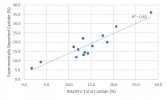
The majority of the steels used don't have an experimentally measured carbide volume that I know of, hence the use of calculations. Here is a graph for a different set of steels that I do have experimental values for. The chart is from an unpublished article.
jmatpro R2.jpg
On a different note, you linked in your article another on 'Sharpness vs Cutting Ability', and i was curious as to why you did not bring up "mechanical advantage" ad the role that played in your CATRA experiment changing edge-angles? Perhaps i should post this next part in a thread on that article? You show in that article that apex-width correlates directly to penetration-force, but I felt that you did not further illustrate that this initial fact is also the explanation for the force required for the rest of the cut (what you refer to as 'cutting ability'), i.e. that the edge-width at any given depth back from the initiation of the cut by the apex is part of the wedge/ramp forcing its way through the material. It is this simple principle that accounts for the difference in CATRA performance between the 20' and 50' edges as I mentioned in your CATRA thread, it explains why the 50' edge was not allowed to cut more and so degrade its edge more.
This is what I wrote:
"The cutting force required for cutting through the beets increased with increasing edge angle. Interestingly, double bevel edges cut with less force at the same angle as the single bevel edges. The single bevel edge was equal to a 10-15° greater double bevel edge. So despite the similar sharpness (edge radius), the force required is much greater to cut through the beets with a more obtuse edge. The force required for the complete cut is sometimes referred to as “cutting ability” though that is not a well-defined term. The CATRA edge retention test measures cutting ability rather than sharpness. So while the sharpness is reduced over the course of the test the CATRA machine itself is measuring the change in overall cutting ability and this property is reduced throughout the test through changes in sharpness. When comparing different edge angles, however, a more obtuse edge cuts less cardstock because of its reduced cutting ability even if its sharpness, or edge radius, is superior to the more acute edge."
"So getting back to the CATRA edge retention test referenced at the beginning of this article. It is clear that the more acute edges, such as the 20° edge, cut better and longer than the 50° edge. That is due to the superior cutting ability of the 20° edge. At the end of the test the 20° edge had a larger edge width than the 50° edge, which indicates that it had lower sharpness than the 50° edge. So with the CATRA test the cutting ability of the dull 20° knife was superior to the 50° knife though the sharpness was better on the 50° at the end of the test."
 
Back
Top
