Edge thickness uniformity

Joined
Sep 16, 2002
Messages
1,577
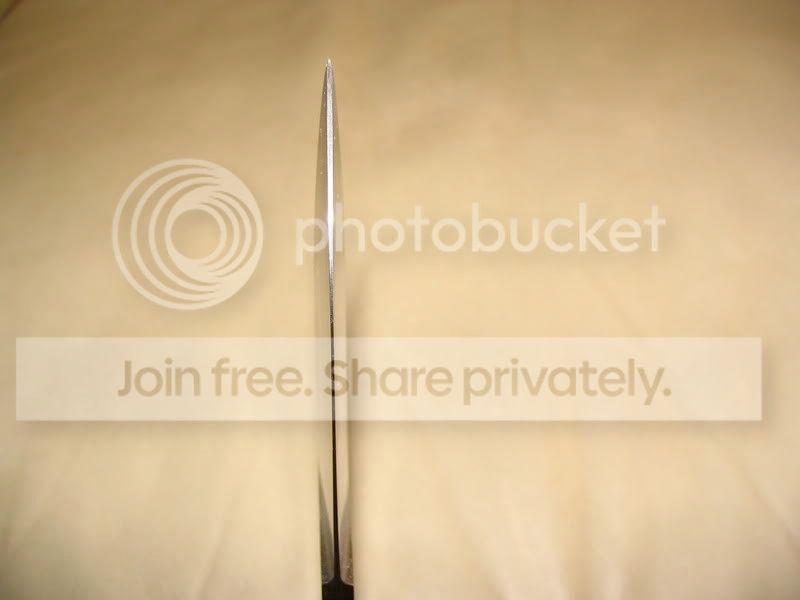
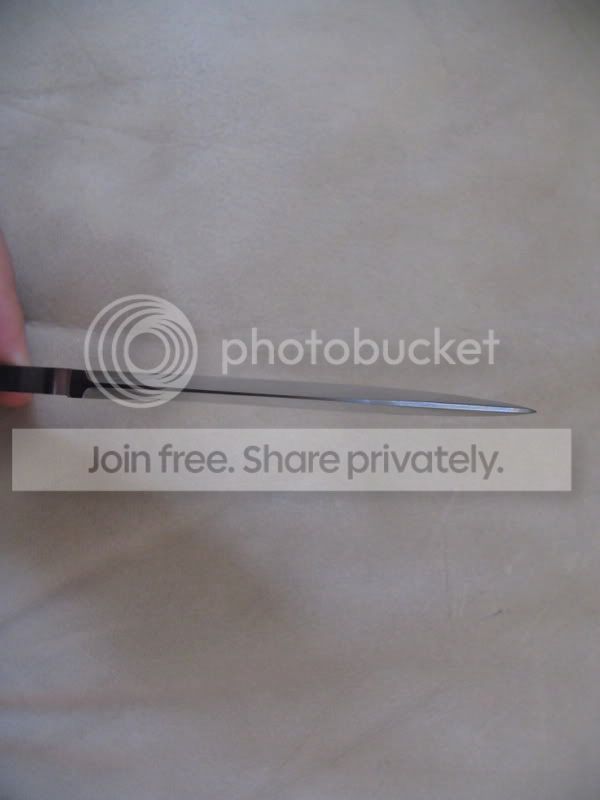
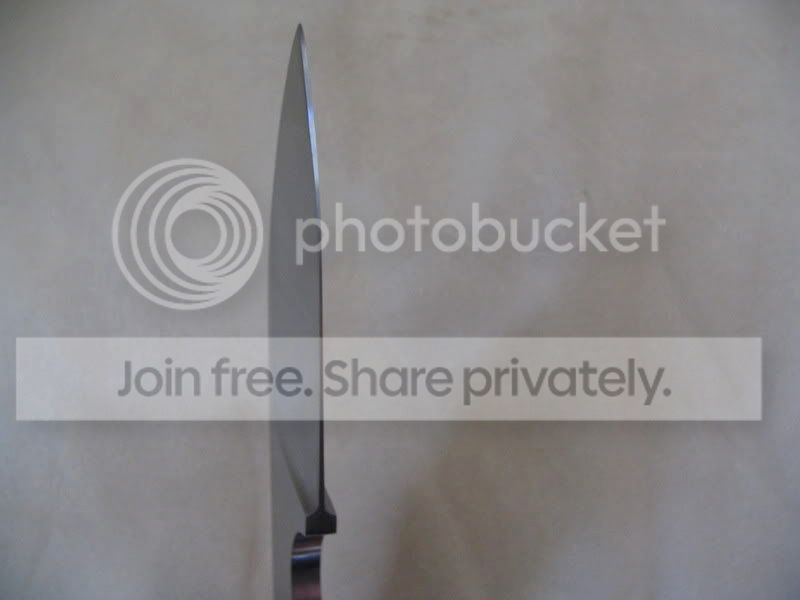
I've finished filing in the bevels (at least all that I can handle) and have started to sand in preparation for heat treat, etc. The problem I have is that as I sand, the edge is getting thinner and thinner, but not uniformly. I think the relative thickness along the length of the edge hasn't changed, and that it's thinning everywhere...but I'm not 100% certain about that.

I really thought the sanding would take care of any unevenness but it's not happening yet and the blade is getting quite thin in the center, while it's thicker near the plunge and tip. Should I be overly concerned about this, or can I expect to be able to sharpen it out? If so, what can I do about it? Again, sanding it doesn't seem to be taking care of it at the moment, and it's really getting thinner than I think it should be in the belly area.
IMG_0870.jpg


IMG_0872.jpg
 
You are not going to sharpen that out. You are spending too much time working the center. You may need to go back to a file and even things out. This is why I like working with files. You can watch what is happening and keep the edge even. Can be done with a grinder too but I like the control I have with the file.
 
Sanding it and sanding it evenly with hindsight are not the same thing, you might be able to even things out by some draw fieling, with some care to work on the thicker parts. Cheers Ron.
 
I'm using a block of wood behind the sandpaper that is as long as the blade, so I'm confused as to why it wouldn't bring the high spots down and leave the middle where it's thinner alone???

Thanks for the input, guys. I must have over 50 hours into this thing already and I think it's starting to win...
 
I had this problem to an extent that I had to scrap a matched pair of daggers I had forged.

It seemes that while draw filing, the beginning and end of the stroke were lighter than the center, which got the belly to go very very thin, and eventually to become steel foil.

The only way around it I've found as of yet is to remember the age old adage that you can always take more metal off, but you can't put it back once it's ground away. TRake it slow, and if you find things getting uneven like this, don't be afraid to go back to a file and carefully even things out, in a very localized way.
 
Also look at your point. It is thinner also, you are running the file and or sandpaper of the end and getting a springboard effect. The bounce causes the tip to become thinner. Also I bet you are sanding in both directions. That means the center is getting more sanding than the ends. I would recommend getting it even with the file ad then only sand to remove scratches. This will give you a flatter and more even bevels.
 
The tip was getting badly rounded and thinned pretty early on while draw filing in the bevels, so I began stopping short or lifting up on the file a bit towards the end of the stroke. This probably is what caused it to be thicker out towards the end of the blade just before the tip. How can I avoid this issue in the future?

When you mention sanding in both directions, do you mean in a back and forth motion, or do you mean sanding at one grit from ricasso to point and then the next grit from spine to edge? I have been doing both while sanding; which is the correct way?
 
You are getting the springboard effect when you put too much pressure on the tip. It is a feel thing and takes practice. It is best to draw file in one direction letting up the pressure on the non cutting stroke and at the end of the cut. If you shape with the file and remove scratches with the paper however you remove them is fine. Also changing directions is good to see where the previous scratches are. I was just trying to illustrate how you may have sanded more in the center. It boils down to there is no real easy way to do this. It takes practice and concentration to get the bevels even. so as they say practice practice practice. Then when you think you got it practice some more.
 
You are getting the springboard effect when you put too much pressure on the tip. It is a feel thing and takes practice. It is best to draw file in one direction letting up the pressure on the non cutting stroke and at the end of the cut. If you shape with the file and remove scratches with the paper however you remove them is fine. Also changing directions is good to see where the previous scratches are. I was just trying to illustrate how you may have sanded more in the center. It boils down to there is no real easy way to do this. It takes practice and concentration to get the bevels even. so as they say practice practice practice. Then when you think you got it practice some more.

I did some of the stock removal with normal filing, but a lot of it was draw filing hoping to keep things flatter. As you recommend above, I filed in one direction only...in fact, completely lifting the file off the work surface although I don't know if this was necessary. I noticed early on the tip rounding, so I made the adjustment I mentioned above. Then I noticed the plunge area not coming down evenly, and my 'theory' was that this was because this area was not seeing the whole width of the file cutting across it, so I did some extra normal filing in that area.

Anyway, I appreciate all of the advice and I'm glad in a way to hear that there's not a fool proof method to this (this means I didn't do anything tooo dumb!) I really hope I can salvage this one, as I have so much time invested in it.
 
I have found that if I put a flat piece of stock under the knife that I'm filing, I can really minimize, and almost completely eliminate the springboard effect. Of course, I had to scrap a few to figure it out, but supporting the workpeice with something suitably strong and stiff underneath has been a lifesaver.
 
I hope for safety reasons that we all are using a backup block behind the blade. If not and you have a bare blade hanging out in space it is an accident waiting to happen. That said yes this is a great way to help reduce the springboard effect. I have different length pieces of micarta cut that I clamp the blade on. Someone has even made an adjustable backup out of a piece of angle and socket head set screws.
 
I have found that if I put a flat piece of stock under the knife that I'm filing, I can really minimize, and almost completely eliminate the springboard effect. Of course, I had to scrap a few to figure it out, but supporting the workpeice with something suitably strong and stiff underneath has been a lifesaver.

That's a good tip, and in fact reminds me of a jig I saw somewhere for the same purpose. At the time, I wondered to myself, why would you need to use something like that!?!

I spent a couple of hours this morning draw filing that area out just behind the tip, and it's better now. It's still a bit thicker there, but actually now thinner than a dime which is what I've read to be the recommended thickness prior to heat treat. (Besides, if I go any further I might just throw it against the wall and never finish it!) The belly is significantly thinner than a dime, and I'm wondering if that is going to be ok to HT??

I'll get a new pic and maybe a measurement later up later. Thanks again!
 
To clarify, I am clamping the blade to a board but of course the bevels and tip do not sit flush, so there is some springboard effect. The jig I saw, as I remember it, used threaded rod that was screwed up against the blade. This compensated for the bevels and tip being thinner and supported it fully.
 
The problem comes mainly from the fact that the sanding block does more work at the center than either side.
Look at the block and the blade:
You set the block on the blade at the ricasso - It covers from the center to the ricasso, but only the edge of the block hits the first bit of the blade edge during the sanding stroke .
You make a stroke toward the tip, applying pressure as you start the stroke.The entire block goes over the center, and you lighten the pressure as it reaches the tip (often stopping before it fully passes the tip). The tendency to slightly lift the edge of the block as you try to turn up the bevel as the tip rises also contributes to less abrasive contact at the edge.
Let's revue this:
Light weight minimum contact at ricasso.
Harder pressure and full abrasive contact over the center.
Lightened and reduced stroke at tip.

Result - more metal removed in the center.

Another problem is that the plane of the bevel at the tip is well below the imaginary line extending from the straight edge of the blade.Thus, if you make a perfectly straight stroke (like it was done on a mill), it would remove less metal at the tip. If you were sanding a wharncliff or a santoku, it would not be a problem.

Solutions:
Careful attention to the stroke and angle of the block.
Full even stroke with a follow through past the tip.
Regular checking and refinement as the edge is defined.
Practice, practice, practice

Stacy
 
Thanks Stacy, that makes sense, and I think what you are saying applies also to draw filing. It also seems to me now that size and shape of sanding block would be critical to help minimize this effect? I was using a block of wood maybe 3" x 4" or so.

I'll have a new progress pic up in a moment...
 
Huh, after about 4 hours of work it sure seemed better in the hand, but now after looking on the screen I'm not sure how much of an improvement there really is. Anyway, I think that's about as good as it is going to get at the moment because I'm sick of looking at.

It is pretty thin there in the middle (this is 1/4" 5160), will this likely be a problem during heat treat?

IMG_0876.jpg


IMG_0874.jpg
 
Exactly! (and yes, filing has the same caveats).
Use as thin a sanding block as is practical. I use a 1" wide block working on knives, and a 2" block on swords. Since I hate hand sanding, most of the time I just live with the finish I get from the belt sander.
Stacy
 
One type of sanding block which is not in a block shape; is a bar of steel wrapped with the sanding paper or cloth. The one I use is around 14 inches long by 1 inch wide by 1/4 inch thick. I taped the ends for grip. I use rolls of adhesive backed paper from Lowes. They come in 80, 120 and 220 grits. This set up gives you a lot of control. It also keeps your fingers away from the sharp edge. Use this sanding bar rite after the grinder. you can see within just a few strokes where the high or low spots are.

Fred
 
Thanks again to everyone for their input. I just got out my dial calipers, and I'm at about .025 at the belly, about .035 out at the tip, and about the same near the plunge. I'm still concerned about the unevenness but also about the thickness everywhere now.

Would it be best to:

-leave it as is and heat treat and finish it? If so, what will the impact be on the finished blade?

-keep working it down trying to get it more even everywhere?

-worry more about working down the tip only (or plunge only)?

-try to file the edge a bit, hopefully without substantially changing the overall blade shape, back into thicker material?

-something else???
 
Back
Top