- Joined
- Feb 28, 2012
- Messages
- 471
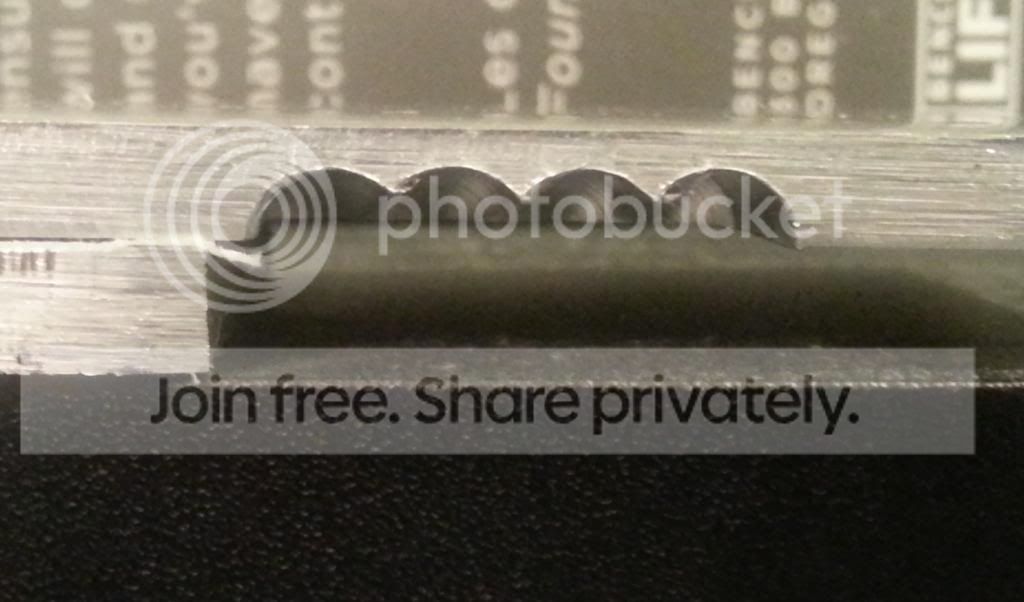
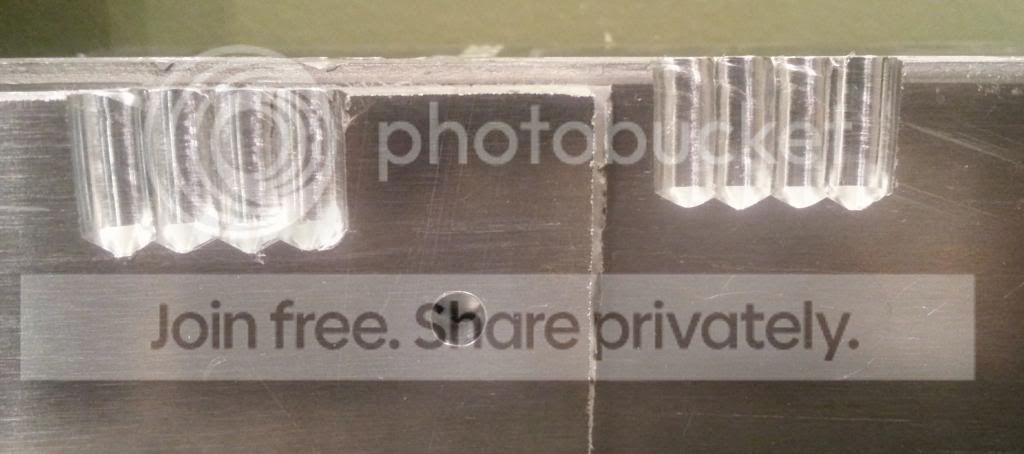
Just need some advice. I am testing out the lock bar cut out on some T6061 .187 aluminum. I have a Carbide 12mm flat 4 flute end mill and as you can see below, am trying to find the right RPM's for my Drill Press to perform the cut out. Basically I am plunging the end mill vertically into the aluminum. The RPM's that I wrote on the block are what the drill press instructions say it should be. I am not so sure that the settings on my Ridgid are accurate to be honest. I noobed out and didn't check the speed on the first pass (the 400 RMP cut.) At 600, the cut came out more square and the 700 rpms even more so. I ended up doing what was stated to be 2k+ (I wrote 1000 on the metal since I don't think it was doing 2k...) The mill didn't look like it was spinning that much faster than it did at 700, so I have my doubts, but the cut did come out a little better than the 700. I just couldn't stand the drill marks in the cut at any speed however.
The last cut was at the highest speed but I did this laterally instead. I did it really, really, slowly. I like the results but it took several minutes to complete it and I am worried about lateral pressure, even if I go slow, on the chuck.
My question is for those that use a drill press for your cut outs... any suggestions? Angles, speeds, lubricants, do it at 2k+ and sand out the cut out to make it smooth, etc. (other than find someone who has a milling machine and have them do it unless that really is the only viable way for me to do this!)
If it looks this rough and takes this long with aluminum, I am assuming it's got to be exponentially harder with Titanium to get good results with what I am doing.
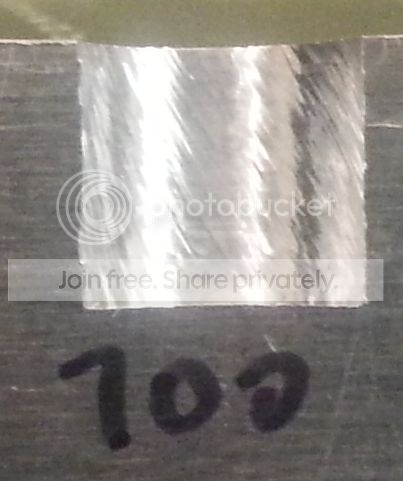

The last cut was at the highest speed but I did this laterally instead. I did it really, really, slowly. I like the results but it took several minutes to complete it and I am worried about lateral pressure, even if I go slow, on the chuck.
My question is for those that use a drill press for your cut outs... any suggestions? Angles, speeds, lubricants, do it at 2k+ and sand out the cut out to make it smooth, etc. (other than find someone who has a milling machine and have them do it unless that really is the only viable way for me to do this!)
If it looks this rough and takes this long with aluminum, I am assuming it's got to be exponentially harder with Titanium to get good results with what I am doing.
Last edited: