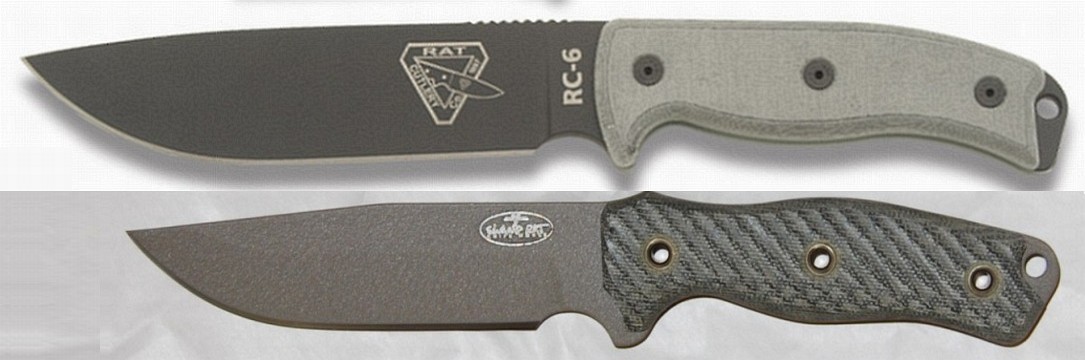
The 10-series -- 1095 (and 1084, 1070, 1060, 1050, etc.) Many of the
10-series steels for cutlery, though 1095 is the most popular for
knives. When you go in order from 1095-1050, you generally go from
more carbon to less, from more wear resistance to less wear
resistance, and tough to tougher to toughest. As such, you'll see
1060 and 1050, used often for swords. For knives, 1095 is sort of the
"standard" carbon steel, not too expensive and performs well. It is
reasonably tough and holds an edge well, and is easy to sharpen. It
rusts easily. This is a simple steel, which contains only two
alloying elements: .95% carbon and .4% manganese. The various kabars
are usually 1095 with a black coating.
52100 -- Formerly a ball-bearing steel, and as such previously only used by
forgers, it's available in bar stock now. It is similar to 5160
(though it has around 1% carbon vs. 5160 ~.60%), but holds an edge
better. It is less tough than 5160. It is used often for hunting
knives and other knives where the user is willing to trade off a
little of 5160's toughness for better wear resistance. However, with
the continued improvement of 52100 heat treat, this steel is starting
to show up in larger knives and showing excellent toughness. A
modified 52100 is being used by Jerry Busse in his lower-cost
production line, and such high-performance knife luminaries as Ed
Fowler strongly favor 52100.
Source:
http://www.bladeforums.com/forums/showthread.php?t=368828