
etch revealing a pattern in non-damascus?

Joined
Jul 8, 2008
Messages
1,079
Hey guys, I have been seeing a pattern develop in my blades of 52100 after the etch for the last couple of batches of blades, Ive also been fine-tuning my heat treat more than ever, and have been getting better cutting performance than Ive ever gotten before.

the pattern started when I started using Aldos 52100, I never got it with mcmaster carr's 52100, it started out that I could see it fresh out of the etch, then it would fade out during the subsequent handling during gurad and handle fitting, until you could barely see it if at all. Now it is coming out bolder than ever, and some stays visible after handling and guard.
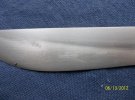
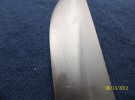
6131252100etch1.jpg6131252100etch2.jpg

What on earth does this? it doesnt seem to be a scratch pattern from sanding, and my etchant seems clean, nothing floating on the surface or floaties suspended in the etchant. I dont get it with my 1095 blades which are etched in the same etchant. It looks like fingerprints in the steel. and this last batch, I can see it in the steel when I get to a 600 grit handsanded finish before the etch. and these blades are cutting extremely well, and exhibit really good edge flexes over a brass rod.

Im forgin at low temps, forgin oversize, and using Ed's Heat treat, {as close as I can, Im not as talented as he is with a torch, so i am just using the forge to heat before the quenches}.

What is this and how do I keep those swirls in the finish from fading?

Joe
 
I'm going with alloy banding, too. I see it in my W2 sometimes in hamon blades. I recall Ed Fowler describing what he called "wootz banding" in his multiple thermal-cycled blades.

I've seen pics of blades where alloy banding was exploited and manipulated for a very cool visual effect.

Here's a W2 blade that DHIII posted a while back with some pronounced banding.
http://www.bladeforums.com/forums/attachment.php?attachmentid=61431&d=1161349143
 
Thanks guys, I may have to watch the 52100 wootz video again. And more research on alloy banding, now that I know what it's called.

Salem, the pattern in that blade looks alot like the one in mine, except for the lines arent as wavy, but that could be the picture taking, I cant seem to get a really good picture of this effect.
 
I wonder if we are seeing the carbide structure? I had a banded hamon once, this looks different to me.

I know with some steels like D2 too short of a soak time can cause this, not sure here.

52100 has a lot to the heat treat, it is very different than most steels.
 
I discuss the etch and its influence on he maker in the next issue of blade.
Etching can reveal a great many variables in the blade that will lead the maker to where he wants to go.
 
When you see banding you are seeing the carbide structure. There are films of alloying ingredients throughout the steel, not fully homogenized as a result of the initial casting process from the melt. With certain thermal conditions, such as those involved with multi quench/normalizing cycles, or a spheroidize anneal, the carbon will be attracted to the bands of alloy film in the steel, arranging itself along the pattern of the bands of carbide forming alloy ingredients. In the case of 52100 I guess those would be chromium carbides you see as banding.

That's my understanding. I wouldn't be surprised if it's flawed in some way. If you do some searching, you'll find guys like Kevin Cashen and Mete talking about it in a more definitive way.
 
You did well. The most significant aspect of an honest etch is that it mirrors what is inside of the blade.
 
Agreed, an etch will tell you a lot that a polish will hide. You can still polish or satin finish it later.

Salem's description is sufficient. The mechanics may be a bit different, but the result is as he states. Stripes of carbides running the direction of the rolling of the initial billet at the factory.
As Ed said, what is outside usually indicates what is inside.
 
Ed, I will look for the next Blade issue, and I might bring a couple of these up next month for our visit and we can test them to destruction and get to see whats inside them, and what they will do.

Salem, thanks for the fairly simple explaination, it s nice to have someone use somewhat normal vocabulary to describe whats happening with a blade!

Stacy, This bathc of blades that Im working on that I took that pic of one, im not sure I could hide it with a finer finish or polish, after I handsanded the second one, and started seeing the pattern in the etch, I started noticing that I could see it while I was sanding lenthwise at 600 grit, without the etch. Im not sure I would try to hide the results of an etch, as that lets the buyer/user know what happened in HT, and is a quality control step for me. Once I started etching, my HT immediatly got better as I could see what really happened vs what I though had happened. But then again, thats why we have blondes and brunettes and redheads, sombody might ask me to do a knife with a different finish, and I could include a picture of the etch with the polished/finished knife.
 
I understand that this blade may have a major banding problem.

What Ed and I were saying is an etch will make many invisible things show up. You can see where the HT is not right, where there is a funny spot or bad place in the steel, or where there is a micro-crack. Alloy banding will often show up as bright silvery lines.
Most of these are not going to be visible before the etching. If the exposed defect is acceptable, or there is no problem, a quick sand and buff will remove all traces of the etch.
 
Personally I don't see a problem with the alloy banding. It's something I shoot for in my heat treat as the blades with a fine alloy banding have out performed the ones I did without banding. Now when I say banding I'm talking fine banding that is barley visible, not large banding that is a sign of overheating.

Best thing to do is test the blade and see how she performs.
 
if you are shooting for the carbide banding and rope type cutting chores then it looks liek you are on the right track but if you are tring for ultra fine edge and less carbide tear out you might want to keep tring

the goal in fine edge without the carbide tear out is the finest grain you can manage and still get to harden proper and keeping the carbides evenly spread out (or use a steel that will have less carbide forming alloys )

a funny thing happened when they made D2 in a CPM type. the guys that loved the toothy edge hated the CPM as it woudl not get toothy but i loved it cause of the super fine edge it coudl now take (i had no use for std D2 in the knives i make )

so know what you are going to have the knives used as and HT to get the most out of the steel for yout app.
 
Strange??? I posted a reply this morning??

Ed, Perhaps it was a bad choice of words. I was referring to Joe's comment that the pattern was too large to buff away after etch. The term "major" was in reference to that.
The point that I was making was that many things will show up in an etch that will buff away later in final finishing.
 
Stacy, i was actually trying to keep the pattern, the last couple batches of blades from this steel had this pattern fresh from the etch, but it would wash out durning finishing. The pattern isnt too large to buff away. But it has been getting bolder with each batch latley. And i would like to keep it. When i see it during the handsanding, its mostly the "eyes" in the pattern that i can see.

I did ger to thinking, i wonder if it has to do with the summer and the etchant being warmer and etching harder than during the winter and that is what is making the pattern show up more
 
Back
Top