Fabrication of a Kephart Knife.

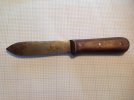
I guess I just don't understand. That blade appears to be the same shape (minus the serrations) as the Russel knife you have posted.
The Russell knife is a "Dadley" not a Kephart.

Most knife patterns are variations on a theme...spear, clip, drop point, trailing point, etc

(And this thread has morphed from it being, originally, about knives associated with Kephart...speaking of variations on a theme.)
 
The Russell knife is a "Dadley" not a Kephart.

Most knife patterns are variations on a theme...spear, clip, drop point, trailing point, etc
OK, I give up! The drawing of the original Kephart looks like a "Spearpoint" to me. I don't have a clue what a Kephart knife actually is:(.

And just to add to my confusion, here is the AI definition of a Kephart knife:
"It is characterized by a 4-to-5-inch, spear-point blade with a, typically, 1/8-inch thickness, a 90-degree spine, and a simple, comfortable wooden handle."
 
Last edited:
OK, I give up! The drawing of the original Kephart looks like a "Spearpoint" to me. I don't have a clue what a Kephart knife actually is:(.

And just to add to my confusion, here is the AI definition of a Kephart knife:
"It is characterized by a 4-to-5-inch, spear-point blade with a, typically, 1/8-inch thickness, a 90-degree spine, and a simple, comfortable wooden handle."

Now....ask it what a Bowie is?
 
OK, I give up! The drawing of the original Kephart looks like a "Spearpoint" to me. I don't have a clue what a Kephart knife actually is:(.

And just to add to my confusion, here is the AI definition of a Kephart knife:
"It is characterized by a 4-to-5-inch, spear-point blade with a, typically, 1/8-inch thickness, a 90-degree spine, and a simple, comfortable wooden handle."

Nuance.

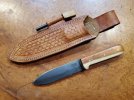
Look at the handful of images of "Kephart" based knives made by a variety of makers. Surely you can pick up the attributes which make them similar when you take into account the grind, swedge, handle shape etc etc

Not all spear shaped blades with a handle are Kepharts, and not all of Kephart's (endorsed) blades were spears.

It's the little things that matter in what sets one thing apart from another.
 
I misremembered the original dates of the Green River apparently, but Sheffield was sending their knives to the Chouteaus of St. Louis at the behest of the American Fur Company in the 1830's and 1840's according to Carl P. Russell's book, "Firearms, Traps & Tools of the Mountain Men".

I have an old I. Wilson butcher knife in the closet somewhere that is representative of the type, but I have no way of dating it accurately. They weren't particularly scarce on auction sites back when I was more involved in studying the tools of the period.

(Modern replicas assembled for fun from Ragnar's Ragweed Forge back in the day, and from the Russell company.)


View attachment 3115244
Yes, in the early 19th century Sheffield was exporting a lot of knives to America, mostly butcher knives and dagger style trade dags. They weren't Green River designs though. The Green River knife pretty much missed the fur trapping era, but thousands of them were sent West after about 1840 when production finally got going. Other designs like the Dadley and the Buffalo skinner were introduced in the 1850s and 60s to meet the needs of the buffalo trade. Sheffield makers saw how popular they were and capitalized on that by copying the knives made by Green River, some were even marked Green River Knife. Lots of the early Sheffield knives were also were marked GR up until 1830, and some confuse this with Green River. GR is Georgius Rex, the mark of either King George III or IV.
 
Nope, thats a Colclesser
Just for reference, here is the original Kephart:

View attachment 3115556
No, thats a Colclesser Bros knife but its not the original as designed by Kephart
pusI6n8.jpg
 
Ainu people
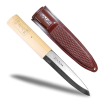
This is a Japanese Makiri Fisherman's knife. First used by the Ainu, it goes back well into the 19th century. I have one. It is interesting to use the Kephart alongside the Makiri. The Makiri has a single bevel edge. When I use them both The Makiri is superior in many ways. The Kephart is much handier.

Screenshot 2026-02-24 at 13.00.40.png

IMG_0210.jpeg
 
Last edited:
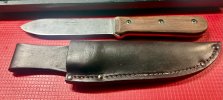
Would this be considered a "Kephart" knife?

View attachment 3115434
A Kephart has a tapered tang. The steel is hard for edge retention but not brittle.

The blade is thickest just above the mid line. Down to the edge, and also tapered to the spine. But the spine doesn’t have an edge. The whole blade is convex shaped, but not symmetrically it is thickest at about 2/3 from the edge.

The spine and edge are not parallel, the blade gets wider for the first 2/3rds then goes to a spear point from there. There is a false top edge for the last 1/3 to the tip.

The handle isn’t flat, from top looking down it is almost coke bottle shaped. Fatter in the middle with a flare at the base of the blade. Also it has a single shallow finger groove.

All of these nuances cannot be seen from the angle most pictures are taken from.

A Kephart is not a simple flat stock removal blade, with 2 wood slabs riveted on.

Hope this helps.
 
Last edited:
A Kephart has a tapered tang. The steel is hard for edge retention but not brittle.

The blade is thickest just above the mid line. Down to the edge, and also tapered to the spine. But the spine doesn’t have an edge. The whole blade is convex shaped, but not symmetrically it is thickest at about 2/3 from the edge.

The spine and edge are not parallel, the blade gets wider for the first 2/3rds then goes to a spear point from there. There is a false top edge for the last 1/3 to the tip.

The handle isn’t flat, from top looking down it is almost coke bottle shaped. Fatter in the middle with a flare at the base of the blade. Also it has a single shallow finger groove.

All of these nuances cannot be seen from the angle most pictures are taken from.

A Kephart is not a simple flat stock removal blade, with 2 wood slabs riveted on.

Hope this helps.
Thank you, that definitely helped.

Now I want one!
 
Back
Top