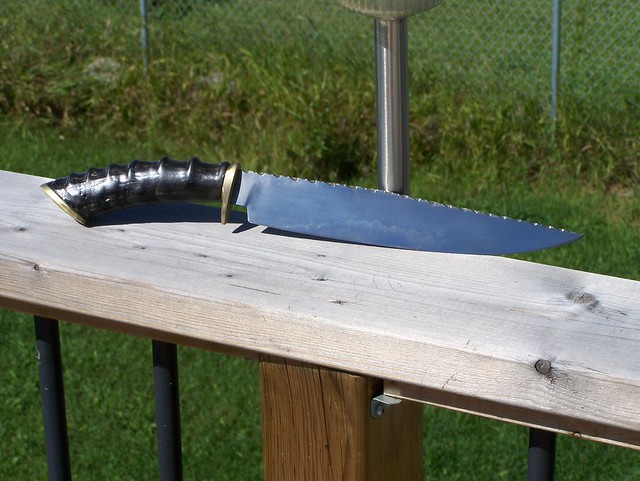
faint popping while attempting first hamon

IIRC, Parks recommends a working temperature from 60F and not to exceed 120F. (Via their MSDS which I haven't read in a long time.)

I personally wouldn't recommend preheating unless your shop gets down to below 50 degrees or so...
 
IIRC, Parks recommends a working temperature from 60F and not to exceed 120F. (Via their MSDS which I haven't read in a long time.)

I personally wouldn't recommend preheating unless your shop gets down to below 50 degrees or so...

The temp I usually aim for is about 105 degrees. I use a turkey roaster for a quench tank and I let the heat get away from me and it just so happened that it was 130 when I quenched. I think I'll just refrain from heating my oil from now on unless its really cold in my garage. I've also changed the program on my evenheat to 1475 for 12 minutes. I really appreciate you all pointing me in a better direction.

Anyhow, the blade seems to be free of cracks and the hamon is definitely present. Not the greatest looking hamon, but my attempt was a success and now I have a process to work with and refine. I'll put a pic in this thread after I finish polish and etch
 
These are bad pics and I can't get the hamon to show up any better than this. I only had lemon juice on hand. I was hoping for better results, but this is what I have.


Last edited:
With the steel being 1095 and an oil quench, you aren't going to always get a superb hamon like yaki-ire gets. Then, once you do the quench the hamon does not develop itself. You have to coax it out of the steel. Hand sanding, etching with a variety of etchants, and practice will determine how bold it will be.

From the photo, it looks like you just did a light etch on the blade as it was after HT.
Take it up to 1000-2000 grit BY HAND, etching at every grit step along the way. Try a variety of etch times, from as short as one minute to 10-15 minutes to see what works best. Rinse and wipe off the blade about every minute to see how it is doing. The best way to describe it in words is that the blade should look a bit over etched when it is ready to go to the next sanding step.
I like 10:1 FC or 100:1 HCl for developing a hamon. Towards the end, rub just the hamon with the etchant by hand, using a cotton ball and wearing rubber gloves. To get the max contrast, you have to work the hamon, and the steels above and below it individually with different polishes, too. Simicrome, Flitz, Rouge powder, Alumina A/B, and Green Chrome powder will get different looks. Mix powders with a few drops of olive or Choji oil to make a thin slurry/paste. Unless you like colored finger tips, use gloves here, too. Gun cleaning patches are perfect for doing this "finger-polishing". Once you get the hamon the way you want it by etching and polishing, only work the areas above and below it with the finger polish.

Here is a great Trick/Tip for hamon that has an steel above and below it ( Ji gane and Ha gane):
These steels are very different in microstructure, and will etch and polish different. That is part of what makes a good polish cause the hamon to POP.
After the blade is to 1000-2000 grit ( or higher) and the hamon is well etched and polished to show boldly ( usually white and wispy), put nail polish on it, carefully following the lines. After that has dried for a day, you can give the blade a quick dip in dilute FC to darken the blade a bit. Use various finger polishes on the areas above and below the hamon to make the upper bevel steel dark and the lower "Edge Steel" bright. Once all is done and you are happy, take off the polish with acetone.

What I like to do with lemon juice is use 1oz. in about 16oz water ... but anything from 8:1 to a 16:1 mix will work. I add about 5 grams of sucrose to that. I find it works gives the best effect at around 40°F. I drink this while spending a few hours working on the hamon D)

 
Listen to Stacy on this. From someone new to learning about Hamons, I love lemon juice. It takes several cycles and polishes to make it work well. I go to at least 1500g before etching. I find 10 min is good, neutralize, and sand with 2000g. repeat 3 or 4 times. I use automotive rubbing compound on a leather strip, then polishing compound. A trizac 3000g pad can be experimented with. Sometimes it makes the Hamon pop, and sometimes it dilutes it. I haven't found any reason yet that I can see why its inconsistent, but when it works, wow!

It takes me 12h plus to do a decent job at this. I'm not very good at it yet, but its coming.

This was my first real attempt, with a steel that shows a good Hamon, rather than pulling it out of O1, or 1084. This one is W2. Its too low at ricasso, and the pic washed out the beautiful effect toward the tip, but you get the idea.

9541206865_36d03a69a5_z.jpg
 
What I like to do with lemon juice is use 1oz. in about 16oz water ... but anything from 8:1 to a 16:1 mix will work. I add about 5 grams of sucrose to that. I find it works gives the best effect at around 40°F. I drink this while spending a few hours working on the hamon D)

:D hahahah!
 
With the steel being 1095 and an oil quench, you aren't going to always get a superb hamon like yaki-ire gets. Then, once you do the quench the hamon does not develop itself. You have to coax it out of the steel. Hand sanding, etching with a variety of etchants, and practice will determine how bold it will be.

From the photo, it looks like you just did a light etch on the blade as it was after HT.
Take it up to 1000-2000 grit BY HAND, etching at every grit step along the way. Try a variety of etch times, from as short as one minute to 10-15 minutes to see what works best. Rinse and wipe off the blade about every minute to see how it is doing. The best way to describe it in words is that the blade should look a bit over etched when it is ready to go to the next sanding step.
I like 10:1 FC or 100:1 HCl for developing a hamon. Towards the end, rub just the hamon with the etchant by hand, using a cotton ball and wearing rubber gloves. To get the max contrast, you have to work the hamon, and the steels above and below it individually with different polishes, too. Simicrome, Flitz, Rouge powder, Alumina A/B, and Green Chrome powder will get different looks. Mix powders with a few drops of olive or Choji oil to make a thin slurry/paste. Unless you like colored finger tips, use gloves here, too. Gun cleaning patches are perfect for doing this "finger-polishing". Once you get the hamon the way you want it by etching and polishing, only work the areas above and below it with the finger polish.

Here is a great Trick/Tip for hamon that has an steel above and below it ( Ji gane and Ha gane):
These steels are very different in microstructure, and will etch and polish different. That is part of what makes a good polish cause the hamon to POP.
After the blade is to 1000-2000 grit ( or higher) and the hamon is well etched and polished to show boldly ( usually white and wispy), put nail polish on it, carefully following the lines. After that has dried for a day, you can give the blade a quick dip in dilute FC to darken the blade a bit. Use various finger polishes on the areas above and below the hamon to make the upper bevel steel dark and the lower "Edge Steel" bright. Once all is done and you are happy, take off the polish with acetone.

What I like to do with lemon juice is use 1oz. in about 16oz water ... but anything from 8:1 to a 16:1 mix will work. I add about 5 grams of sucrose to that. I find it works gives the best effect at around 40°F. I drink this while spending a few hours working on the hamon D)

Ok, I'll save the lemon juice for lemonade.
I actually sanded this up to 600 grit on the bevels. Pics do not show it very well, but I did. I was just surprised that I could see the hamon better before I sanded than after. Clearly there is a lot more to this than I had initially thought. I'll try sanding to a higher grit and get Some fc.
 
Last edited:
Back
Top