Fake School - This is NOT a Case 64052

KnifeHead

Knifemaker / Craftsman / Service Provider
Joined
Apr 5, 2006
Messages
5,572
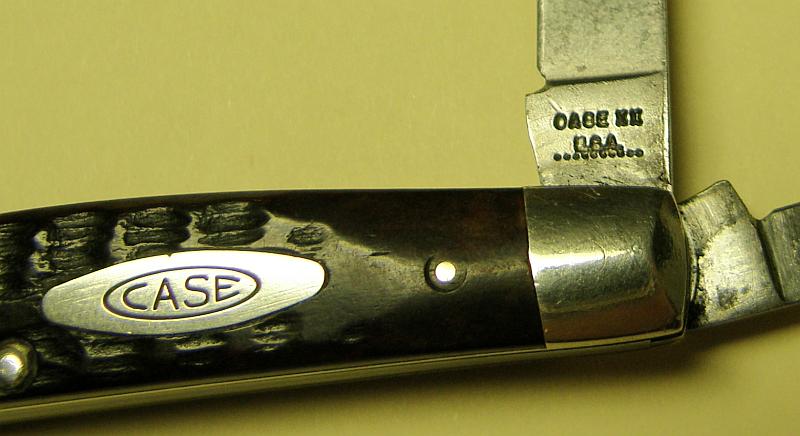
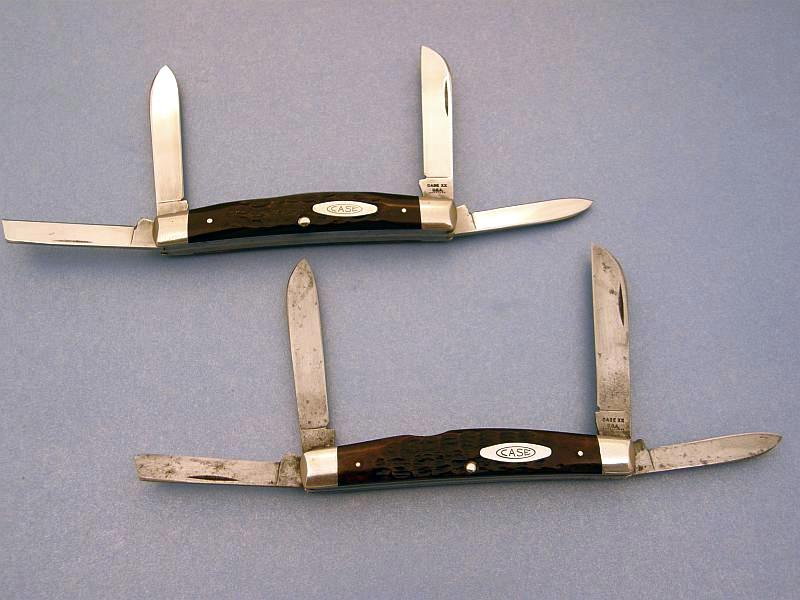
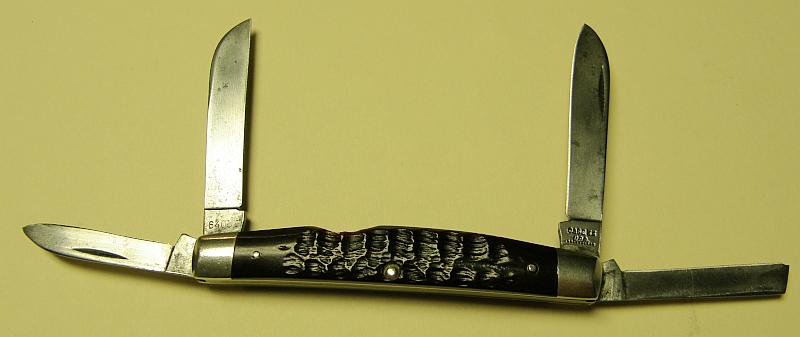
Here's an otherwise good looking "old" knife, you would think. It's suppose to be a 1970 Case small congress but it isn't. Looks good at a glance but my bad for not looking closer.

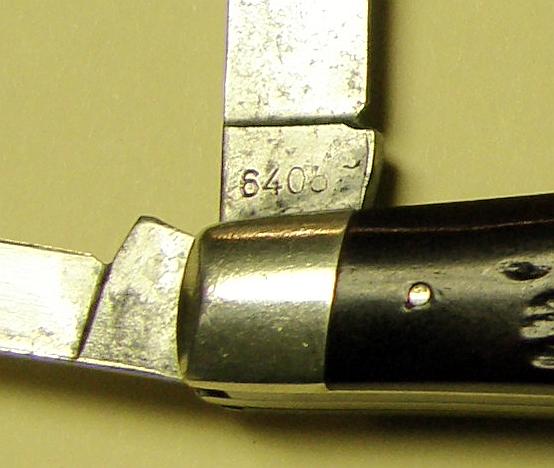
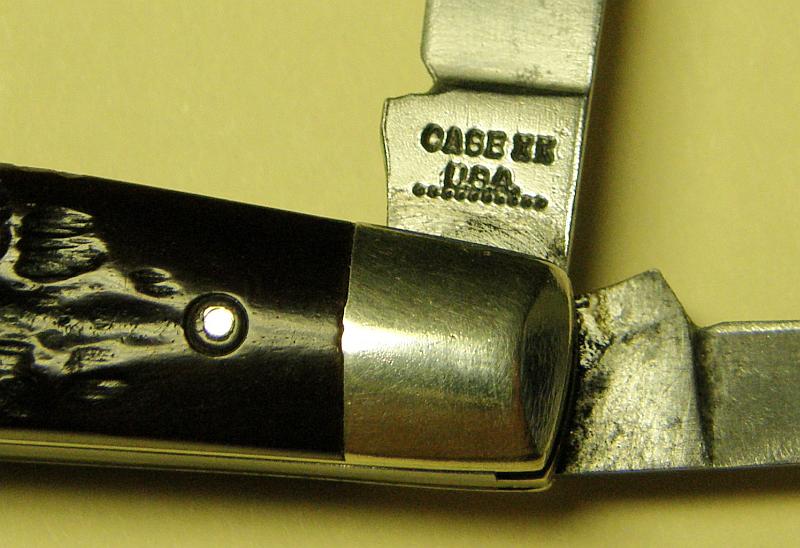
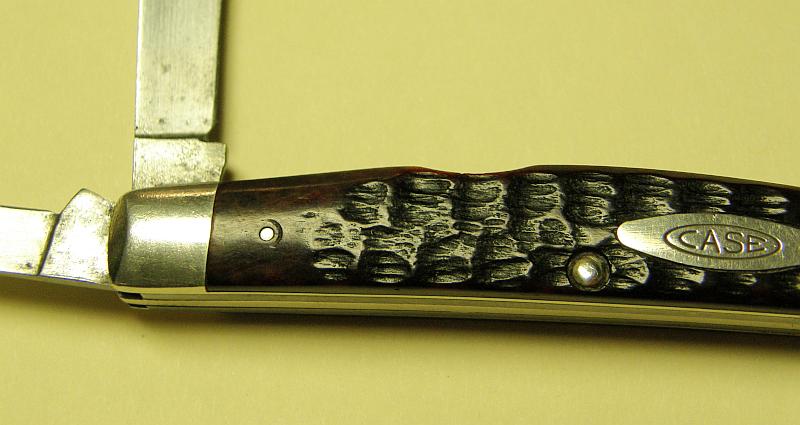
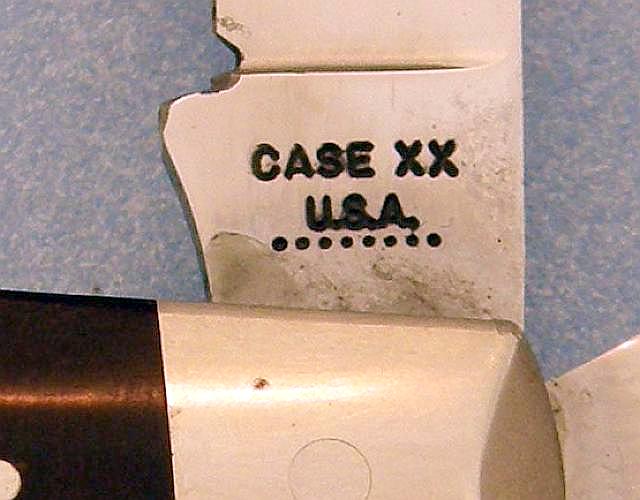
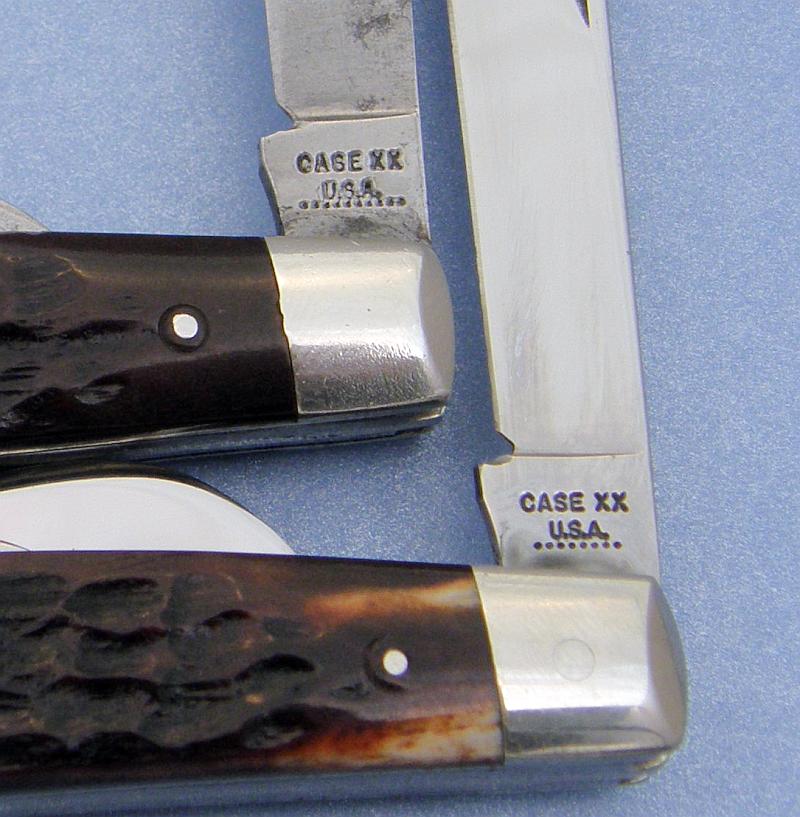
Look at the bulbous Case XX stamp. It's not crispy like the real deal. The 64052 pattern stamping is really bad. The marks around the pins are signs of shoddy, dare I say, workmanship. The shield inset job was done by hand. Do you see anything else?

I was in a hurry and didn't look at it with a loop but, thankfully, didn't pay very much for it. Had the price been up where it should be I think I would have looked a little closer and caught it. Another fake is off the street though but there is plenty more where this came from so, buyer beware.

It's still a knife. I sharpened it up and I'm going to use it on the bench till it gets worn down or broken and then I may just crack it open for practice. :D
PB020006a.jpg


PB020006b.jpg


PB020009.jpg


PB020011.jpg


PB020013.jpg
 
I dunno Kerry -- if it's a fake, it looks a *lot* better done than most fake Case knives I've seen. My question is: if it's a fake, why fake a 1970 Case 64052? With that green bone, it would have been much more profitable to fake up an early Case XX (1940-1950), and the straight "Case XX" stamp is a heck of a lot easier to do. The number stamp doesn't look too bad really -- it starts deep and gradually fades in a consistent manner to a stamp not applied quite dead perpendicular, not unusual for Case - also the numbers are spaced evenly and they're in line with each other, all good. I'm also *not* seeing any stress risers around the stamps (upward metal displacement around each letter - typical of them being cold stamped - and thus fake). The scales look to be very well fitted with the bolsters - not typical of a fake.

Look at the construction: is the center liner quite thick -- about as thick (or maybe even a bit thicker) than one of the springs? If so, this is a characteristic of a real (somewhat) vintage 64052. The blade profiles look like they should - nothing weird looking there. From what I can see of the shield inset - it might have been an issue of a dull bit tearing the bone as it did the insetting. Hmmm, were the shields of 1970 Case knives glued, not pinned? IIRC they were glued -- and came out easily. That might be a replacement or reglued shield. The hafting looks pretty decent - typical of a true vintage Case.

By 1970, Case construction quality was already slipping somewhat as they worked to leave their hand craftsmanship behind, so the various problems you're seeing wouldn't surprise me on a real Case of that era.
 
Looks legit to me, I see Case knives from that era with all the things your pointing out all the time.
 
I think the master blade, and thus the one with the Case stamp, should be the sheepsfoot and not the spear blade. Just my 2p.

Looked again...seems both large blades have the stamp and dots which seems odd IMO.
 
I am no expert by any means so I took the knife with me to the NKCA show in Shepardsville this past weekend. I shared the knife with someone I trusted that would know what it is. He immediately told me the name of the guy that apparently cranked out hundreds of these sometime ago.

I asked the same questions, why do people waste time making these when they don't make very much money on them. It seems nobody can answer that one. I do know if a fake is extremely crappy they wouldn't be able to sell one. It just doesn't make any sense to me to put so much effort into a knife I only paid $50 for in an antique shop. Maybe they do it because they can.

Almost forgot, I was able to compare the stamping on this knife with the counterfeit examples listed in the "Counterfeiting Antique Cutlery" book before I took it to the knife show.
 
Men, this knife is as counterfit as a $3 bill. You can't pass judgement with a photo, gotta have it in your hand.
 
I see Case knives from that era with all the things your pointing out all the time.

Yep. And that's why I always tell people looking for users to buy Case knives from the past few years - their quality is really back on track compared to the "dots" era (1970s).
 
I have to admit that I don't have the experience of looking at many 70's era knives to make comparisons. I do understand that it would be relatively easy to increase the value of a knife by pulling the blades out of an off year knife and putting in a faked 10 dot or 5 dot to increase it's value. Apparently that is one of the things counterfeiters do.

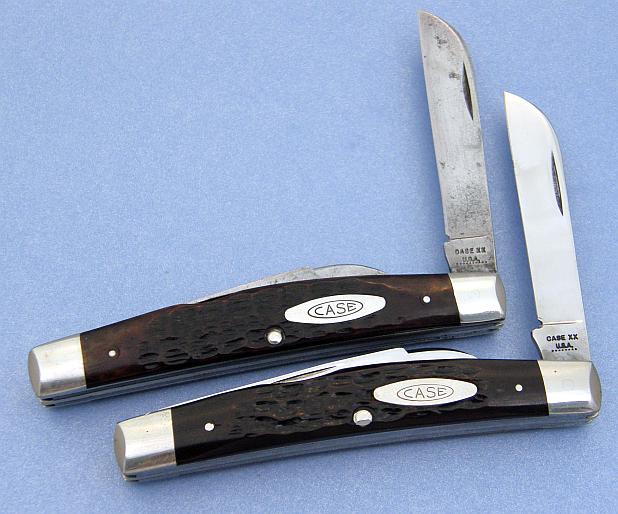
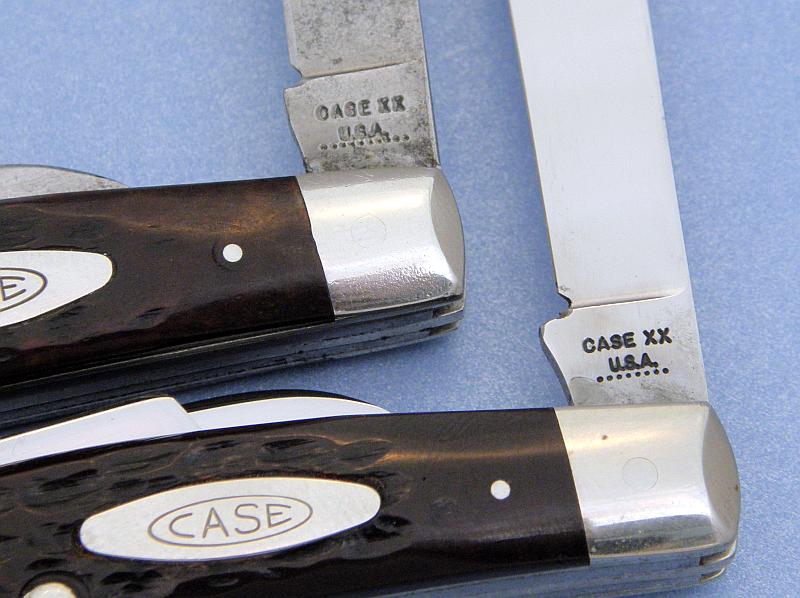
I do have access to a 1972 congress in mint condition and layed both of these knives down for comparison. I think the handle, pin and shields look pretty much the same as far as workmanship. The stamping is mighty queersome though, posted here for your amusement. The stamp on the 70 is what I would describe as being "webbed" or over stamped. The stamp on the 72 is crisp with no webbing.

The 72 is on top in this image. The blade config looks ok.
PB020014.jpg


PB020017.jpg


PB020022.jpg


PB020023.jpg


PB020024.jpg
 
Whew, man, I thought I'd totally lost my mojo there for a while -- thanks for the second set of pictures - that last picture makes it very obvious that it's been restamped. So, it *is* a Case 64052, just not the particular vintage of 64052 it's pretending to be. So long as the blades all have good walk and talk, and they all take a good edge and keep it reasonably well, I'd say a carbon steel 64052 with full blades for $50 is a pretty decent deal.. Use it up and enjoy it.
 
Live and learn, thankfully :) I pulled the trigger on the thread title before I had a chance to look at another similar knife. I was pretty sure the stamp was hokey and not so sure about the other parts of the knife.

I don't know what others think about this kind of thing but when I encounter a forgery, I feel I should share it so that others learn what to be aware of. This is how we can all learn more about the dark side of knife collecting.

Yessir..it's a good knife otherwise. I sharpened it up and it cut me. Retribution for outting it apparently. :)
 
Just about any object that has ever gained wide acceptance and developed a "name" has at one time or the other been counterfeited. The counterfeits that bite the hardest are those made contemporaneous with the real item, since their construction, materials, and design aesthetic match the genuine article far better than any later counterfeit attempts (plus, they're genuinely as old as the real thing, or very nearly). Most of my collecting is of Sheffield folders made before 1900 -- guess what - there are German made Sheffield counterfeit knives - made during the 1890s. Yes, I have one, sigh. :jerkit: Apparently they made a lot of them -- I keep seeing them come up on ePray - various patterns and designs - all very English looking - with various tang stamps evocative of real Sheffield firms, just not quite matching any (IIRC, mine says "Clark Bros"). Fortunately, the German makers' fetish for steel pivot pins instead of matching the pivot pin material to the bolster material gives them away (their very brassy looking nickel silver is another clue).
 
I don’t know about the rest of you, but I find how to identify and spot fakes very interesting. Heck I’m almost tempted to start collecting fakes. LOL
 
I don’t know about the rest of you, but I find how to identify and spot fakes very interesting. Heck I’m almost tempted to start collecting fakes. LOL
Heh, if you want to collect fakes, just follow the shiny on eBay - you'll soon have a bagful. :D

Seriously, for anyone really interested, if you don't already have it, get a copy of "Counterfeiting Antique Cutlery" - awesome book. Beyond that, if you're interested in antique knives, then start tracking down all the reprints and old catalogs you can get your hands on -- study blade shapes, swedging, pin placement, etc. Remember, the great old knives were handmade - they were a craft and an art - they have an aesthetic that you can soon begin to pick up on once you see enough images of them. Once you pick up the vibe, you will quickly pick up on things just not being right in a fake -- pay attention to that feeling. If you feel something is just not quite right, even if you can't immediately put your finger on it -- let it go.

You might be tempted to not pay close attention to the line drawings in the old catalogs, since you might feel that they're only approximate -- not true: I've found those old line drawings to almost universally be extremely accurate (even down to pin placement). Get a copy of "Levine's Guide to Knives and Their Values - 4th edition" by Bernard Levine (note: do NOT get the 5th edition - it's junk -- it was cranked out and chopped up with no input from Bernard Levine; get the 2nd or 3rd edition if you cannot find the 4th). Check out Bernard Levine's forum here (he has a sticky there: "Immunize yourself against fakes" - good stuff). Pretty much his first rule is "buy the knife, not the story" -- the bigger the fake, the better the story - the real thing can sell itself. And a certificate of authenticity only certifies that it's a genuine fake.

There's lots more of course, but that should get you going.

-- Dwight
 
Back
Top