Favorite edge angles for your daily

Joined
Dec 2, 2012
Messages
4,691
My last knife (which i lost) had m390. I gave it a sub 14° edge. That steel performed very well. Held its edge for decent amount of time.

I ordered a new knife in s90v, and keep seeing that it has a lot of carbide and does not prefer low angles. Though, on reddit, someone mentioned that he has a very low angle, but adds a microbevel slightly higher to remove the fractured carbide. Anyone have any insight into this?

I do plan on high grit stones (4000+), and maybe microbevel eith an 8000 grit.
I want as low as an angle for general daily tasks like cutting boxes and packages open. This knife will not see any hard use, I have beaters for that.

If it makes any difference, the s90v will be from shirogorov.
 
I have only ONE knife in S90V, a Spyderco Manix 2.

It came with a very crisp factory edge at or slightly below 30° inclusive (15°/side), which I think was Spyderco's target for most, if not all of their blades. I've only very lightly touched it up on a DMT Fine at that default angle, and it responded easily and beautifully to that. I wouldn't worry at all about the edge being too acute on this one - especially if the knife isn't going to be put to hard use. And on that note, most knives I use all fall within 25°-30° inclusive (12.5°-15°/side). For light or typical uses, I've not had any complaints with any of them.
 
Last edited:
I generally go with 18 degrees. Much below that and I start to see a little edge damage under magnification.
 
Larger folders like my Cold Steel Voyager get an angle about 18 degrees, just low enough to touch up on the 20 degree slots on the Sharpmaker. My Spyderco folders get an angle low enough to touch up on the 15 degree slots on the Sharpmaker. It’s somewhere near a 17/20 and a 12/15 respectively. For blades that are wide enough I started using a DMT Aligner for sharpening on my bench stones, so I tend to think of terms of the notches on that. 3 notches on the Voyager get low enough for the 20 degree slots and 4 or 5 gets low enough for the 15 degree slots with my Endura, Delica, and Byrd Tern.
 
. . .
I ordered a new knife in s90v, and keep seeing that it has a lot of carbide and does not prefer low angles. Though, on reddit, someone mentioned that he has a very low angle, but adds a microbevel slightly higher to remove the fractured carbide. Anyone have any insight into this?

I do plan on high grit stones (4000+), and maybe microbevel eith an 8000 grit.
I want as low as an angle for general daily tasks like cutting boxes and packages open. This knife will not see any hard use, I have beaters for that.
. . .
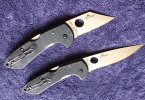
This one is right up my alley these days due to my Frankenstein like experiments in my L a a a b o o o r i t o r y ( see the heavy mods in my image ) .
Yes , for those with fortitude enough to gaze upon my repulsive (but necessary ) " experiments " , those are S90V blades surgically implanted into those coarse and brutishly unsivilized Siren handles ! (I love them) .

Reprofiled both blades to 14 degree per side (by goniometer) polished to 8000 DMT and diamond stropped bevels .
Frightening things ; hard to fit them properly in the plastic V in the goniometer ; the edge wants to catch and hang on the steep sides of the V guide seat .

MY BOTTOM LINE FIRST :
Only you can determine the edge angle that will work best for your use (heck that's the fun of it :) ) .

Now to continue with my verbose verberosity :
The long blade has had some , sane / careful use off-and-on over several months and still sinks into the flat of my thumb nail in a sick kind of way . . . (~= hair whittlinglyish sharp) .
but
the short blade ; that has been used to cut some rather thick (?fiber glass?) reinforce box straps that were around corrugated, five foot on a side boxes with machines over a hundred pounds in them . . . well the edge is surprisingly dull .
((also note the scratch marks on the side of that short blade ; that's not tape glue that is scratches in the alloy .)) ((( ! )))
Dull =
won't hardly catch on the flat of my thumb nail ; mostly just skates across taking a thin curl off my nail .
will still take a continuous curl off the end of my thumb nail all the way across (((surprisingly ))) . Shows what pure polished edge Bevels and acute edge geometry alone can do.

These straps are so hard on my edges I have taken to cutting them with a little (very small ) hack saw with like 40 teeth per inch blades . One stroke per strap .

I supose my point at this point , is that the S90V edge was not flattened / rolled or chipped but mearly dulled at this acute geometry . I'm keepiing mine at 14 .

Sure sure I could use toothy edges .
I HATE TOOTHY EDGES .

Enjoy your edge adventures . 😃😚😳😡🧐😊

1775850104654.jpeg
 
Last edited:
Only you can determine the edge angle . . .
Basically this :
Start "too shallow / acute" and go from there .
I wonder if Murry and I actually met if there would be a matter / anti mater implosion . 🤣🤪(he loves toothy . . . I can't stand them ) (he's a food guy I'm a woodworker & metal worker guy . . . that's the dif ) .
 
17 degrees is my newest best friend ;) I recently, on a whim, bought some of the sharpal degree blocks, the sides of this pyramid has degrees from 14, 17, 20 and 25. There are two of these, one with a magnet base and one with a nonslip pad for other than steel plated diamond stones.
I am pretty proficient at keeping the same angle, I just need a quick handy reference to help me set my wrist properly and this seems to fit my needs great. I did a few knives and it went very well, ending up with nice even sharp edges.

Untitled by GaryWGraley, on Flickr

G2
 
I've been running this S90V Spyderco for a long time at a low angle and it's been great. Usually run my pocket knife at a pretty low angle though, say 12-13dps, but to be honest I generally just eyeball the bevel angles. When I've actually measured they end up being around 13deg. Lower will slice better, it's just physics. If I have a steel that can't really support the low angle as long, I'll go maybe 15-17dps. I also like having some bite so for me that means ~400gr or 40um.

SYCSUPXh.jpeg

IrJ8aP8h.jpeg
 
Once I managed to understand sharper stays sharper longer, all kitchen knives went to 15°(except junk). Most of my EDC's live at 15° with a couple harder use blades at 20°.
For customers, I either put a very similar angle back on the blade that was existing or the factory angle.
If I intend to change the bevel on any knives, I talk about it with the customer first. Interestingly, you will find most don't care, but I'm not trying to ruin any one's life by "screwing up" their favorite knife.
 
When I read the book, “Knife Deburring”, Vadim stated, generally speaking, large knife makers put a overly obtuse angle on knives for folks that will abuse their knives so they aren’t finding themselves doing copius amounts warranty work. Most decent steel will handle a narrower edge than what they came from the factory with. Not sure if the knife makers on here would agree with that or not. I see knives with 25 degree bevels fairly often. When setting edge angles on customers knives I do consider the amount of damage on them before making that decision.
If you’re not doing “Forged in Fire” testing, a narrower angle can really improve performance, to a point. IMHO
 
Ideally each user would be able to lower the edge angle until it was too low for their uses. Alternatively the manufacturer/maker could supply edges with angles in the 10 degree per side range and the user could raise them until damage stopped. The latter option requires an informed buyer to be willing to accept damage so the former option is safest for the makers. It is however FAR easier to raise the edge angle than reduce it when hand sharpening and power sharpening is so potentially damaging that one must be very careful of false results. This all requires tight control of edge angles, typically only found with guided systems or the most practiced hand sharpeners.

Consider that Larrin has shown/quantified the effect of edge angle on CATRA testing to the point that steels like AUS-6 can tie or out cut steels like CPM S110V with an edge angle difference of 8.5 degrees per side or more. AUS-6 at 12 degrees per side cut the same amount of CATRA card stock as S110V sharpened at 20.5 degrees per side. Sharpening S110V at a commonly recommended angle of 22 degrees per side (dps) means AUS-6 at 12 dps will out cut it.
 
Ideally each user would be able to lower the edge angle until it was too low for their uses. Alternatively the manufacturer/maker could supply edges with angles in the 10 degree per side range and the user could raise them until damage stopped. The latter option requires an informed buyer to be willing to accept damage so the former option is safest for the makers. It is however FAR easier to raise the edge angle than reduce it when hand sharpening and power sharpening is so potentially damaging that one must be very careful of false results. This all requires tight control of edge angles, typically only found with guided systems or the most practiced hand sharpeners.

Consider that Larrin has shown/quantified the effect of edge angle on CATRA testing to the point that steels like AUS-6 can tie or out cut steels like CPM S110V with an edge angle difference of 8.5 degrees per side or more. AUS-6 at 12 degrees per side cut the same amount of CATRA card stock as S110V sharpened at 20.5 degrees per side. Sharpening S110V at a commonly recommended angle of 22 degrees per side (dps) means AUS-6 at 12 dps will out cut it.
That would be oranges to apples… and I agree, you can damage an edge using an abrasive belt or even high speed stropping. I’m not sure what you mean by false results though?
 
Last edited:
Almost everything gets less than 15° I hand sharpen, but when I've measured it, they are around 12°. Less than .015" bte. I'm told my edges are Sharp. Sharper than what most are used to. I agree super sharp knives stay sharp longer. (Acute)
Choppers need to be more obtuse than that. I tend to chip/damage the edges, then back off some.
 
Last edited:
That would be oranges to apples… and I agree, you can damage an edge using an abrasive belt or even high speed stropping. I’m not sure what you mean by false results though?
What is apples and oranges?

False results in the sense that you can have a super sharp edge that has also been damaged. I’ve had this show up in brush knives and large chefs knives when I sharpened them on a belt sander. They were super sharp, and for normal cutting did a fine job. However any impact would dent the blade. I went back to hand sharpening and the denting went away. For the brush knife, I was limbing branches and anything less than about 1/4” caused denting. For the chef knife, it was an old 10” knife that had been relegated to rough use, not food prep. I was using it to trim some small branches around the grill and got dents in the edge. I gave it a couple of good burr raising hand sharpenings and it went away.
 
Back
Top