
Feather pattern billet--WIP

Fred.Rowe

Knifemaker / Craftsman / Service Provider
Joined
May 2, 2004
Messages
6,848
First weld. 26 layers 1084/15n20--
DSC01612.JPG


Turned billet 90 to make crushed "W"
DSC01613.JPG


W's drawn out cut into sections.
DSC01619.JPG


W's are starting to show.
DSC01630.JPG


Last weld before the cleave. 112 layers of "W"

DSC01642.JPG


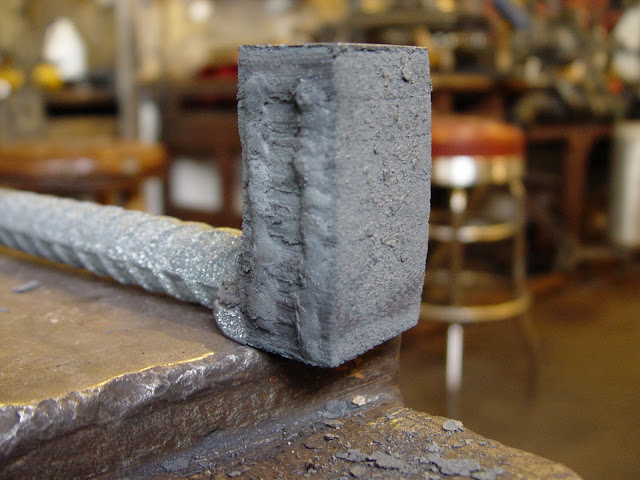
I dry weld billets. This is the carbon jacket left behind after the final weld.
DSC01638.JPG


Heating the billet after the final weld so it can be squared in the press before cleaving.
DSC01643.JPG


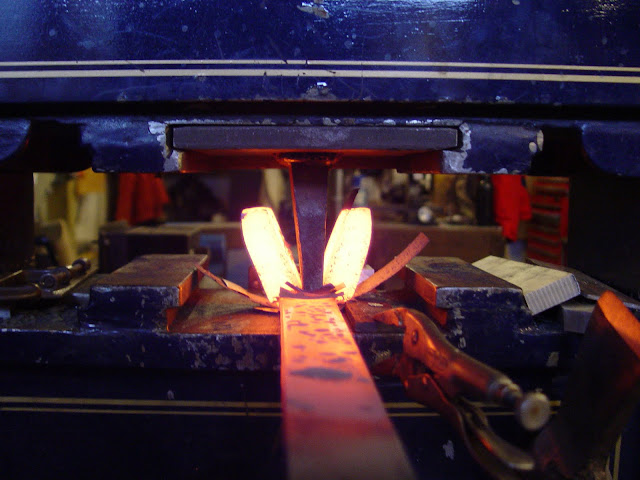
Here is the billet being cleaved in two.
DSC01648.JPG


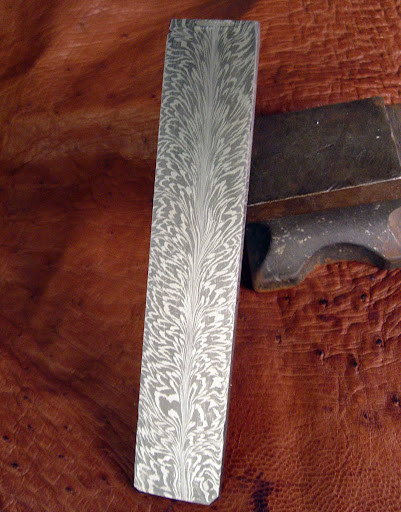
The finished flat stock is 6 x 1 5/16 x 3/16. For me feather pattern is a crap shoot, always full of surprises.
DSC01651.JPG
 
Lookin good, saw this in the other thread. Turned out very nice.

Makes me wish I had a power hammer, and a surface grinder, and a welder, ..........:D
 
Thanks for the pics Fred. I seriously think if I had the proper equipment to make damascus I would probably do almost nothing but make billets. Particularly feather pattern if I had the skills. Eventually I'd make some knives out of them.
 
I love Feather Pattern. It is by far my favorite pattern I have seen to date, and that one looks just as good.
 
Fred,

Thanks for the pics., especially your feather cleaver die. I've made a lot of "W" since you can do so much with it but have never made dies for a feather pattern.

After cleaving the "W" billet do you do anything to remove potential scale on the new surfaces or simply close the cleaved billet as soon as possible?

Gary
 
Fred,

Thanks for the pics., especially your feather cleaver die. I've made a lot of "W" since you can do so much with it but have never made dies for a feather pattern.

After cleaving the "W" billet do you do anything to remove potential scale on the new surfaces or simply close the cleaved billet as soon as possible?

Gary

You can see in the pic where the cleaver is going down through the billet that it goes into the surface of the flat stock thats being used as a handle. This way you end up with two separated pieces. They are stuck to the bar where they are tacked. Remove the pieces from the bar, grind any surface scale off and re-heat to a forging temp. Using a flat die in the press, flatten each piece and square it up. Surface grind it on the mating surfaces and the reweld. I've had much better results since I started taking the pieces apart and surfacing. I read a post from Bruce Bump, saying that he takes them apart this way.

Are you using borax; have you tried hydrocarbon solvent?


Fred
 
Very nice feather Fred! :)

This is pretty much exactly how I have made them. I've made a couple that started as stacked jelly rolls also (based off of a Don Fogg knife that graced the cover of Knives Illustrated several yeas ago :cool:).

Thanks for sharing Fred! :)
 
Thanks for sharing. I'd be interested in any further words you have about hydrocarbon jacket welding. A few questions if you have time:

The first picture shows the billet after the first weld. So, after soaking the cold billet in kerosene, you heat it up to welding temp, then soak a while before pressing? Is welding in a series of bites right with kero? Then, one pass of overlapping bites and your weld is good? Or do you set the entire weld between big flat dies with one press?

After the first weld is made, I'd assume the only way to proceed is to let the billet cool, cut it up, grind clean, tack weld, kero soak, heat? It seems that kero flux could not be safely applied to steel at any real heat- and that you'd only get one press or series of bites before needing to cool before any further fluxing could be done.

Do you ever cool the billet, soak in kero, heat and re-weld again for insurance before going to the next cutting/patterning step?

Feel free to answer all, some, or none... thanks in advance for your response!
 
You can see in the pic where the cleaver is going down through the billet that it goes into the surface of the flat stock thats being used as a handle. This way you end up with two separated pieces. They are stuck to the bar where they are tacked. Remove the pieces from the bar, grind any surface scale off and re-heat to a forging temp. Using a flat die in the press, flatten each piece and square it up. Surface grind it on the mating surfaces and the reweld. I've had much better results since I started taking the pieces apart and surfacing. I read a post from Bruce Bump, saying that he takes them apart this way.

Are you using borax; have you tried hydrocarbon solvent?


Fred

Thanks, Fred. I like the idea of separating the two pieces, just haven't seen it done until now. And yes, I'm still using borax but would like to hear what's working for you.
 
Thanks for sharing. I'd be interested in any further words you have about hydrocarbon jacket welding. A few questions if you have time:

The first picture shows the billet after the first weld. So, after soaking the cold billet in kerosene, you heat it up to welding temp, then soak a while before pressing? Is welding in a series of bites right with kero? Then, one pass of overlapping bites and your weld is good? Or do you set the entire weld between big flat dies with one press?
It has to be done in one press with large dies. The reason; the HS encases the billet in a somewhat fragile carbon casing as it comes to welding temperature. If the billet is pressed in sections it will shatter the carbon "canister" and allow oxygen to contact the billet surfaces.

After the first weld is made, I'd assume the only way to proceed is to let the billet cool, cut it up, grind clean, tack weld, kero soak, heat? It seems that kero flux could not be safely applied to steel at any real heat- and that you'd only get one press or series of bites before needing to cool before any further fluxing could be done.
Its a different technique than borax so there is a different sequence. A couple of things to keep in mind, when the original billet is put together it needs to be welded up thoroughly. I stick weld the ends with two lines and the sides of the billet at one inch intervals; I tig the sides. The reason for this is the carbon canister. If thin pieces of steel are used, such as 15n20, the sides need to be welded, otherwise they will move when heated and break the carbon canister letting the oxygen enter. The side welds are only needed when the pieces are thin. Once you are welding 3/8 inch thick sections its not necessary.
Since I switched to HS my welding temp have come down. I weld at 2250 fh with excellent results.


Do you ever cool the billet, soak in kero, heat and re-weld again for insurance before going to the next cutting/patterning step?
Just like any canister welding the first weld should do it. The carbon jacket that forms is really cool. It shapes itself around the welds around corners it takes the shape of the outside of the billet.
The welds I have been getting using this technique offset any extra time that it takes. The fact that I don't have to use borax itself is wonderful. no mask is needed and no burned out forge.


Feel free to answer all, some, or none... thanks in advance for your response!

Try it with a small stack of mild steel and see for your self. By the way; I soak the original billet for 45 minutes after it reaches 2250. I almost got out of making damascus I got so frustrated with inclusions and bad welds and flying flux:eek: I'm sold on the hydro carbon solvent.
 
Beautiful feather Fred.
Looks like there is a dagger waiting to emerge from that bar of steel to me.

BTW:
don't you think Nick's new glasses make him look a lot smarter?
 
Funny that you would say that ,Mark.

I bought a fantastic bar of feather pattern from Randy Haas. It was one of the nicest I have seen.
Yesterday I was showing it to a knife maker friend and telling him how I planned on forging the tip up and pull the bevels down to make a wicked fighter/Bowie. He looked at me in shock, and said, "Your, not going to ruin the dagger that wants to come out of this bar, are you!" I said, "Fighters sell and daggers sit on the table." He smiled and said, "If I made a dagger out of that bar, I would never talk about selling it."
 
Beautiful feather Fred.
Looks like there is a dagger waiting to emerge from that bar of steel to me.

Dang it man! I was going to do a drop point hunter instead of a dagger with that piece because I didn't think my grinding was up to it. Now I have to rethink the dagger.

I've never made a dagger before. I'd hate to mess up nice steel. Even practicing on three or four pieces before might not be enough to get it.

Also, learning about the process is amazing. Very cool.
 
Dang it man! I was going to do a drop point hunter instead of a dagger with that piece because I didn't think my grinding was up to it. Now I have to rethink the dagger.

I've never made a dagger before. I'd hate to mess up nice steel. Even practicing on three or four pieces before might not be enough to get it.

Also, learning about the process is amazing. Very cool.


I am sure Fred's damascus billets have a pretty good shelf life haha. Dont rush into anything with the bar if you dont feel ready yet, work in some more common steel you are used to and get at it when you feel confident. This is the reason i still don't use damascus. Well that and since i am not really at the point of selling knives regularly, the cost is prohibitive considering they will sit in a drawer or be given away to people.
 
Back
Top