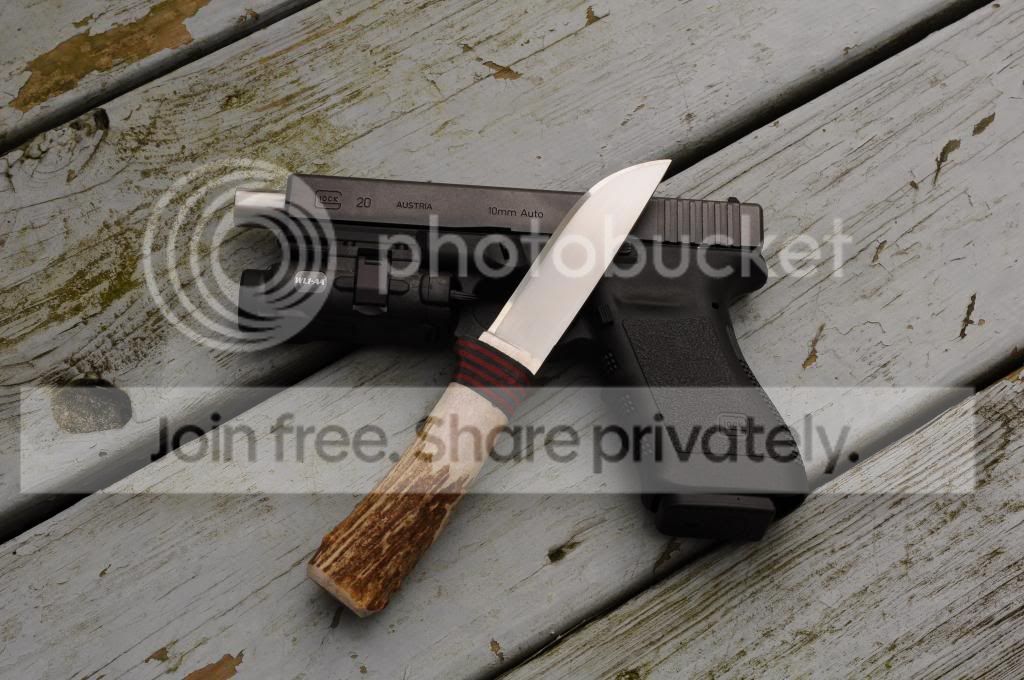
Feedback appreciated

Joined
May 12, 2010
Messages
303
I've been trying for a couple of years. Can't afford a real grinder so I've been using a Harbor Fright 1x30 and files and lots of sandpaper.

Specs:

Steel: S35VN
Heat Treat: Peter's 59-60 HRC
Handle: hidden tang with Homecarta and stag
Other: sharpened to 40* inclusive and finished to 600 grit
Notes: cut about 60 linear feet of cardboard tonight. Like hot knife through butter. Afterward it wasn't shaving sharp but 20 licks on each side with Bark River green compound on a strop and she was back to shaving.

Anyway, how am I doing?
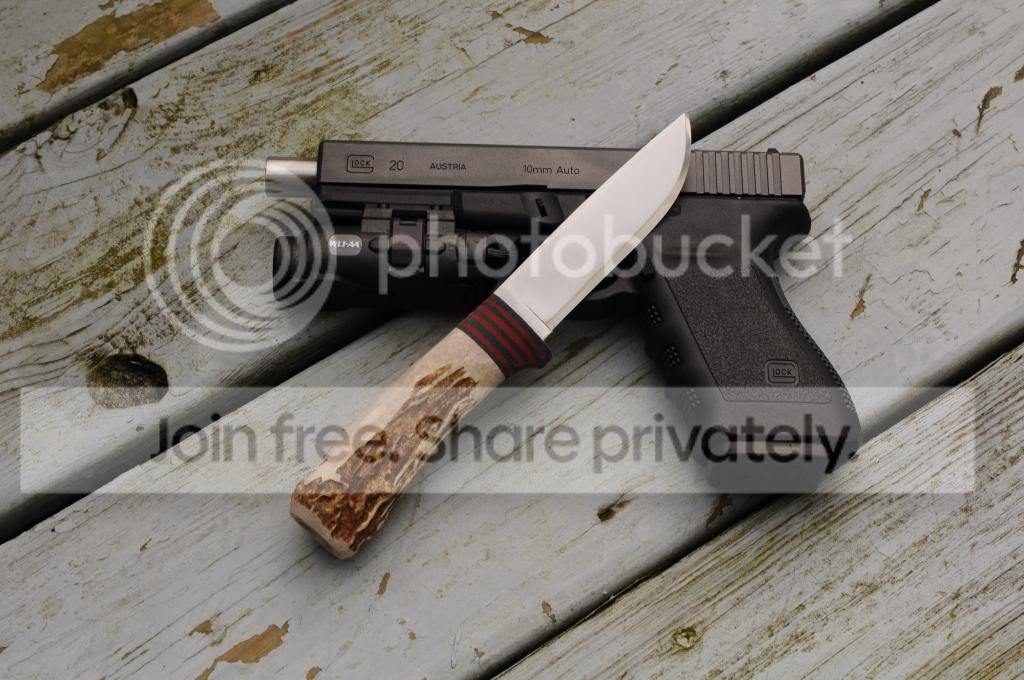
DSC_4197_zps4a04d589.jpg


DSC_4195_zps4b18525b.jpg
 
First you tell me how thick is the steel ? But from here it looks pretty darn good. That is a very short primary grind line and if there is a secondary , well where is it? Just the same do more, do more. Frank
 
Frank, I think the reflection on the blade is masking the plunge. Looks good from what I can see. I suspect, guessing from the pistol used as a size reference, that the handle may be on the short side for extended use. But I am just guessing.
 
I left the crown on the handle but it looked really off, so I removed it and thus shortened the handle. Could use another half an inch but can't put back what was taken off. Feels good doing some cutting in my hand so works out ok. The light isn't fooling you, the plunge doesn't quite make it to the spine. It looked good off my little 1x30 belt sander but after heat treat and final sanding it came out the way it did. Still working on technique and have no shame in admitting to it. Sure is sharp though so I'm pleased with Aldo and Peter.

For a working knife, is it too thick at the shoulder? I only have a cheeapy caliper so I can't give an accurate measuerment, but consider that I sharpened to 40* inclusive for the final edge.
 
Last edited:
The part that strikes me - you may want to work to a thinner edge so the secondary grind is smaller
 
Get a set of calipers. Even a cheap pair of plastic ones will work, and get the edge down to 0.030 before heat treat. To me it looks like my earlier knives where the edge was 0.080 before heat treat.
 
I was thinking the same thing... the sharpening bevel going that far up the blade indicates a thick edge.
Absolutely this. Before a final edge I put on, I think .030" is good for very hard use knives. Skinners, etc .010-.015" is nice.
 
Thanks guys. At this point could I do some post heat treat grinding? This knife will be for my personal use so I'm not too worried if I mess up the finish.
 
Thanks guys. At this point could I do some post heat treat grinding? This knife will be for my personal use so I'm not too worried if I mess up the finish.

Absolutely... do it without gloves so you can feel the steel heating up, and have water handy to cool the steel in. I often cool/dunk the steel after each pass on the grinder, it's messy but you do not want to blue/overheat the edge at this point! You will not be able to refinish the ricasso without removing the handle, so don't grind on that part...
 
Looks like you made a very nice knife, but as you progress, you'll likely find what others have already pointed out: You want to thin the blade a little more.

Like you and many others, I started out much the same, making very thick primary edges and sharpening to about 40 degrees inclusive. This isn't necessarily a bad thing, and makes for a very tough knife, but you'll find that it does hamper performance when it comes to cutting/slicing.

Now I take my primaries much thinner and typically go with a 30 degree inclusive, and I'm much happier.
 
Looks like you made a very nice knife, but as you progress, you'll likely find what others have already pointed out: You want to thin the blade a little more.

So, good advice, but what are YOU going to be using the knife for? That is the question. How are you doing? You tell us. If it is a cardboard cutting machine for work, it seems good to me. If you are planning on using it in the kitchen for slicing cheese, way too thick.

Not to hi-jack the thread here, but have any of you new makers considered joining BladeSports? They use a 10' knife and cut just about everything from 2X4s, drinking straws and golf balls to rope in competitions? I learned a hell of a lot playing with those guys. I guess what I'm trying to say is: use the knives you make and make the knives you use.
-M
 
Thanks guys. I'm only working with a harbor fright 1x30 so I took it slow and cooled with water often. I still need to re-sand the blade finish but so far it's performance is much improved (at slicing cardboard anyway). So thanks for the feedback, I went and picked up a half way decent caliper so hopefully in the future I'll get it right the first time!
 
Last edited:
I found the calipers the best tool I bought. The next best is good quality abrasives. I sanded on my first knives for weeks, then realized the difference good sandpaper makes.
 
Back
Top