Ferrule/Guard fluting (please look NickWheeler)

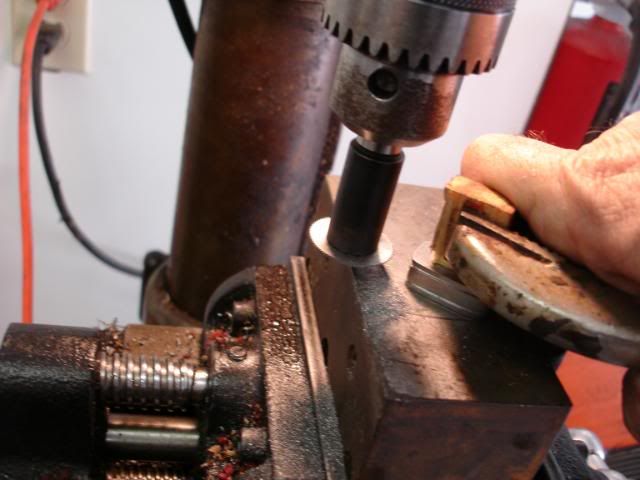
.030 slitting saw in mandrel...hand sliding collar/spacer on steel plate ..flip for matching slit both sides...clean up with needle file
DSC00773.jpg


John
 
Nathan, it leaves me with a 0.010" step between the spacer and handle material, which is totally on purpose. I then buff the sharp edge with a hard buff and pink compound which puts a tiny radius on it.

This, to me, is signature to a very high end piece. It's easy (again, IMHO) to just sand everything flush. Another benefit to it, is if you have slight changes in handle material (like ivory moving on you) it's not as glaring as if they'd been flush.

Kevin Cashen gave a talk on precision fitting of guards at Ashoken last year.
One of his little details is to very slightly chamfer both edges of the different
handle materials where they meet. Adds a little detail and protects against
movement just like your approach.
 
For super thin lines I do that with a super thin cut off wheel set up in the Foredom on a table I built John... but I still haven't figured out how to do it on an integral :confused: :)
 
Nick, thanks for the tips mate. I have used a screw file to cut the thin grooves but the jeweller's saw looks like a better deal.
Cheers Bruce
 
I do the jewlers saw thing, then move to chainsaw and three square files.
Have also used abrasive wheels set up like what John's doin.
 
When I do flutes say on pearl or bolsters, I use a saw to start but I start with what in reality is the hack saw blade. I bought what's known as a nail cutter which will take a hack saw blade . These are only a couple of bucks but do provide great hand comfort. I'm presently doing diamonds on some black lip pear. It works great to get you started on the right track.I usually use a 32 teeth per inch or something available that is very fine. It sure gets the "lines to be grooves" clean cut and avoids skating and little messes that sometimes leads to changes. I will often use two sizes of files to get the groove size I want. I sand the grooves using rods from 1/16" up or even a knife type shaped in a sheeps foot style with a rounded edge. All very much the same as talked about here. Frank
 
Back
Top
