FFG: Two ways?

Joined
Jan 22, 2010
Messages
35
Hey all,
I was thinking about it the other day, and wouldn't there be two different ways to make a FFG. One being the traditional Spyderco way, where the spine gets thinner and thinner, while the other would the keep the thickness of the spine for most of the blade length. I was curious about the latter, so I figured I would ask you guys (or gals) about it.
Wouldn't it make the knife stronger, yet still have good slicing capabilities?
I am also aware that in order to do this, the angle of the bevel would change as it went down the blade. What kind of problems would that present?
What would be the pros and cons of this kind of FFG, and would it be recommended, particularly with more brittle steels that would not do as well with the Spyderco FFG?
Thanks all,
Andrew
 
It comes down to balance and flow. You are correct that the angle of the bevel would have to change as you move to the tip, becoming more and more obtuse as the belly sweeps to the tip. I've ground blades that stay near full thickness until the belly begins to sweep to the tip, and then the spine narrows down to the tip. This helps reduce a severe obtuse or blunt angle near the tip. However, the trade off is a significantly heavier blade, and reduced slicing performance. Also, there are many who believe that a fully tapered blade is superior at distributing torque loads than a more rectangular design. It sure does wonders for balance.

--nathan
 
This just begs the question: What are you slicing? For something like a combat/utility knife it might be just fine that last two inches of the blade don't slice much better than the first two inches. With a kitchen or hunting knife, where strength is less of a premium, the distal taper is worth thinning the blade as it nears the tip.

As far as the strength of a distal taper goes, I think that forming a long triangular piece of steel is probably stronger by weight, but not simply stronger. In constructing a bridge weight is a primary consideration - you can't just decide to double the thickness of everything. But a knife isn't going to collapse if it is too heavy. I guess the main possibility for a distal taper resisting damage better would be if the blade steel is springy enough to take advantage of the thinning toward the tip to flex rather than break. But most blades are not that springy at any thickness.

You can always grind it the thick way and experiment with slicing something soft before heat treat. If you don't like it, start tapering the grind until you do.
 
Thanks RX, I like that idea. I'm not slicing anything in particular, it was just a hypothetical inquiry.
Sorry to cause any confusion. Thanks though for all the input and such. Much appreciated.
 
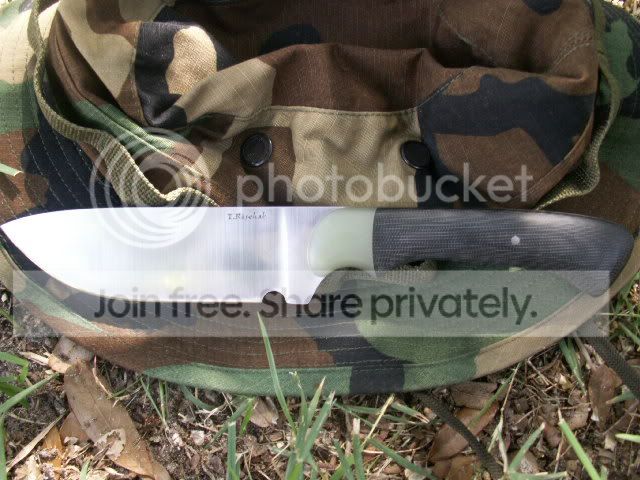
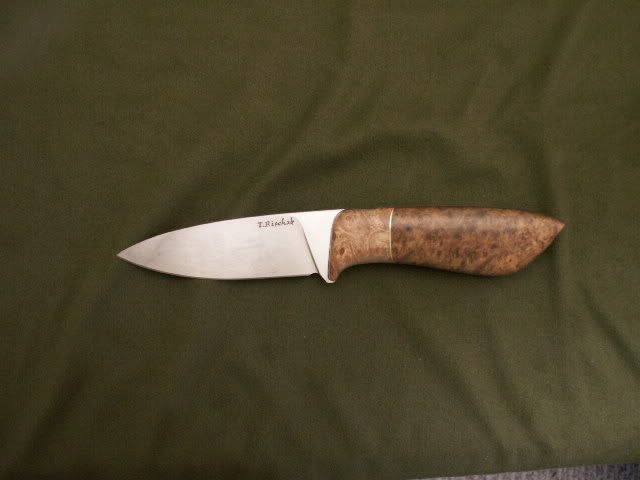
If you keep the same angle all the way from plunge to tip you will have a lot of full thickness on the spine till you get to the tip. This is when the spine is straight with no curve. However, if your spine has any curve to it then it will decrease in thickness towards the tip. When I say curve I mean from plunge to tip, not the last inch or so of a drop point (for example). I ground both of these with a constant angle. The spine on the second one is an arc from butt to tip. Not a single straight line across the top.

no curve
Beaterwhole.jpg


Curve
Jeep4.jpg
 
Back
Top