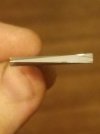
finally broke a blade

Joined
Mar 26, 2018
Messages
13
I have been practicing full flat grinds freehand, been using the bubble jig to prepare for this moment, but have not made a knife that i would take to finish yet. I decided that i would break one to see what it looks like. here it is, this is 80crv2 bought from chuck at AKS
20180802_014252.jpg 20180802_014315.jpg

held it between 1505 and 1510 in a pipe muffle inside my propane burner forge for about fifteen minutes.

Tempered at 300 for an hour, thrown in the freezer overnight. Then tempered twice at 375.

This seems like a good fine grain. How does it look to you guys?
 
375 seems a bit low for most knives, but for a break test, good. Freezer didn't do anything. Grain looks great. Even for a kitchen knife, I would probably just do 400 F. Quench, cool to the touch, into the oven at 400 for 2 hrs, cool via any method, back into the oven for round 2.
 
I agree with Joe.
The snap temper and freezer treatment did nothing.
400°F to 450°F would be a better temper.
 
One thing you need to remember about a forge is that it is not even in tempature. Even with a muffle it’s colder twords the openings. With a thermocouple you also need to remember it’s only telling you what the temp is right in that spot where the tip of the sensor is. In all honestly 5° vararation is good for a heat treat oven and near impossible in a forge. I’m not saying your controller is lying to you I’m just saying that you can’t expect it to be that even of a temp inside the muffle. That’s why we move blades in and out. the muffle just spreads out the hot spot into a larger area. If you can see any difference in color of the hot steel it’s at least 100° hotter or colder then the other area. That’s why thy say take it to non magnetic and go one shade lighter and quench. That one shade lighter is 100° And you will see non magnetic around 1400°. So if you pull the blade out and you can see any difference in the color along the blade from one end to the other then the temp is quite a bit off.

Just giving you a heads up so you don’t get led down the path of false security.
 
I am definitely glad that I broke the blade. picture on the left is near the plunge while picture on the right is near the tip, the blade portion broke into four pieces! These numbers I got across multiple forums and youtube videos. There were a couple people on here who said they didn't see a reason to temper a blade above 400! I have a knife that I carry that I did this way, and I love the performance when it comes to just cutting things like cardboard and zip ties. When I broke this knife, however, I realized that a customer would shatter this thing. (I don't sell my knives yet, nor do I feel that I am close to doing so) Were these guys right to say they wouldn't go much over 1500 when soaking any carbon knife steel? AKS says 1545 to 1615 for 80crv2

I wish I could video tape the process here like you JT. (appreciate the content btw) Its hard to explain the whole process that you use without leaving some things out. Even with a muffle forges aren't plug and play you have to watch them, new makers out there. I try to keep the blade as close to the thermal area around the tip of the thermal couple as possible. Lately I haven't been making knives with much more than a 3 inch blade. The color doesn't seem to change until about halfway down the handle, which I know creates a weak spot between hard and soft steel, but I am hoping that with it being under the handle that that doesn't become an issue for general knife use. I didn't realize that even if the color was the same it could mean a huge temperature difference.

I will be honest, the only reason I did the 300 and into the freezer is because one night I lost track of time and didn't realize how late it was and that there was no way I would be able to stay awake for the normal 2x 2 hour temper cycles I was doing. I wanted to try the freezer thing because multiple people do just that for carbon knives that they sell. I know Ed Fowler does, is that because it is done multiple times over multiple days or is that just a 52100 thing?

I am not arguing, you guys know much more than I do, I just want the information for future reference and for those new makers that could be reading this post. There is a metric TON of misinformation out there.

 
My austenizing temp when I’m using 80crv2 is 1520 in my salt pot. I do some thermal cycling prior to that, however. I’m far from an expert, but this was some help I got from a very good maker and it seems to work for me and my equipment. Looks like you’re well on your way to success.

Jeremy
 
I have seen those 1545-1615F temps posted before. I feel they are a good grain refinement and stress relief range (1650 followed by 1550), but 1515 to 1525 is a better austenitization temp for a eutectiod steel knife blade. I suspect ( but don't know absolutely) that the higher numbers are for industry HT where the desired results are different than ours.
 
I think that the freezer treatment on SS or HCS is a nothing, bad info. Not sure what it would corespond to on any TTT graph I have seen either. It definately isn’t anywhere near cold enough for cryo. The dry ice “quench” is to minimize retained austenite. I dont think freezer temperatures accomplish this meaningfully better than do room temperatures.
 
The "freezer treatment" was started by Ed Fowler. It has been debunked by metallurgists, but still persists.

In short, any steel with a Mf lower than room temp is going to gain very little if anything by dropping to zeroF/15F range (the average temperature of a home freezer). These steels need to drop to -100F, which is the temp of a dry ice and alcohol bath. The steels in this group are high alloy and stainless steels.

52100 is a pretty simple steel. The Mf for 52100 is around 150F ( 100% conversion point), so cooling it lower than room temp does absolutely nothing. The main point is that it is impossible to get more than 100% conversion.


ADDED INFO:
Now, for those who care, 52100 when tempered between 450F and 575F will convert the RA into a bainitic structure while retaining the martensite, which is why it is so good for bearings. The added toughness makes for less stress failure. To increase RA, they raise the austinitzation temp to the upper numbers. The RA decomposes in the temper to a bainite like structure. The subsequent temper will stabilize the structures and give the steel a high toughness.
 
Back
Top