
Finally got my drill!

Joined
Jan 19, 2007
Messages
288
drill press pics

I have a big drillpress. :jerkit: Made in PRC, of course, but very tough. I add a small milling machine XY vice. I will be able to mill some sloted guards and slots for hidden tang. all the stuff for only 300$
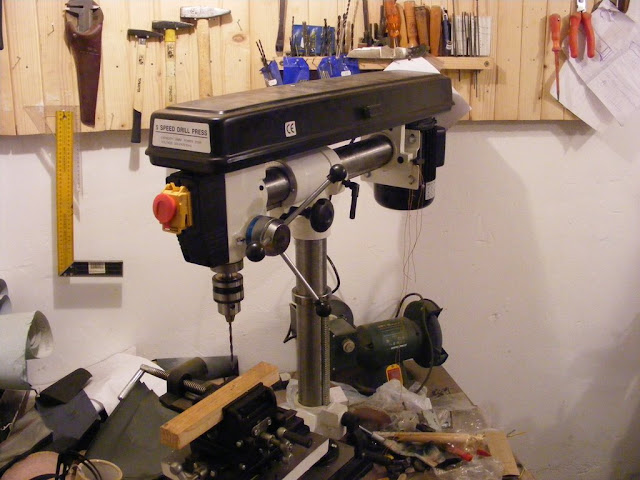
DSCF3949.jpg
 
Cool. Congrats! Be careful with side loading in a drill press. The machines just aren't built to take it. So if you do try some milling, go very slowly.

--nathan
 
Congrats on the new tool... always a joy!

Gotta rain on your parade a little though. That drill is not designed for lateral loading, and if you use it like a mill you'll quickly have something that's not suited for anything, let alone drilling an accurate hole.

Use your vise to drill holes in a straight line, and then file everything clean. :)
 
Thanks and thanks for the tips. Looks like next machine will be small mill.......
It never ends, doesn't it? :D
 
You can mill in a drill press, but the depth of cut has to be very light. If you shave off no more than .010" depth of cut per pass it will probably be okay. But if you mess up and overshoot on a pass while half way down and bite a cutter into your work piece you can damage the spindle, and push your chuck off its taper creating a heavy projectile with an endmill sticking out one end. I don't recommend milling with a drill press for that reason, though I would do it myself.

However, I don't even own a drill press, so what do I know...
 
How do you drill holes Nathan? :D

I just use an old Bridgeport, so I never could justify the room to add a drill press.

And I have milled using a drill chuck. The last time was several years ago, I was putting a big hole in a big PVC block using circular interpolation. I had the drill chuck in (for drilling a start hole) and I was thinking "bah, it's just PVC, I'll just stick the cutter into the drill chuck and save myself 20 seconds). After about 10 seconds the helix of the endmill had pulled the cutter far enough out of the drill chuck that the depth of cut was out of control and the cutter seized in the plastic. About one second after that the jaws on my ~$400 drill chuck were red and melty...

Not my brightest moment...
 
When I was first getting started I used an X-Y vise on a drillpress for milling. I did indeed pull the chuck off several times. I broke a lot of cutters and finally switched to using diegrinder burrs, still kinda didn't work well. I bought a small mill-drill from Grizzly (cheap chi-com crap) and it works reasonably well. I really need a bridgeport (Hey Nathan you got any you wanna get rid of now you are all automated?)

-Page
 
Could he use 2 flute mills and drill one hole then move over 1/2 a hole and drill again, repeating the process untill he has done the slot. Mills work much better for this than drill bits being square ended, short and rigid and he would always have pressure on the taper. Then after he was done drilling the slot make a full depth pass thru the cut. I have never donne thish with a press but, it works well in my mill.
 
the drilling connected holes with center cutting endmills is a very good process, the problem would be the sideways cut to clean up. 4 flute cutters would actually be better for that as the shocks that hammer the the chuck off the taper would be less in a 4 flute. When I was using my drillpress to mill I found the diegrinder burrs to work best because the 30 or so flutes carried the work continuously so the shock and vibration was less

-Page
 
to cut slots in a drill press you can mark out your slot in the guard and drill holes the entire length of the slot. then you can run the mill down the slot easier since there will be very little to remove.
 
That was my point exactly. Holes, than light milling at the pinch of the milimeter. Now I am thinking that is maybe better to clean slotted guard with thin cut off disc on my 125mm angle grinder after drilling and cleaning sticked guards with chainsaw file. Atleast unthil I buy a mini mill from the same brand. :rolleyes:

Hey, Guys, a question. What speed to use drilling annealed blade steels and guard materials such as 416ss and 304ss? And what for a light milling?
 
Last edited:
I just use an old Bridgeport, so I never could justify the room to add a drill press.

And I have milled using a drill chuck. The last time was several years ago, I was putting a big hole in a big PVC block using circular interpolation. I had the drill chuck in (for drilling a start hole) and I was thinking "bah, it's just PVC, I'll just stick the cutter into the drill chuck and save myself 20 seconds). After about 10 seconds the helix of the endmill had pulled the cutter far enough out of the drill chuck that the depth of cut was out of control and the cutter seized in the plastic. About one second after that the jaws on my ~$400 drill chuck were red and melty...

Not my brightest moment...


I never would have thought the sever angle on end mills would have pulled the cutter into the material!
 
I really need a bridgeport (Hey Nathan you got any you wanna get rid of now you are all automated?)

-Page


But... then what would I use for a drill press?

I do have an old mill I'd be interested in selling. 1998 Vetrax with Fanuc controller - 17X38" travels, RS232 with DNC dripfeed. It drills holes real good. About 5,000 lbs. $2 a pound - you can't get a decent steak for that...
 
I never would have thought the sever angle on end mills would have pulled the cutter into the material!

Oh yeah, that helix can pull an endmill out of a drill chuck or pull a work piece up out of a vice (and throw it at you!).

A fellow I used to know once had that happen to him with a big 2" thick chunk of ABS he was working on. That is where I learned the term "degloved" in reference to a hand injury. His arm won't rotate below the elbow anymore. Watch that helix.
 
But... then what would I use for a drill press?

I do have an old mill I'd be interested in selling. 1998 Vetrax with Fanuc controller - 17X38" travels, RS232 with DNC dripfeed. It drills holes real good. About 5,000 lbs. $2 a pound - you can't get a decent steak for that...
If I had $10,000 I'd probably jump, sadly it's beyond my capabilities to aquire

-Page
 
Speed for drilling stainless 416 and 304? :confused: Please :)

About 50 SFM. The RPM will be determined by your drill diameter.

700-800 RPM will work for a 1/4" hole. Feed hard enough to avoid chatter and squeal and work hardening. Let up as the web exits or you'll over feed.

Edit:

Nothing bad happens if you cut that value in half and it might reduce HP and rigidity requirements. Reduced RPM would certainly reduce the need to peck or use coolant. However, I do not suggest going ultra slow - it makes it harder to maintain a reasonable chip load and I don't think the mechanics of the cut work the same at very low speeds.
 
Last edited:
Back
Top