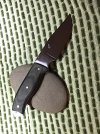
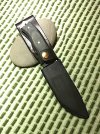
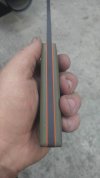
Finish handle before patina/hot blue?

Joined
Sep 22, 2017
Messages
28
Hello everyone. I have been searching the forums and have not found much on blade surface treatments and handle shaping. I am making my 6th knife right now and just finished up the handle last night. I have been rough shaping the scales and finishing each end, then epoxy and pins to the tang. Once cured, I clean everything up with the belt sander and hand sanding. I have been happy with my work and see improvement each time. My problem is I want to start experimenting with hot bluing/forced patina. I forced a patina on my most recent blade. It turned out good. I got the handle all done and in the process sanded all the patina off of the exposed tang edges. I use West System G-Flex and paper micarta on this one. Against all my instincts, I boiled the vinegar and forced another patina. Handle and all. Fortunately it turned out ok, aside from the SS pins showing a little wear. Lucky I think.

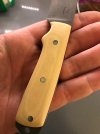
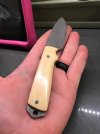
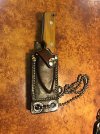
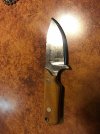
How could I avoid this in the future? Especially with the hot blue. No way a handle would hold up under those conditions. Do I temporarily fix the scales to the blade and finish it before permanent attachment? If so, how do I get them on there? I really like the freedom of just getting them epoxied and cleaning up the mess afterwards but know that approach won’t work forever. Any advice would be greatly appreciated. I will show you fine folks a pic of my last knives.3B157415-06D1-44C0-979F-426E0DAEFDDA.jpeg52F11AC4-F0E5-4793-A0A0-22353B7DB577.jpeg0E427077-C0B8-4B83-B6F7-54B5D9EF0DA4.jpeg4E45457B-A8BF-4960-9A27-239A264A3F56.jpeg2C5394A7-6FA9-47A8-BE19-0D7C57E308E4.jpeg7FE6B512-5026-4957-9866-F2A2F80DA71F.jpegF60FF0BE-C98F-4D48-8E6B-FCFB9D7A8F54.jpeg
 
You're doing nice work. Why mess it up with "patinas" that don't wear well?
Thanks for the compliment. I am trying the different finishes because I am worried about rusting and pitting. (Working with 01) I also like the look. Plus, it’s something else to experiment with! I do understand your point though. It seems as far as patinas go, you either like them or you don’t.
 
If you make precision holes in the blade and scales, you can finish the handle with just pins temporarily holding it, finish the blade with bit blue or whatever, then assemble without more sanding.

That's how I do parkerized blades, if they're not done with removable scales using screws.

0122172012c.jpg
 
Hello everyone. I have been searching the forums and have not found much on blade surface treatments and handle shaping. I am making my 6th knife right now and just finished up the handle last night. I have been rough shaping the scales and finishing each end, then epoxy and pins to the tang. Once cured, I clean everything up with the belt sander and hand sanding. I have been happy with my work and see improvement each time. My problem is I want to start experimenting with hot bluing/forced patina. I forced a patina on my most recent blade. It turned out good. I got the handle all done and in the process sanded all the patina off of the exposed tang edges. I use West System G-Flex and paper micarta on this one. Against all my instincts, I boiled the vinegar and forced another patina. Handle and all. Fortunately it turned out ok, aside from the SS pins showing a little wear. Lucky I think.

How could I avoid this in the future? Especially with the hot blue. No way a handle would hold up under those conditions. Do I temporarily fix the scales to the blade and finish it before permanent attachment? If so, how do I get them on there? I really like the freedom of just getting them epoxied and cleaning up the mess afterwards but know that approach won’t work forever. Any advice would be greatly appreciated. I will show you fine folks a pic of my last knives.View attachment 796037View attachment 796038View attachment 796040View attachment 796044View attachment 796045View attachment 796046View attachment 796047

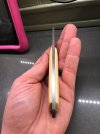
Double sided tape ;) I do it on this small knife . And then I decide to use Danish oil ........and here we are :mad: So if you decide to use wood for scale , think about finish before you glue scale .

s8GlUOa.jpg

rZXFLwe.jpg

NpiIPWH.jpg
 
Last edited:
If you make precision holes in the blade and scales, you can finish the handle with just pins temporarily holding it, finish the blade with bit blue or whatever, then assemble without more sanding.

That's how I do parkerized blades, if they're not done with removable scales using screws.


View attachment 796092
Nice work! Really like the contrasting liner. Do liners have a little “give”? I sometimes have really minor gaps between scales and tang. I am doing most of my rough blade sanding on a 1x30 HF belt sander. not idle for keeping things flat.

Double sided tape ;) I do it on this small knife . And then I decide to use Danish oil ........and here we are :mad: So if you decide to use wood for scale , think about finish before you glue scale .


s8GlUOa.jpg

rZXFLwe.jpg

NpiIPWH.jpg
Great looking knife! Is that a forced patina? When you say double sided tape do you mean the real thin stuff that is basically just the adhesive? I can usually find the thicker padded stuff.
 
Nice work! Really like the contrasting liner. Do liners have a little “give”? I sometimes have really minor gaps between scales and tang. I am doing most of my rough blade sanding on a 1x30 HF belt sander. not idle for keeping things flat.


Great looking knife! Is that a forced patina? When you say double sided tape do you mean the real thin stuff that is basically just the adhesive? I can usually find the thicker padded stuff.
Thanks !
Boiled vinegear. Yes , it is very thin but hold strong .On all my disk sander I use that tape to hold sandpaper .
IFUxwk2.jpg

P2RLYzO.jpg

ekgLYSG.jpg

2hBjBaL.jpg

6Z6peP2.jpg

unPc5zQ.jpg
 
Last edited:
No give, they're g10. You'll have to flatten by sanding on a piece of glass or granite by hand to eliminate those gaps.
 
Thanks for all the help/advice. One more question. After I have formed the scales and have everything ready to epoxy I tend to have a little epoxy slip out on the tang. How should I deal with that? Clamp things up then wipe down the epoxy? The Gflex gives me plenty of time but it is so damn sticky. Use a little acetone? Any advice here? Thanks again.
 
Yes, clean it away after clamping with acetone or denatured alcohol. Acetone usually works best in my experience but alcohol works too. Check it again an hour or two after the first cleaning as more will likely extrude out under the clamp pressure. Usually after a couple hours at room temp it's done moving, but if you clamp, clean and walk away you're likely to come back to beads all around the scales that are impossible to remove without affecting the underlying finished parts.
 
Yes, clean it away after clamping with acetone or denatured alcohol. Acetone usually works best in my experience but alcohol works too. Check it again an hour or two after the first cleaning as more will likely extrude out under the clamp pressure. Usually after a couple hours at room temp it's done moving, but if you clamp, clean and walk away you're likely to come back to beads all around the scales that are impossible to remove without affecting the underlying finished parts.
Going to give it a try. Thanks!
 
And make sure to remove the epoxy up to the scales but don't toch the epoxy-joint with acetone.
If you use wood for scales it can suck up the acetone and prefent a good joint
I had to do a rehandle bacause of this
 
Back
Top