Finishing African Blackwood?

Joined
Jul 23, 2006
Messages
1,231
Hi Everyone,

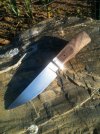
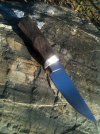
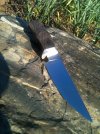
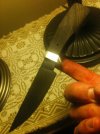
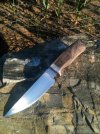
I am currently working on a Hunting Knife for a customer. The handle is in African Blackwood with nickel silver furniture. How do you folks typically finish this species too get the lustrous black finish....Tung, Danish, Linseed Oils?....Stains?


Thanks,

Bob

IMG_0410.jpg

IMG_0411.jpg

IMG_0412.jpg

IMG_0413.jpg

IMG_0409.jpg
 
All I've ever done with blackwood is sand down to at least 600 grit and then buff or finish off with paste wax.
 
Thanks Ray....I've got a mess of scrap pieces.....I'm gonna experiment with finishing those.
 
I used to carve African blackwood every day with African carvers in Africa (of all places!) into people and elephants and whatnot, and they use black shoe polish most commonly. For a glossier finish they use floor wax. Either requires sanding to as high a grit as you can stand, but since it's impossible to get higher than 400 in Tanzania they never went higher than that.
 
Is that really African Black wood? It looks like Macassar ebony to me which is equally as dense but has that brown through it , and to me makes it more attractive. THe knife looks super too ! Frank
 
Blackwood can easily be that brown, though most stuff that color never makes it out of Africa but rots in the forest after it's cut down. It also looks lighter before finish sanding. Stuff that's totally black is actually pretty rare, and usually ends up in a clarinet or oboe.
 
Is that really African Black wood? It looks like Macassar ebony to me which is equally as dense but has that brown through it , and to me makes it more attractive. THe knife looks super too ! Frank
Reply With Quote

I sure hope it is.....picked up the wood from my local "Woodcraft Store"....paid a pretty penny for it too.
 
If you sand it down to a nice fine finish and then hit it with a few coats of boiled linseed oil, it will darken up after a few days
 
It should darken up just by sanding it with finer grit paper. After I get done with the paper I'll go over it with 00000 steel wool. Bob, what grit is it sanded to in pictures?
 
make it slick. burn the 'hairs' off. drop it in a jar of lemon oil. leave it a day, remove & wipe dry. wipe it down with paste wax & buff it a lot.
 
Looks more like East Indian rosewood than anything else except Pau ferro. No way does it look like African Blackwood. Woodcraft is notorius for not knowing the species they sell.
 
If you folks are just going by the color and the brown stripes, then that is where you are getting a mis-identification.

It looks just like Blackwood to me. This wood is brown and striped until sanded and buffed. It turns much darker when the resins get heated a bit. Age will also darken it more. As said, the stuff you see that is ebony black has usually been dyed or stained to make it even blacker than it is ( I like the natural look, and do not use any colorant).

I sent some blackwood to a newbie a few years back and he thought he had ruined it, because when he sanded it down, it turned brown ( from the aged black of the block before sanding). All was well when the knife was finished.
 
If you folks are just going by the color and the brown stripes, then that is where you are getting a mis-identification.

It looks just like Blackwood to me. This wood is brown and striped until sanded and buffed. QUOTE]

You seem to be stating the handle wood in the photos are brown and striped because it hasn't been sanded yet???

African blackwood is dark thru and thru and doesn't require heating the surface by sanding to darken it. I've got about 50 blocks of African blackwood on the bench cutting it up like I've done for years. Blackwood LOGS are black thru and thru....just search for photos on the net to debunk bad information. Not to say there can't be SOME color variations within a species at any given time nor that this particular handle wood is not blackwood.
 
I have handled dozens (and seen hundreds) of blackwood logs in Tanzania (which is where most of it comes from), and carved a lot of them into something or other. I've seen it as light as what's above through a whole log, and as black as ink too. Truly black stuff is actually pretty rare, though it's most likely what you'll find here because only the best stuff usually makes it overseas. It will get darker with time and will get darker as you sand it finer but not too much (kinda like black canvas micarta does). A piece that light will probably never turn black. That's ok though, because it looks good, is finished and shaped well, and fits the overall package. I'm guessing that most of us who have used blackwood before could tell in an instant whether it truly is blackwood or not if we had it in hand. I'm also guessing everyone will probably stick to their own opinion since that doesn't seem to be an option.
 
Last edited:
Some good points, wordsmith. It's nearly impossible to cover all the data regarding physical properties of a given species in a foram thread. I should have pointed out fresh cut log ends will appear quite different from older logs that have had a chance to photodegrade. Photodegradation accounts for much of wood color changes ala naturale sans finish interference.
 
I love African Blackwood because it is a naturally stable wood that takes a nice glassy polish with little effort. I wish more of the lighter colored stuff was imported because I prefer it over than the darker stuff.
 
Back
Top