Fire un-lighting...the vital, boring chore of wood craft

...
I slowly pour about a gallon of water on the fire, then wait a minute and get more water. Then I start pouring it on about a liter (quart) at a time, poking a long, sharpish stick into the ground.

I do this for about ten minutes, poking thoroughly into the soil and mixing in water until I can stick my hand down into the soil underneath where the fire was comfortably. A fire that's been going for a few days can heat the dirt underneath up at least a good foot below the surface, and I want to make sure that the whole thing is absoutely 100% out before I go.

...

This is exactly the method I was taught when I was a kid and still use today -- particularly the part about keeping your hand in the soil (I use a 10 count).
 
Dammit, I knew I was doing something wrong. I've been putting my hand in first, then pouring water until it stops hurting.

I'll try it your way next time.
 
I was watching Ray Mears tonight and he really stressed, this, he even scattered the wet ashes around with his bare hands so it wouldn't leave a pile, then put leaves back over top.
I was burning a big pile of brush only an hour before that at my cabin, several big buckets of water, then I shoveled wet ashes over the still smouldering bits.

I like the pit idea for smaller fires, I will probably try that.
 
NEVER anything less than 5 gallon bucket over the pit, even if it does not need it. Of course I stir, stir and stir some more when pouring the second bit. usually this creates a nice ash puddle. Nothing pisses me off more than people not helping to put out the flames because "it'll go out eventually". Usually the last time I go out with them either. If you can't respect the land enough then you don't deserve to be out there with me!
 
Aye, it's always an important thing to put out your fire the right way. I'm a fan of the trench method myself. I usually let it burn down as much as possible, carefully scrape the ends of any large pieces to remove embers, then use the dirt to smother the ends further. I break up any coals left after stirring and letting them burn out, until it's all just fine ash, then douse with water. After that I stir in dirt and more water until I can stick my hand in and feel that's it's cool. I then turn it all over so I'm sure there are no embers buried at the bottom of the trench. Then I fill the trench in, and replace ground cover.
 
It really is extraordinary how many people leave fires burning. Way too often I've had to put out abandoned fires, because "it will burn itself out". I heard this line from a scoutmaster whose troop had lit a hillside on fire the preceding year. You can imagine how un-impressed I was with his woodcraft skills!

A few things I've learned:
The inside of bigger chunks can keep burning even when the outside is wet, so chop everything into small bits.
The wind will blow your fire around during the night while you are letting the big chunks burn out. Tend that sucker!
Dirt works if you don't have water, and is great for burying the ashes.
Most important: Don't piss on the fire if you have been eating sardines.
 
To bad the dumbass college kids responsible for this didn't read this thread.

http://www.cbc.ca/world/story/2008/11/18/teafire-sheriff.html
They think it was Westmont college students
The SB Sheriff is really hush hush
He said they were local residents associated with a school, but declined to comment further.
Westmont college is like a 1/2 mile hike to to Tea House
No Westmont College students are involved in the Tea Fire, according to school President Gayle Beebe, despite rampant speculation among area residents and media.


While Santa Barbara County Sheriff’s Department spokesperson Drew Sugars wouldn’t comment on the information released by Westmont Wednesday afternoon, Beebe said in an email to Westmont students, faculty, and staff that Sugars informed school officials Wednesday afternoon that “no current Westmont students were present nor in any way involved with this tragic incident … Investigators have determined that no current Westmont students were involved in the fire. Any suggestions to the contrary are false and damaging, Beebe said. “Despite rumors and speculation on the Internet, our utmost priority throughout the investigation has been addressing the needs of our campus and the surrounding community.”
Here are some pics from the fire:


WARNING graphic dead possum
Click at your own risk==>


I guess the moral of the story is put out your damn bonfire!!:mad:
 
NOOOOOOOOOOOOOO!!!

3044822296_8dcde462a7.jpg
 
NOOOOOOOOOOOOOO!!!

3044822296_8dcde462a7.jpg
Oh
Are you a FORD lover?===>


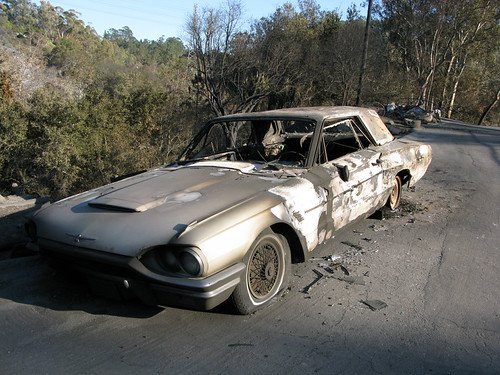
That T Bird wasn't cherry
But it had major potential
I wonder if it's still salvageable?
I bet the frame is all warped from the heat
Wait a minute...how do we know that possum is really dead?
LOL
That is what my friend said when I told him I found a dead opossum (my bad..i thought it was possum)
We both chuckled :D
 
My OCD kicks in when it's time to leave the fire. I handle it similar to how the OP handles it. I need to know that I am doing the best I can to ensure I'm not respsonsible for anything bad happening to Mother Nature.
 
I agree with teaching the importance of making sure its all the way out. I ran a small class and told my students (also my fellow staff) that they needed a plan to put the fire out before they should light it. half failed. I've seen a ground fire before, a small one, but still pretty scary. and it was in a place that has been a burn pit for decades.

the only time I've been advised to leave a fire burning is on the tundra, it probably wont go far if it does spread, and it really sucks to get your fire all the way out and find that the snow-mobile won't start or the dogs have left you behind.
 
Back
Top