Over the weekend I went to the 5th annual Fire & Brimstone Hammer-In in Marriottsville, MD. My goal was to study with Jeff Pringle and try to learn the secrets of crucible Wootz production. As he has two methods he uses, I wanted to make an attempt at both remelting iron as well as direct reduction from ore in a crucible.
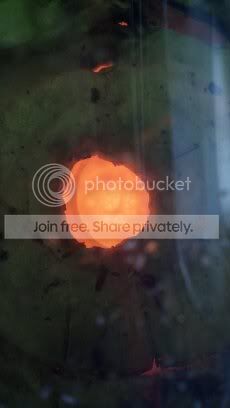
The first melt was a smashing success. We used a #10 silicon-carbide crucible for this run. The charge was 2 kilos of wrought iron (mostly old stock wrought nails, some iron bar we scavenged at a local lime kiln, and a little old wagon tire) with about 300 grams of charcoal fines. That was topped off with some smelting slag from last year and a beer bottle to give us some quick melting slag to keep the charcoal fines from burning off.
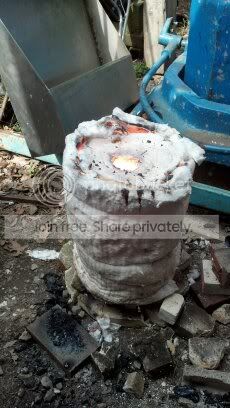
Into a Jeff Pringle special smelting furnace it went. These are field-expedient furnaces made of a quick roll-up of 2" high-temp kaowool rolled up into a "shell" and then a spiral of kaowool rolled up for the lid. All of this is held together with bailing wire and set on a stack of hard firebrick with a plinth of hard brick for the crucible. A quick iron pipe burner is stuck through the side and fed with a shop-vac and propane.
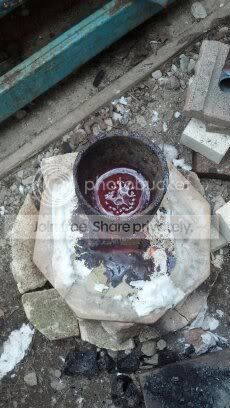
You can see the furnace (in pieces) here next to a cooling crucible:

Here are some more pictures (Click for the super giant sized version):
First Wootz puck of the event.


Look at those dendrites!


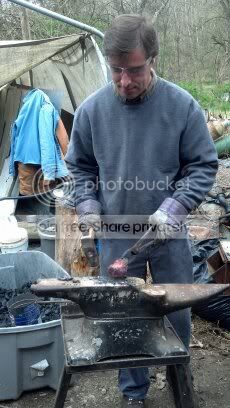
From a 2kg charge we ended up with a 1.9kg ingot. Not bad yield all things considered. After 2 normalizing heats we cut a section off to test forge. Initial indications point to this being a forgeable ingot, though it will REALLY be a test of my patience to not destroy it. It sparks very well and seems to be quite high carbon.
The second run was direct reduction of ore in a crucible. The charge was 1.5kg of magnetite ore (that was sold as magnetite, but had some other stuff in it apparently). To that we added .75kg of charcoal fines and topped it with slag from the previous run and bottle glass. Due to the "extra" stuff in the ore charge this one never went liquid. We tried bombing it with extra silica sand, charcoal, and borax to try and flux it into melting, but it just wouldn't go. We did manage to make a bunch of BBs and a very small puck of Wootz (about the size of a silver dollar). I took the BBs and re-melted them in another run. Given another chance, I'd do a magnetic separation of this ore and it would probably work fine.
The third run wasn't mine, but was done by Jeff and Chris Price. The feedstock for that one was meteoric iron (Campo de Cielo) and charcoal. It formed a nice puck with a very interesting surface coloring(best guess was that it was caused by the slight bit of iridium in the iron), but sadly it had some micro porosity at the grain boundaries and so will likely need to be re-melted.
The fourth smelt was direct reduction of taconite pellets collected Sunday morning from the train tracks near the event. Ore cars drop them pretty regularly so a 15 minutes scavenger hunt gave us about 4 kilos of ore. Charge was 1.5kg of taconite and about 600g of charcoal fines (we ran out of space in the crucible, more charcoal could have been added, but didn't seem to be needed due to the ore melting so nicely). This produced a nice little puck which I haven't had a chance to weigh yet but I'd estimate to be about 1kg. It sparked well but forging tests haven't been done yet.
The fifth(!) run of the weekend was of iron (nails and bar) and charcoal with all measurements made by eye as the scale had left with its owner by that time. Due to the concerns raised by the micro-porosity in Chris' smelt, this one was killed with aluminum TIG rod just before cooling to solid. Another nice, solid puck with great dendritic structure and good spark. It went in the iron-in-the-hat and was won by Aldo.
Here's a picture of the weekend's output:

More info as I work on my 2 pucks....
-d
The first melt was a smashing success. We used a #10 silicon-carbide crucible for this run. The charge was 2 kilos of wrought iron (mostly old stock wrought nails, some iron bar we scavenged at a local lime kiln, and a little old wagon tire) with about 300 grams of charcoal fines. That was topped off with some smelting slag from last year and a beer bottle to give us some quick melting slag to keep the charcoal fines from burning off.
Into a Jeff Pringle special smelting furnace it went. These are field-expedient furnaces made of a quick roll-up of 2" high-temp kaowool rolled up into a "shell" and then a spiral of kaowool rolled up for the lid. All of this is held together with bailing wire and set on a stack of hard firebrick with a plinth of hard brick for the crucible. A quick iron pipe burner is stuck through the side and fed with a shop-vac and propane.
You can see the furnace (in pieces) here next to a cooling crucible:
Here are some more pictures (Click for the super giant sized version):
First Wootz puck of the event.


Look at those dendrites!


From a 2kg charge we ended up with a 1.9kg ingot. Not bad yield all things considered.
After 2 normalizing heats we cut a section off to test forge. Initial indications point to this being a forgeable ingot, though it will REALLY be a test of my patience to not destroy it. It sparks very well and seems to be quite high carbon.The second run was direct reduction of ore in a crucible. The charge was 1.5kg of magnetite ore (that was sold as magnetite, but had some other stuff in it apparently). To that we added .75kg of charcoal fines and topped it with slag from the previous run and bottle glass. Due to the "extra" stuff in the ore charge this one never went liquid. We tried bombing it with extra silica sand, charcoal, and borax to try and flux it into melting, but it just wouldn't go. We did manage to make a bunch of BBs and a very small puck of Wootz (about the size of a silver dollar). I took the BBs and re-melted them in another run. Given another chance, I'd do a magnetic separation of this ore and it would probably work fine.
The third run wasn't mine, but was done by Jeff and Chris Price. The feedstock for that one was meteoric iron (Campo de Cielo) and charcoal. It formed a nice puck with a very interesting surface coloring(best guess was that it was caused by the slight bit of iridium in the iron), but sadly it had some micro porosity at the grain boundaries and so will likely need to be re-melted.
The fourth smelt was direct reduction of taconite pellets collected Sunday morning from the train tracks near the event. Ore cars drop them pretty regularly so a 15 minutes scavenger hunt gave us about 4 kilos of ore. Charge was 1.5kg of taconite and about 600g of charcoal fines (we ran out of space in the crucible, more charcoal could have been added, but didn't seem to be needed due to the ore melting so nicely). This produced a nice little puck which I haven't had a chance to weigh yet but I'd estimate to be about 1kg. It sparked well but forging tests haven't been done yet.
The fifth(!) run of the weekend was of iron (nails and bar) and charcoal with all measurements made by eye as the scale had left with its owner by that time. Due to the concerns raised by the micro-porosity in Chris' smelt, this one was killed with aluminum TIG rod just before cooling to solid. Another nice, solid puck with great dendritic structure and good spark. It went in the iron-in-the-hat and was won by Aldo.
Here's a picture of the weekend's output:

More info as I work on my 2 pucks....
-d