First contact with knife making

Joined
Aug 25, 2006
Messages
61
Hi all,
I've been a knife aficionado for quite a few years now, and since I like to work metal (been into chainmails in the past) I think I'd enjoy knifemaking.

I've been searching the forums and the net a lot but was just finding some bribes of informations here and there. These could mostly get me started to some extent but I'd like to get some more specific/detailed info.

Actually I think it's the kind of info that anyone like me that wants to get started in this would find useful. I'm moving from my apartment to my new house this summer, so I'll be able to setup a decent working place (I've been waiting for this!). However I'll be starting from scratch with no tools.

Of course I'd start small, to learn the basics, and won't be able to afford big powertools from the start, so that's why I need advice about where I should start, considering I'm on a budget.

I'm sure that in order to help me out you'll need to have some questions answered regarding my situation, so ask away as I'm not sure about what you need to know.

I'm taker for any kind of informations and advices

Thanks

O.
 
The first thing many would suggest here is to fill out your profile. There is a good chance you might be able to find a maker near you that you might be willing to help out in person.

You can get started with minimal tools. Hacksaw, files, sandpaper, some spring clamps, c-clamps, and a drill can pretty much get a knife made. Assuming you're going to go the stock removal method.
 
Thanks for the tips
Profile filled out :)

I assume stock removal would be the way to go as a starter - How should I consider the heat treating part regarding stock removal? Mandatory/Recommended/not needed?

Thanks

O.
 
You will be better off sending it out for Ht if you want to be safe. I am not sure who you could send it to in your neck of the woods. Good luck!
 
Yeah the HT is pretty much mandatory, I'd send it out most likely. Of course it also depends on the steel you're planning on using as well, something like a stainless you'd probably be better of sending out. Either way doing it on your own would require either a forge or a HT oven. We have a few Canadian members on here, they might chime in on here with some more info on HT. You can also check Unky_Gumbi's WIP thread. He's in Canada and I think he mentioned where he got his HT done in there for his knife.
 
Last edited:
There is some great information available in the stickies at the top of this forum. I know there are some dead links here and there, but again, a lot of good resources.

A helpful searching hint: type in your search in google followed by {site:bladeforums.com} with the brackets removed.

Remembering back to when I first started researching the making of knives, I thought I'd give you a general synopsis of the steps required to make a knife.

1. Find your blade material. This could be anything from a pre-formed, pre-heat treated blade (i.e. a "kit" knife) which you finish with a handle all the way to the latest and greatest high tech stainless steel. A suggestion to make your life easier would be to use a known steel. The reason for this is explored later in the list, but suffice it to say the each steel has a specific requirement for heat treatment. Good steels to start with include 1084 if you're heat treating yourself or pretty much any steel if you're sending it out (though air hardening are easier to have heat treated...these would be typically your standard stainless steels of 440C, ATS34, 154CM, etc).

2. If you didn't opt for a pre-formed blade blank, you next have to layout your design and shape your blade profile. You can layout with anything that will mark steel including a scribe or a sharpie. Shaping also comes in many forms. You can use a drill to make holes around the outline of your blade, and then use a hacksaw to "connect the dots". Or you can use an angle grinder to get close to your profile and then clean it up with files. Or you can use a belt grinder.

3. Now you need to layout and drill holes for your handle pins/bolts/tubing/etc. You can manage this with a good drill bit and a hand drill, or a drill press is just that much easier. Do not wear gloves at the drill press, and DO wear eye protection. Also, clamp your blade down so it doesn't become a spinning blade if the bit seizes.

4. Now the tough part: shaping the bevels. Without power tools, you accomplish this with a file. A chainsaw file is helpful to establish your plunges, and then a flat file can be used to start removing the material. You can finish by draw filing. If you do some searching for these topics, you will find plenty of suggestions, tips, jigs, etc. A faster way to do it is with a belt sander. Many makers start with something like a Craftsman 1x42 or similar and then upgrade to a 2x72 at some point.

A good tip is to clean your file on a file card after every one or two passes to keep from galling your work. Also, chalk in the file tends to help it cut longer between clogs.

Also, take your edge down to just a tad thinner than a dime before heat treating.

5. After you have your blade shaped, you can do some sanding to further smooth out the deep filing marks. Get something flat to back your sand paper and go to work. Use some kind of fluid (cutting fluid, WD40, motor oil) to help keep the grit in suspension longer. Use sandpaper like it's free.

6. Now you're ready for heat treatment. At this point, many new makers send out the blades for heat treatment. This is where working with known steel comes in. Each steel has a specific heat treating recipe. And yes, all steel needs to be heat treated to make a servicable blade. The reason Lowe's or Home Depot's weld steel will not make a knife is because it doesn't have enough carbon. Steel, in its most basic form is iron and carbon. You have to have enough carbon to harden the steel appreciably. There are many other alloying elements that are added to various steels to create specific properties that also effect heat treatment. This is why knowing what steel you have is imperrative. My suggestion is to send it out for heat treatment, or build a simple small propane forge (maybe a two brick forge) with a baffle to use in heat treating. Regardless, temperature control is important. Overheating can cause bad effects that will make your knife brittle. Not enough heat and you don't harden. 1084 is a good beginner steel because it has a critical temperature very near where the steel becomes non-magnetic. It is just a bit higher, but you should be able to get very close to the ball park using a magnet. After the entire blade becomes non-magnetic and evenly colored, you can quench the blade in something like canola oil (probably fast enough for 1084 in the thickness of a knife). Don't think, however, that all steels will harden just fine in canola. Some need a faster quench (formulated oils), some need a slower quench (air or plate). Again, it depends on your steel.

After hardening (heating to critical and quenching), you need to temper the blade to make it less brittle. This is done at much lower temperatures (generally in the 400-500F range), and it releases some of the stress from the steel, lowers your hardness, and creates a servicable blade. If you send your blade off, this will be done as part of the heat treating service. If you do your own, you typically temper for 2 hours, 2-3 cycles dpending on the steel. The temperature also depends on the steel and your target hardness.

7. Now that your blade is hardened, you have to do some finish sanding to remove oxidation or scale from your blade and get things just right. Once you have your blade where you want it, tape it up to prevent scratches.

8. Next you have to apply a handle. There are full tang knives, hidden tang knives, slot tang knives, etc, etc. Most likely your first attempt will be a full tang which just uses scales attached to either side of the handle tang. Mark your hole locations in your handle material and drill them. Next shape the front of your scales where they will meet the ricasso. Next, epoxy you scales to the tang along with your pins/bolts/tubes/etc and let it cure for a day. Use a slow cure two part epoxy. Many makers have used Devcon 2-ton, though it's not the toughest.

9. Now that the handle is affixed, you have to shape it. Use a sander, files, sand paper or whatever you have to accomplish that.

10. Finally, sharpen your blade and get to cutting.

This is a very crude, limited list of the rough steps needed to make a knife. It's likely I've even left out some important part in my haste of typing; however, it will give you the idea. Keep in mind that there are MANY ways to accomplish the same thing, so my methods aren't necessarily everyone's and vice versa. Geometry of the cutting edge is vital in performance as is the heat treatment. That's why the emphasis on using known steel and getting an accurate heat treatment.

I hope this gets you started with some good search topics. Read what you can, and visit nearby makers to learn from them. Soak up the information, and learn from your mistakes. And HAVE FUN!!!

--nathan

 
Wow Nathan, this is a hell of a post, and exactly what I was looking for! Thanks for all these info, this will indeed help me a lot to get started. Also thanks to Flex and Panch0 for your recommendations, I'll consider them for sure when the time comes!

Nathan, I'd even suggest you make a sticky with a copy of that post, as I'm sure it would help others like me. Even if all the info is not here, it's already plenty.

I did read the stickies already, before starting that thread, but didn't find them quite relevant or clear enough on some points considering my needs/situation. And that's without talking about the many dead links :P

Another question if you allows me to ask:
If I were to buy some power tools as a starter point, that could also be used for misc work in the house (read renovations and the like) is there anything that you'd recommend? What about a bandsaw or a scroll saw (which one would be best?) or maybe a Belt Grinder, if I can find one used that's not too expensive that is?

Again, thanks a lot to all of you guys for your inputs, and don't be "impressed" by Nathan's big post, I still want the input from other sources too!

O.
 
read these books

http://www.bladeforums.com/forums/showthread.php?t=603203


There are some excellent videos and books in the public domain that you can access with torrent files.

Look here for the Green Pete video for a very simple approach to a handmade knife.
http://thepiratebay.org/user/KnifemakerC/

I see that you are in Quebec
http://www.knifemaker.ca/
Rob at the link above is a good Canadian source of supplies and also does heat treatment.

Pat is also from Quebec
http://www.bladeforums.com/forums/member.php?u=121729
http://www.lemeeknives.com/

and
if you can make it to Toronto this Saturday
http://www.ckg.org/
2010-spring-show-flyer-772x1024.jpg
 
Last edited:
As for starter power equipment...I would say a drill press and a belt grinder would be good to start. You don't need a huge drill press, but a 10" or 12" benchtop from the home improvement store goes a long way. Also, as for belt grinder, there are a number of options including building your own. However, if you just want something that is useful for a variety of tasks and can also get you started in knife making, a 2x42" from Sears would probably be my choice. If you wanted a bandsaw, you could get a portaband metalcutting bandsaw, mount it upright and make a sturdier table for it. It's space saving and will cut whatever you need it to. Check out my shop tour on my website for an idea. Or a 4x6" horizontal/vertical bandsaw is also a good option, but takes much more space. Both can be had at Harbor Freight for cheap.

So for overall usefull tools that don't break the bank, I'd say a drillpress, 2x42" belt grinder, and maybe a portaband (or even an angle grinder).

--nathan
 
Great, thanks!

Seems there's a lot of options from which I'll have to make choices.
About Belt Grinder: Can't seem to find anything similar to what I see on the net in stores like Sears, HomeHardware/HomeDepot, etc.

My idea of a Belt Grinder is this: http://bit.ly/bMyK6h Of course I can't really afford paying 800$+ for this so could there be some kind of alternative out there I'm not aware of?

Also, thanks to [bunch_of_numbers] (just Kidding, thanks to 1234567890 :P) for the book links! Will be reading them for sure!

O.
 
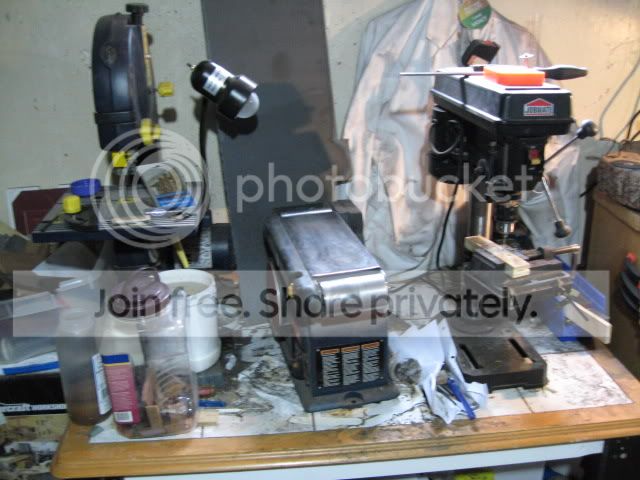
I only have a 4" x 36" ginder that I bought at Home Depot for around $100 a few years ago. I wish that I learned long ago how efficient the disk is (cheap grinding disks at Princess Auto in 120 & 220 grit). I believe I bought good belts for it online from Supergrit that have worked well enough considering the limitations of the machine. A cheap drill press from Canadian Tire, a small vice, a couple of clamps (don't clamp too hard or you will squeeze out the epoxy and it won't be able to do it's job), files and sandpaper and after that you decide if knifemaking is for you! It will be slow but I feel that in the beginning that is a good thing.

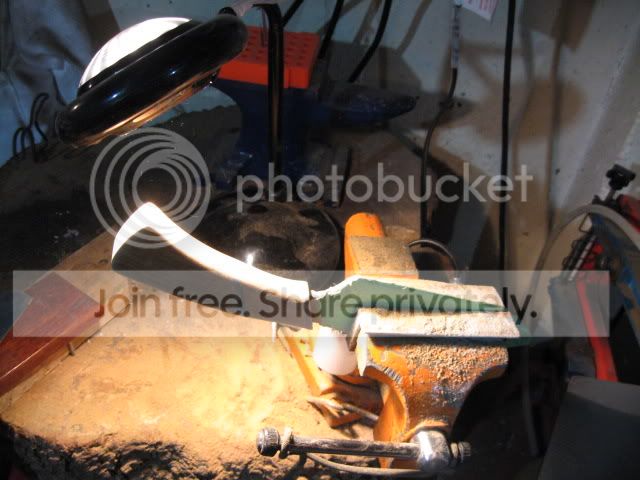
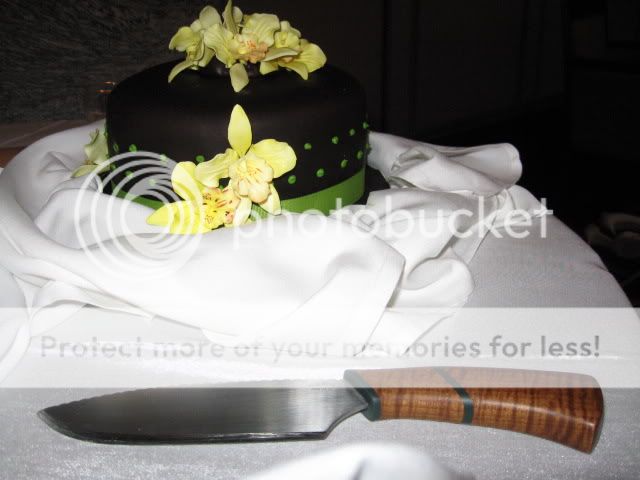
Here is my setup (and my last knife):
IMG_4705.jpg
(I never use the bandsaw except as a table and light)
IMG_4873.jpg

IMG_5081.jpg


I don't know the knifemakers from the east but knifemaker.ca is who I get the majority of my supplies and heat treating from,and they have been great.
 
O, if you have access to taps and a drill press or have a friend who's handy with tools, you may check out the Grinder-In-A-Box kit on the For-Sale forum here. I have one nearly completed, and it's a solid piece of work. I made knives for years before I finally afforded the KMG (and I paid way more than $800 to get what I wanted ;) ). I started on a Grizzly 2x72" (I still use it all the time) which runs in the $600 range. Coote's also run in that range. If you can wait a while, there's a new grinder being worked on my Tracy Mickley and David from Great Lakes Water Jet that's going to be a nice system.

http://www.knifedogs.com/showthread.php?t=5925&page=8

I don't know the cost on it, and they're still in the development phase.

I have three 2x72" now, and I love 'em all :D. It's hard to go wrong with one. If you're industrious, you should search for the NWG (No-Weld Grinder). Tracy sells them on his site (www.usaknifemaker.com). It's a design based on the KMG and can be bolted or welded together to make a good grinder for anywhere from $300-$600 depending on how industrious you are in coming up with steel and parts.

--nathan
 
Great knife Cuts_Like_A_Kris! Thabks for your input too

I have the luxury of waiting to see the pricepoint of that new grinder as I'll have access
to the house from June 1st only, thanks for the tip! Also I'll hace a lot of work to do in the house before I can get to knives... It's a shame! :P In the meantime I'll probably start hunting down a drill press, vice and such

thanks again guys

O.
 
There is some great information available in the stickies at the top of this forum. I know there are some dead links here and there, but again, a lot of good resources.

A helpful searching hint: type in your search in google followed by {site:bladeforums.com} with the brackets removed.

Remembering back to when I first started researching the making of knives, I thought I'd give you a general synopsis of the steps required to make a knife.

1. Find your blade material. This could be anything from a pre-formed, pre-heat treated blade (i.e. a "kit" knife) which you finish with a handle all the way to the latest and greatest high tech stainless steel. A suggestion to make your life easier would be to use a known steel. The reason for this is explored later in the list, but suffice it to say the each steel has a specific requirement for heat treatment. Good steels to start with include 1084 if you're heat treating yourself or pretty much any steel if you're sending it out (though air hardening are easier to have heat treated...these would be typically your standard stainless steels of 440C, ATS34, 154CM, etc).

2. If you didn't opt for a pre-formed blade blank, you next have to layout your design and shape your blade profile. You can layout with anything that will mark steel including a scribe or a sharpie. Shaping also comes in many forms. You can use a drill to make holes around the outline of your blade, and then use a hacksaw to "connect the dots". Or you can use an angle grinder to get close to your profile and then clean it up with files. Or you can use a belt grinder.

3. Now you need to layout and drill holes for your handle pins/bolts/tubing/etc. You can manage this with a good drill bit and a hand drill, or a drill press is just that much easier. Do not wear gloves at the drill press, and DO wear eye protection. Also, clamp your blade down so it doesn't become a spinning blade if the bit seizes.

4. Now the tough part: shaping the bevels. Without power tools, you accomplish this with a file. A chainsaw file is helpful to establish your plunges, and then a flat file can be used to start removing the material. You can finish by draw filing. If you do some searching for these topics, you will find plenty of suggestions, tips, jigs, etc. A faster way to do it is with a belt sander. Many makers start with something like a Craftsman 1x42 or similar and then upgrade to a 2x72 at some point.

A good tip is to clean your file on a file card after every one or two passes to keep from galling your work. Also, chalk in the file tends to help it cut longer between clogs.

Also, take your edge down to just a tad thinner than a dime before heat treating.

5. After you have your blade shaped, you can do some sanding to further smooth out the deep filing marks. Get something flat to back your sand paper and go to work. Use some kind of fluid (cutting fluid, WD40, motor oil) to help keep the grit in suspension longer. Use sandpaper like it's free.

6. Now you're ready for heat treatment. At this point, many new makers send out the blades for heat treatment. This is where working with known steel comes in. Each steel has a specific heat treating recipe. And yes, all steel needs to be heat treated to make a servicable blade. The reason Lowe's or Home Depot's weld steel will not make a knife is because it doesn't have enough carbon. Steel, in its most basic form is iron and carbon. You have to have enough carbon to harden the steel appreciably. There are many other alloying elements that are added to various steels to create specific properties that also effect heat treatment. This is why knowing what steel you have is imperrative. My suggestion is to send it out for heat treatment, or build a simple small propane forge (maybe a two brick forge) with a baffle to use in heat treating. Regardless, temperature control is important. Overheating can cause bad effects that will make your knife brittle. Not enough heat and you don't harden. 1084 is a good beginner steel because it has a critical temperature very near where the steel becomes non-magnetic. It is just a bit higher, but you should be able to get very close to the ball park using a magnet. After the entire blade becomes non-magnetic and evenly colored, you can quench the blade in something like canola oil (probably fast enough for 1084 in the thickness of a knife). Don't think, however, that all steels will harden just fine in canola. Some need a faster quench (formulated oils), some need a slower quench (air or plate). Again, it depends on your steel.

After hardening (heating to critical and quenching), you need to temper the blade to make it less brittle. This is done at much lower temperatures (generally in the 400-500F range), and it releases some of the stress from the steel, lowers your hardness, and creates a servicable blade. If you send your blade off, this will be done as part of the heat treating service. If you do your own, you typically temper for 2 hours, 2-3 cycles dpending on the steel. The temperature also depends on the steel and your target hardness.

7. Now that your blade is hardened, you have to do some finish sanding to remove oxidation or scale from your blade and get things just right. Once you have your blade where you want it, tape it up to prevent scratches.

8. Next you have to apply a handle. There are full tang knives, hidden tang knives, slot tang knives, etc, etc. Most likely your first attempt will be a full tang which just uses scales attached to either side of the handle tang. Mark your hole locations in your handle material and drill them. Next shape the front of your scales where they will meet the ricasso. Next, epoxy you scales to the tang along with your pins/bolts/tubes/etc and let it cure for a day. Use a slow cure two part epoxy. Many makers have used Devcon 2-ton, though it's not the toughest.

9. Now that the handle is affixed, you have to shape it. Use a sander, files, sand paper or whatever you have to accomplish that.

10. Finally, sharpen your blade and get to cutting.

This is a very crude, limited list of the rough steps needed to make a knife. It's likely I've even left out some important part in my haste of typing; however, it will give you the idea. Keep in mind that there are MANY ways to accomplish the same thing, so my methods aren't necessarily everyone's and vice versa. Geometry of the cutting edge is vital in performance as is the heat treatment. That's why the emphasis on using known steel and getting an accurate heat treatment.

I hope this gets you started with some good search topics. Read what you can, and visit nearby makers to learn from them. Soak up the information, and learn from your mistakes. And HAVE FUN!!!

--nathan

Dude, seriously, that was perfection. Thank you.
 
I do think that was one of the largest posts I've ever typed. :D. And as I said, it's just a general idea, and there are many ways to skin this cat. But I thought it might be helpful for someone just starting out.

--Nathan
 
Back
Top