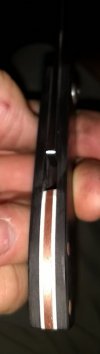
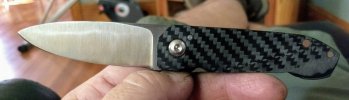
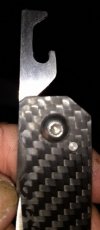
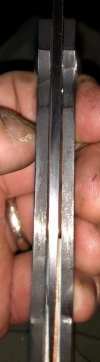
You will get to make a cool knife and learn how to make a corkscrew. The biggest mistake is making the spiral taper in pitch or diameter. The screw needs to enter in one place and spiral down without any pitch or spacing change. If there is, it will tear up the cork. Many cheap commercial corkscrews have this problem, and are horrible at pulling a cork.
First you need to learn to make regular corkscrews. These are fun to make, and make great gifts. They sell easily at $20. I recommend measuring several corkscrews and seeing the dimensions you need to achieve.
It is easiest to start on a 1/4"round mandrel, and after getting the hang of it, go to a 3/16" mandrel. Make a bunch with about a 3" tang piece sticking out from the spiral. Don't worry about turning the tang up yet. As you get good at making corkscrews, try making them in 14 gauge. The ones that will fit a knife will be 14 or 16 gauge, and obviously the HT will need to be well worked out by then.
The best way to learn is to get several two or three foot long pieces of steel music wire at the hobby shop, or online. This is basically W1/W2 or 1095. 12 gauge is best to start with (.08"/2mm). The trick is to chuck the mandrel rod in the vise ( piece of round brass or steel) and spiral the red-orange hot wire around it. You need to drill a hole though the mandrel to fit the wire. Once about 6" of the wire is hot enough in the forge - stick the end through a bit, and wind tightly 5 or 6 turns. Cut the wire tail at about 3" long ... and make more. Cut off the part through the mandrel and clip the wire stock to leave a 3" tang. When you have made a batch of these, Heat up to red and open the spiral into the corkscrew. Use a screwdriver to do it, and use a small torch to aid in heat. Take the spiral end and shape the tip with a 1/4" taper to a sharp tip. All these final shaping steps are done with localized heats, and a small torch works well. Next, shape the tang. Turn it in so it forms a line across the spiral, then turn the tang up to make the tang shaft. The spiral should be close to concentric on the tang. Reshape the whole thing until it looks right. Once the corkscrew is shaped to your liking, turn the tang at 90° about 1.25" above the screw. The tail if the angle should be at least 1" long. The HT is where a corkscrew sails or fails. Do the HT as if the steel was 1095, quench in oil, and then temper around 500F. This should give a good spring temper. Play with it if you have too soft/too brittle issues.
Make the handle from a 3-4" long round piece of wood that you will split in half. An inlet a channel for the tang will hold the corkscrew tang. Two 1/8" pins add strength and keep the alignment.
The easiest way to make the handle is on a lathe. Make a spindle with 4 or 5 on one piece of turning stock and leave them connected with just a small cut to mark each cut point. It is easiest to make a batch of these while you are turning. I suggest making a dozen handles. 1" exotic wood turning stock is often sold in bundles and comes out to less than a buck a handle. Shape each handle segment as you wish, but leave about 2" of the turning stock square on both ends. Drill the pin holes all the way through from one side, using the square ends as a reference. Turn 90° and split the spindle in half on the bandsaw with a cutting sled. Try to make the cut 1mm off center so the corkscrew will end up centered exactly when assembled in the inlet. Temporarily stick some pins in the holes, and cut the spindle into separate handles. Inlet one half of each handle with a ball burr and have the tang pass just over the pin hole. The inletted channel should be an "L". It is easier to do the inletting on the long piece before cutting into individual handles if making batches of them.
For super simple practice handles, a 3" to 4" piece of 1" maple or walnut dowel will work fine.
Once you have all that mastered, you can play with starting with 10 gauge wire and forging a taper into the wire. This will allow a strong shank and a thinner spiral.