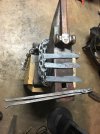
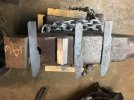
You are a brave man Josh, practicing with DH3's W2. I think you did a fair job. Before you even light the forge, have a plan. Know the steps you are going to go through. Know if you are making a full tang or hidden tang blade. Going with the flow is ok. A blade will sometimes suggest for you to try something a little different. But remember, you are the one holding the hammer. You're giving the orders. If you watch experienced forgers you will notice that they are constantly working all sides of the work piece. Don't let one side get too far away from you before correcting it. Keep your thicknesses in control. Keep correcting the profile. Don't work a section until you are ready for it.
If you are starting with round stock, begin by making it bar stock (unless you are going for the round ricasso integral thing). From bar stock, start by tucking in your square corners at the tip so you don't form a fish mouth. Then make your preform to compensate for the rise of the spine when creating the bevels. Limit your work to the blade area until your taper, bevels and profile are done. Again, keep the piece moving and correct the profile and thicknesses as you work. Don't swing the hammer wildly. Pay attention to the angle of the hammer face in relation to your work to avoid putting unnecessarily deep marks in your work. If you do put deep marks in, take the time to smooth that out. Don't drop the hammer randomly on the work. Place your blows methodically and in a controlled manner as you work the bevels. Place one blow next to the last, overlapping blows slightly. Use approximately the same number of hammer blows and of the same force on both sides of the blade so you don't introduce uneven stresses into the steel. When you are finished with the blade, move to forming the ricasso, then to the tang. Towards the end you can go over the whole knife straightening and tweaking until you are happy.
Your pieces look good. They just need some more work which should be no problem. Keep posting the progress.