First Framelock - stop pin help

Joined
Aug 12, 2006
Messages
1,302
Lately the urge to try and make a framelock flipper has been too strong to fight. I made a working mock-up out of aluminum and I like it enough to want to do it for real. Like many though, the intimidation factor is also strong. Part of what overwhelms me is the materials shopping list. There are lots of options at the various suppliers but I'm having a hard time getting a grip on the sizes of the various hardware I need. So, can any experienced folder maker help me with a specific shopping list? Steel and titanium I should be okay with. Steel will be about .14" and titanium about .15". I wanted to go the bearing route but thought I should keep it simple and opt for phosphor bronze.

So...
1) Washers come in thicknesses of .005, .010 and .015. Benefits and drawbacks?
2) Pivots - I'm leaning towards .25" and was actually looking to see if I can find a length of 1/4" treated stainless rod already tapped to a 6-40 and make my own. Any tolerance issues going this route?
3) Standoffs - I need two. I want to go with flat heads flush with the Ti. I think the simplest thing would be a threaded barrel with a recessed screw on each end. Any advice?
4) Detent ball - Size recommendations?
5) Stop pin - Needs to be solid. Press fitted?

Thanks!
 
Last edited:
Well, here is a bit of stuff that should help.
You will need a detent ball - 1/16. If you leave it .010 high then you will need .015 washer minimum to clear as the blade rotates.
The 1/4 pivot will work if you have built the necessary pivoting clearance into your pattern.
Two stand offs for such a big knife is to me very under what should be used. They not only keep the liners apart but help to provide overall handle rigidity . Better to have the flat head screws go through non threaded stand offs and thread into the opposite scale.
Sorry, I'm not sure how or where you are using the stop pin, since this is a flipper. I hope this can get you started. If your pattern pieces work, then you should be fine. Frank
 
Im currently in the same boat. I want to start making a folder, but can't get past the drawing. One thing that is helping me, is taking all the folders I own an putting new scales on them. Its helped me with troubleshooting and getting use to taking the knife apart and putting it back together.
 
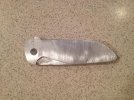
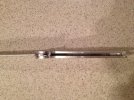
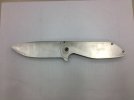
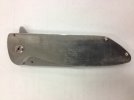
Thanks Frank! That does help. A lot. I didn't consider the washer thickness in relation to the detent. I was thinking more along the lines of a thicker washer to prevent the blade rubbing when closed. There is plenty of room for 1/4" pivot. I can probably have the stop pin act as the third standoff as long as I keep it around 3/16", which is what's in there now. Being that the pivot also would act as a standoff, though, is the stop pin too close to be effective as a standoff? what i mean is should the third standoff be somewhere at the the mid point of the handle? that might be tricky in my design. It's hard to see the stop pin in the picture but it's right above the pivot. The other two standoffs are on the butt.

The flipper trigger would have been a little bit bigger but I only had a 1.5" bar of aluminum to work with. I turned the pins in my drill out of the same piece of aluminum and the current pivot is just some Instamorph. The blade shape isn't final but it is close just lacking some details. The final blade will be a FFG and nearly 1/4" longer but I somehow broke the tip off of the model.

I never considered a screw from one side only for the standoffs. How does that work? An unthreaded barrel with the screw going through it from one side right into a thread on the other side and sanded flush? Would the same procedure work for the stop pin?

closed.jpgphoto-120.jpg

Damn. I couldn't upload my video because it's only on my hard drive.
 
Last edited:
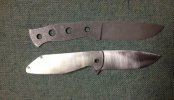
After work Friday I profiled the knife out in both Ti and S35vn. Saturday morning I put it all together and headed for the knife show in Jersey. I figured why not solicit opinions from some guys whos work I admire. Darrell Ralph spent the most time with me and offered up a some great advice so I went home and modified the profile a little bit with their input. A big thanks to Jeremy Horton, too.

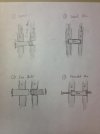
One thing that is still bothering me is what to do with the stop pin. While press fitting will probably be easy I'm not sure how well that would lend itself to an easy disassembly. Strength is the primary concern followed by ease of instalation. So hear is a crappy sketch I made with some options (I didn't draw a press fit). I purposely left out shouldered pins because of the difficulty of adjustment. Right now the proto is like sketch #4 but I can easily go to #2 if it will be stronger. I haven't seen #1 before but I thought it would be interesting to try but might have a problem with too much available adjustment. Stop pin.jpg

Other problems with #1, finding a hardened screw the right size that I can chuck in a drill and turn down the threads to make the shank smooth for 3/10".

BTW - I am now shooting for a pin with an OD of .125" but may just add a stop/stud to the blade.
 
I like that no 3. It's simple and I know from, experience that it works. Your pivot is going to provide the spacing needed. And after rereading your material thicknesses I believe the two stand offs will work well. Yes that will require taping the far side, but if you use threaded stand offs and try to come on from both sides, you could run into a bunch of trouble due to even a very small misalignment problem. Keep on making! It seems to me you are coming along quite well. That trip to the show to take to makers was a great idea, by the way. With respect for your attitude and desire to achieve, Frank
 
No. 3 it is. Going by what you said earlier on the standoffs I mulled over the idea of a backspacer (or in this case a buttspacer) and the idea has really grown on me. I think it will be slightly stronger and I like the idea of adding a little color to the knife with an orange or whatever color G-10. Even with the buttspacer I like the idea of a single screw tapped into one frame. Although this will probably exacerbate the problem you mentioned.

The next go around I would need to move the stop pin back about .06" which would fix the opened position but of course screw up the closed position. The more I play with ideas the more I realize that absolutely EVERYTHING on a folder is a compromise. I think I may end up going with a combo thumb stud / stop pin in the blade while retaining the current stop pin because I like the idea of the added lateral support and it would make relocating the current stop pin back a little less worrisome.

Is the down side to a large pivot going to be more surface area in contact with the tang making for more friction?

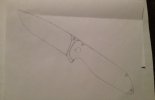
I think a whole book could be written just on lockbars. I believe that Fellhoelter wrote that optimally the (I wish I remembered the terms) radial(?) extending from the pivot center to the outer edge of the lockbar face should be as close to parallel as possible to the lockface. Meaning, pushed towards the front of the handle as much as possible. I don't think my design lends itself to well to this concept. I'll keep tweaking it, though. photo.JPGopen.JPGpair.jpgclosed.JPG

Oh, yes I know all my holes should come in from the edge a little. Rookie mistake.
 
Last edited:
In fact the large stop pin is a good thing. It will help to add stability. I know use 3/16" pivots on all but the very smallest of my folders. That means that one with a 3" blade will have a 3/16" pivot.
What you are saying here in reality is that folders must be planed and that patterns for most of us are essential. Once the pattern is known to be good then you are ready to go ahead.
To me the back bar is essential in liner locks. But, I do not make frame locks with the heavy liners. My back bars go from the back of the knife to the front where the front acts as a stop pin. As well I always make mine out of metal and use at least four screws to keep them in place. You can remove material from the bottom of the blade so that the stop pin will act as the place the blade closes to.
Yes, the "tweaking" is the way to go in advance to starting your real one. Continue to work with your model until you see it works as it should. Frank
 
I think there should be a stern warning somewhere that it takes making a few folders to begin to really understand the geometry- that's why they're so fascinating to build, because there's so much to consider about how all the parts interact.
It's a rocking fun adventure, though!
 
Take a look at take down pics of the Sebenza 25 (in the Chris Reeve forum). The early model (they changed it soon after the release) has a pressed stop pin that might interest you. Another good folder to inspect is the Spyderco Southard flipper. I don't believe it was the first, but it has a stop pin that rides inside a channel in the blade. Very clean design, although probably pretty advanced.

I've owned both, and a number of other designs, and the two above stand out as excellent solutions.

Oh, may as well look at the Strider SnG too. I'm not a big fan of the knife, but the design is solid.
 
There are some excellent books on making folders. A few are really pricy, but others are affordable. There are good videos, too.
 
Mike Vagnino has a really good little booklet that gives you all the basics of a liner lock for about five bucks.
Some of the best money I've ever spent, and most all of it would apply to what you're doing.
 
I'm going to check out some of the books mentioned and my buddy Leif (BF member) is letting me borrow some videos. It's funny you mentioned the Spydy Southard because since I'm having such a hard time locating the stop pin I was deliberating going with an internal. Yes, it's more work but really it doesn't seem to be too difficult to do on a drill press with the right tooling. However, a channel in the tang has inherant strength issues so I was thinking to go the other route. I haven't seen it but I'm sure they're out there, a pressed stop pin in the tang and a C channel part way through each scale. I think it would be much stronger because there is more material left around the channel and the reduction of heat risers around the channel if it were in the blade. It really is much more time consuming to do it this way so please let me know if the effort is worth it.
 
Back
Top