

- Joined
- Feb 26, 2016
- Messages
- 65
This was my first attempt building a hidden tang. This is also my first post, so If I've committed an egregious forum error of some kind, I apologize. I’m always so thankful to all the people, across many disciplines, who take the time to post informative videos, build-alongs, or DIY projects to the web. So, despite my timidity, I’ll try to add some value to the world as well, even if through my mistakes.
I decided to keep the design simple since I was dealing with several new challenges in this build. Initially I wanted to run the tang through the pommel and peen it over for a more traditional build. The steel is O1 and knowing that it is semi-air hardening I conducted some tests with a small sample. Despite all my efforts it proved completely unyielding once exposed to any heat. I tried heating to critical and submerging it in vermiculite as well. I considered brazing on a threaded tang but ultimately opted to build it in a manner similar to the Ka-Bar.
So here is the brass guard setting up on the blade with JB Weld. I wanted to solder it, but haven’t yet achieved the results I’m looking for on test samples.
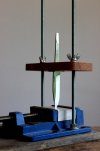
I wasn’t satisfied with the fit of the first guard, and so practiced again with a piece of 1/8” micarta. The second attempt went much better, so I cut another piece of brass and gave it a go. The third effort yielded a nice tight, perpendicular fit. My primary weapon of choice was a warding file, since it is thin and makes a fine cut. As expected a few bumps emerged just lateral to the ricasso during the final hammer fit. I used the micarta guard cut previously as a backing while I hammered on the brass guard to prevent deformation. I removed the guard and polished out the raised burrs with little effort.
I wanted to make a stacked leather handle since I have an abundance of scrap leather, and I’ve always appreciated the look of them. I made the little clamp below to assist.
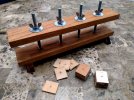
I cut the leather to 1.5” x 1.25” and epoxied them together into small blocks under modest pressure in the vice. Once they cured for a day, I began progressively applying more pressure to compact the leather blocks while I prepared the blade, guard and other materials. My concept was that pre-made blocks of compacted leather could be drilled and filed out for a superb fit, and fewer joints during final handle glue-up would be easier as well.
Once everything was ready I dry stacked all the components, except for the last section of micarta which caps the pommel.
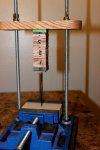
This allowed me to determine how many extra pieces of leather would be needed to achieve the desired tang depth.
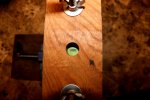
The picture above shows the tang now extending under compression just short of where the pommel cap will be. I took a measurement from the bottom of the wood to the top of the vice as a reference, since during the final glue-up I wouldn’t be able to sight the tang with the cap in place.
Prior to glue-up the pommel cap was secured to the micarta and copper section above it with blind pins and epoxy. I also put some small teeth in the end of the tang with a cut-off wheel.
Once the epoxy set up the first order of business was to get the pin through the pommel unit and tang. I squared the sides of the handle to the aspect of the blade to ensure that the drill bit wouldn’t wander at an angle through the pommel. First, I drilled down to the tang and then stopped as soon as I felt it hit metal. Even though it was never quenched the O1 will want to resist the drill bit, plus its tapered, so I used a carbide tipped Dremel bit in the drill press to make sure I had a good divot IOT prevent the drill bit from wandering. Then I chucked up the 3/32” bit again and continued through to the other side.
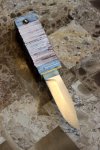
I epoxy and peen the pin with a flat face in an effort to fatten the entire column for a hard fit. I would prefer a threaded or peened tang but for a blade of these proportions I feel its an amply robust build.
To help me shape the handle and keep the organic curves symmetrical I drew out some vector profiles using Inkscape. Its free for download off the web if anyone is interested. Vector programs are so useful.
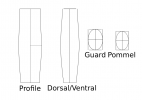
I cut out the guard and pommel profiles and glued them in place on the blade using simple stick adhesive. They remained in place until the very end. Then I placed the cut-out profiles on the left and right sides of the handle and began shaping to those proportions. After that, same thing for the dorsal and ventral sides of the handle.
Once I had a four-sided block of roughly the correct proportions I began taking it down to an octagon. From there I went back and forth between hand sanding and the 2x72 until the shape was satisfactory.
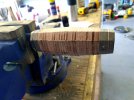
You can still see the vector cut-out glued to the pommel in the picture below.
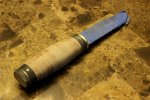
When it came to applying finishes to the leather I decided to stick with known quantities. I used oil-based dye and progressively sanded to finer grits between applications, finishing out at 2000 grit.
Although I like the high gloss of Resolene I decided to use Satin Sheen to add some additional protection to the leather. In my experience Resolene seems to completely seal the leather, which is great, as long as it holds up. However, over time I feel that the ability to periodically condition the leather is beneficial. Satin Sheen provides a nice acrylic base to the leather, but I can still work some wax into it with a little heat from the gun. Once the handle soaked in some wax I sanded with 2000 grit again until it was progressively less sanding and more burnishing.
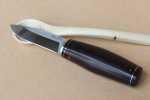
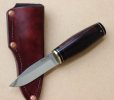
I feel its a pretty high gloss considering I didn't use CA glue. I’ll try to do a better job documenting the process should I post something like this again. Please feel free to throw any advice my way.
Isley
I decided to keep the design simple since I was dealing with several new challenges in this build. Initially I wanted to run the tang through the pommel and peen it over for a more traditional build. The steel is O1 and knowing that it is semi-air hardening I conducted some tests with a small sample. Despite all my efforts it proved completely unyielding once exposed to any heat. I tried heating to critical and submerging it in vermiculite as well. I considered brazing on a threaded tang but ultimately opted to build it in a manner similar to the Ka-Bar.
So here is the brass guard setting up on the blade with JB Weld. I wanted to solder it, but haven’t yet achieved the results I’m looking for on test samples.
I wasn’t satisfied with the fit of the first guard, and so practiced again with a piece of 1/8” micarta. The second attempt went much better, so I cut another piece of brass and gave it a go. The third effort yielded a nice tight, perpendicular fit. My primary weapon of choice was a warding file, since it is thin and makes a fine cut. As expected a few bumps emerged just lateral to the ricasso during the final hammer fit. I used the micarta guard cut previously as a backing while I hammered on the brass guard to prevent deformation. I removed the guard and polished out the raised burrs with little effort.
I wanted to make a stacked leather handle since I have an abundance of scrap leather, and I’ve always appreciated the look of them. I made the little clamp below to assist.
I cut the leather to 1.5” x 1.25” and epoxied them together into small blocks under modest pressure in the vice. Once they cured for a day, I began progressively applying more pressure to compact the leather blocks while I prepared the blade, guard and other materials. My concept was that pre-made blocks of compacted leather could be drilled and filed out for a superb fit, and fewer joints during final handle glue-up would be easier as well.
Once everything was ready I dry stacked all the components, except for the last section of micarta which caps the pommel.
This allowed me to determine how many extra pieces of leather would be needed to achieve the desired tang depth.
The picture above shows the tang now extending under compression just short of where the pommel cap will be. I took a measurement from the bottom of the wood to the top of the vice as a reference, since during the final glue-up I wouldn’t be able to sight the tang with the cap in place.
Prior to glue-up the pommel cap was secured to the micarta and copper section above it with blind pins and epoxy. I also put some small teeth in the end of the tang with a cut-off wheel.
Once the epoxy set up the first order of business was to get the pin through the pommel unit and tang. I squared the sides of the handle to the aspect of the blade to ensure that the drill bit wouldn’t wander at an angle through the pommel. First, I drilled down to the tang and then stopped as soon as I felt it hit metal. Even though it was never quenched the O1 will want to resist the drill bit, plus its tapered, so I used a carbide tipped Dremel bit in the drill press to make sure I had a good divot IOT prevent the drill bit from wandering. Then I chucked up the 3/32” bit again and continued through to the other side.
I epoxy and peen the pin with a flat face in an effort to fatten the entire column for a hard fit. I would prefer a threaded or peened tang but for a blade of these proportions I feel its an amply robust build.
To help me shape the handle and keep the organic curves symmetrical I drew out some vector profiles using Inkscape. Its free for download off the web if anyone is interested. Vector programs are so useful.
I cut out the guard and pommel profiles and glued them in place on the blade using simple stick adhesive. They remained in place until the very end. Then I placed the cut-out profiles on the left and right sides of the handle and began shaping to those proportions. After that, same thing for the dorsal and ventral sides of the handle.
Once I had a four-sided block of roughly the correct proportions I began taking it down to an octagon. From there I went back and forth between hand sanding and the 2x72 until the shape was satisfactory.
You can still see the vector cut-out glued to the pommel in the picture below.
When it came to applying finishes to the leather I decided to stick with known quantities. I used oil-based dye and progressively sanded to finer grits between applications, finishing out at 2000 grit.
Although I like the high gloss of Resolene I decided to use Satin Sheen to add some additional protection to the leather. In my experience Resolene seems to completely seal the leather, which is great, as long as it holds up. However, over time I feel that the ability to periodically condition the leather is beneficial. Satin Sheen provides a nice acrylic base to the leather, but I can still work some wax into it with a little heat from the gun. Once the handle soaked in some wax I sanded with 2000 grit again until it was progressively less sanding and more burnishing.
I feel its a pretty high gloss considering I didn't use CA glue. I’ll try to do a better job documenting the process should I post something like this again. Please feel free to throw any advice my way.
Isley


