
First knife design critique.

Joined
Dec 1, 2013
Messages
32
I'm wondering if some of the people that have done this before would help me critique my design. I'm not sure of all the technical terms and such but I would love to learn. It's a drop point bushcraft style. im planing on using O1 tool steel 3/16 thick, with grean canvas micarta over black G10 liners. 9in overall length, 4 3/4 from handle to tip. I'm planing on a high flat grind. I'm not certain on the pin location or number yet. It will be used as a hunting/woods knife as I don't EDC fixed blades. With all that being said here it is.
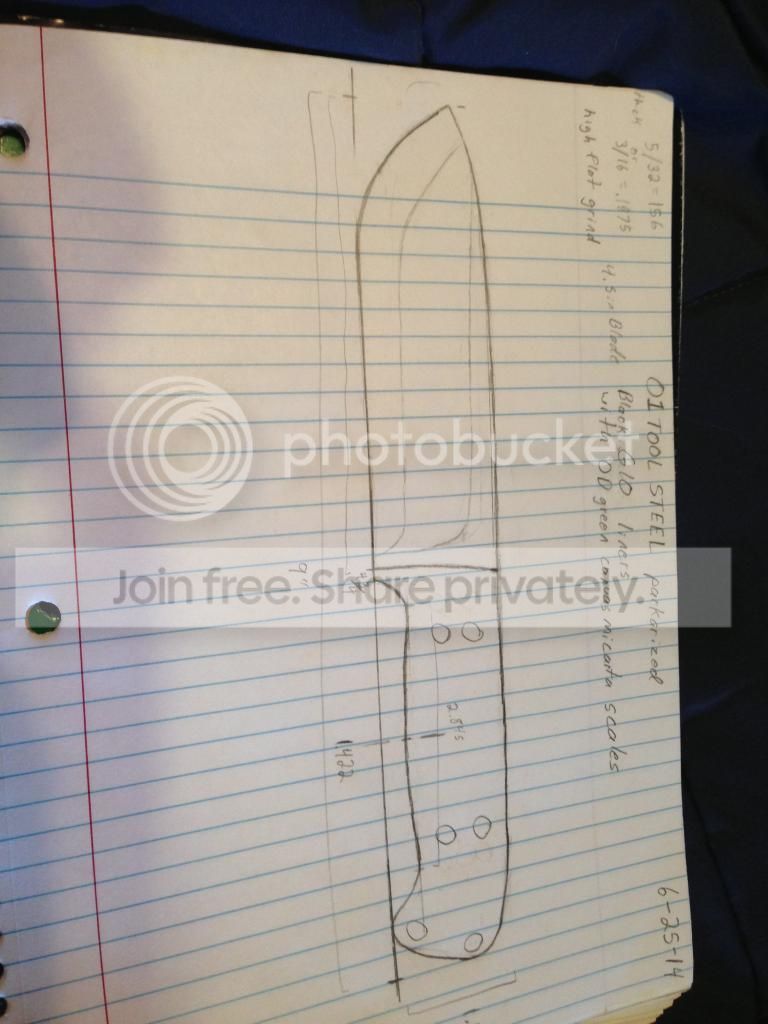
 
It looks like a pretty nice and simple design. The only thing I might consider changing is the belly of the blade. It looks a little bit fat to me (I'm one to talk). See what you think of it with a little less belly on it. Otherwise, looks good. Dive in!

 
I'd probably thin the handle out a bit and deepen the choil. Think about how fat the grip will be too.
Good luck in your implementation.
 
mY 2 CenTs ;0)

Also when taking a picture of a drawing, try to get directly above the drawing, taking a picture at an angle distorts what the rest of us see, also rotating the picture before you upload is nice, I always get a kink in my neck when the pics are sideways ;0)

knifepic_zpsebbb7d97.png
 
My standard advice: Make a cutout of your design on a piece of cardboard or thin wood (ideally same thickness as your intended knife). There's a lot to be said about having it in your hand vs. looking at it on paper. Simple is good, but also pay attention to your lines; what is aesthetically pleasing?
 
excelent advice langadune. a friend/tutor here in argentina told me the same..

i would go for a single smooth curve on the bottom part of the handle, just for keeping it simple. Just an opinion!
 
My standard advice: Make a cutout of your design on a piece of cardboard or thin wood (ideally same thickness as your intended knife). There's a lot to be said about having it in your hand vs. looking at it on paper. Simple is good, but also pay attention to your lines; what is aesthetically pleasing?

This is a great tip ^^^ I learned this on some of my first real estate developments, I had my Entry Feature guy mock up a full size cardboard version of the proposed entry design elements--like Langadune said looking at things in real dimensions is a good thing.
 
Wow thank you all! Keep the ideas coming! My main concerns form my original drawing where that the spine was too flat and the high flat grind would not leave much meat to the blade. I kind of want it to be a blade heavy knife just for hunting and general brush work so I still want some .187 thick material on the blade. Also that the blade was too straight but l seem to like what Shane came up with. Also I like the idea that JK came up with in that the spine is more sweeping but I want to stick with my tip and rear handle ideas.

Also thanks for the 3D tip I kinda did that with a paper photocopy of the knife but nothing in total 3D. Sorry about the pictures I didn't know how to rotate them.
 
Okay I'll play with colors too!! LOL


Hard to get it exact since I'm not great with MS paint I'd go something like this. Leave a bit more ricasso, take the belly out of the handle (cut out both versions and see what feels better to you. Like someone else said deepen the choil a bit but not make the transition as square is it is in that pic at the front of it. I'd just go two pins/Corby bolts in the handle (although centered). Easier to line up two on your first knife but that's just an esthetics thing adding more. Oh I'd also round off the front of the scales and not have it be part of the finger guard. Could consider rounding out the butt a bit too but again personal preference.

Like this only not as crappy of a curve.


Are you planning on heat treating the O1 yourself or send it out?
 
Last edited:
Well I have a lot of re-drawing and testing to see what feels good to me. Keep the ideas coming!

As far as heat treating I will probably be sending it out to peters. Although I looked on there website and I couldn't find much as far as price. A friend said he could probably take it to work and hear treat it but I don't know how exacting that would be.

Also I'm going to parkerize the blade after heat treating so it won't rust, and I'm putting OD green scales on it. My question is I want black or dark gray pins for the handle. What are all my options? I was thinking carbon fiber, but I'm not sure how ridged that would be, or if it would just swedge down when you peen it into the tang.
 
If you're sending it out and are concerned about rust why not go stainless? Personally I'd send it out rather than have you're friend do it, you'll find there is a lot of work that goes into making a knife and I'd prefer to know the HT was done right (unless your friend does HT quite a bit). Peters will do it right and you'll know the RC of it on the invoice they send back to you. The best of my knowledge you can't peen CF considering most pins are a form of metal I don't know what the best way to have the color you're looking for maybe someone else will chime in. But you can call Peter's and they'll tell you the price for one blade, you get a better price sending in multiple ones but they're top notch. I actually had a blade get lost in the mail for about 2-3 months after they sent it back to me and they were beyond diligent tracking it down calling post offices to locate it and getting it back to them so they could re send it out to me, really top notch.
 
Also I'm going to parkerize the blade after heat treating so it won't rust, and I'm putting OD green scales on it. My question is I want black or dark gray pins for the handle. What are all my options? I was thinking carbon fiber, but I'm not sure how ridged that would be, or if it would just swedge down when you peen it into the tang.

Carbon fiber makes nice pins. However, you don't peen them. They will just get crushed. They are not malleable like metal pins.
 
Ok so how do you make sure the handle is secure in the pins without any movement if using CF? I understand you would use epoxy as well but there is still going to be about .002- .003 clearance between the pin and handle scales.

And as far as rust and stainless, anymore I'm not a fan of stainless in much of anything. In my experience, tool steel will hold an edge longer, it will take abuse far beyond that of stainless. And personally I don't like the polished look. Plus I take care of my tools so I could honestly leave it uncoated and it would be fine but I like to over do stuff.
 
There should be clearance between the pin and the hole in the tang. The hole in the scale should be fairly snug, but not so much that there is no room for epoxy. Also, any small gap between the pin and handle should be filled with glue and will be next to invisible.
 
As you can tell by the different drawing changes an 1/8" makes a big difference in how a knife looks and functions. It doesn't take sweeping changes just little tweaks.
The suggestion about doing a cutout so you can hold it in your hand is an excellent one. There is much to be learned from this.

Let us see how it comes out, Fred
 
Thanks everyone! Just a bit of an update, I got my harbor freight 4x36 belt sander in(yeah I know it's not the best but it'll have to do for now) I'm working on this as time allows but I do plan to keep it updated. Also I plan on using my original drawing for three reasons, #1 this is my first knife so if its not the best oh well it will be a learning experience. #2 I kinda mocked it up in card bored and it honestly felt great in my hand and #3 I already had it traced onto a piece of mild steel that I plan on using as a templet/practice grinding on. Then after I feel I'm doing ok I'll move on to the way more expensive O1.
 
One big thing in getting handles and pins to stay put is using the right epoxy. The 5 minute syringes are nearly useless. Get a slow cure resin to get a long life bond. G-flex and System Three T-88 are both good. The slower the cure the better. I use 24 hour resins. 1 hour is the absolute minimum.

Properly glued in, the G-10 pins will be there forever. The tang hole should be about 25-50% larger than the pin/rivet. The scales should be drilled with a few thousandths clearance and shouldn't be too snug. Put resin in the handle holes as well as on the G-10 pins, and insert them with a twisting motion. Clamp with just enough pressure to hold things in place. Too much clamp pressure will squeeze all the resin out from between the tang and scales. A great tip is to slightly hollow grind the tang and/or the back of the scales to make a very shallow reservoirs fro the resin. Just leave a flat area around the perimeter. Then you can clamp firmly without fear of a glue starved joint.
 
Everybody here has given you excellent suggestions. Mine? Just make the knife. I too tried to follow a precise and detailed plan for the first knife I made, and it came out entirely differently than the drawing. Make your knife with your design in mind, accept the imperfections, learn from them, and then go make another.
Cheers. :)
 
As far as pinning goes, you can countersink your holes and peen the pins in and you will have a very strong mechanical attachment as well- epoxy is only necessary as a sealant if you do this.
With wood you have to be careful not to split the scale, but with g10 you can move a fair amount of metal before you have a problem.
 
Ok very very helpful information!

I did have one thought though, if I parkerize/coat the blade and then pin the handles on, grinding them will take the parkerizing off the tang. I want the whole blade to be parked. Could I use some sort of bolt instead of pins? This way I could contour the handle before I parkerize the blade then use some 243 blue locktite after its all done. Although pins and industrial epoxy seem to be a better option, I don't know of any other way to contour the handle without losing the parkerizing.
 
Back
Top