
-
The BladeForums.com 2024 Traditional Knife is available! Price is $250 ea (shipped within CONUS).
Order here: https://www.bladeforums.com/help/2024-traditional/
You are using an out of date browser. It may not display this or other websites correctly.
You should upgrade or use an alternative browser.
You should upgrade or use an alternative browser.
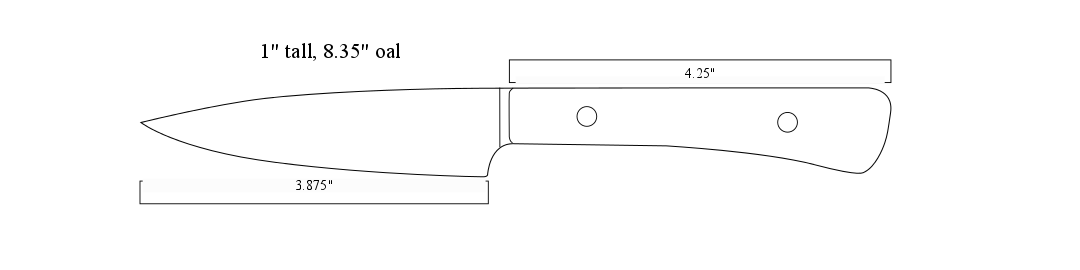
First knife design. Please critique/advise
- Thread starter ciliatus
- Start date

- Joined
- Jul 7, 2013
- Messages
- 2,614
I like the design a lot. 440c is a fine steel, but I also think 3/32 is a bit thick for a utility/paring knife.

Hengelo_77
Basic Member
- Joined
- Mar 2, 2006
- Messages
- 6,319
I like the design as well.
Just make sure that the transition from the handle to the dropped edge is rounded a bit so that it doesn't irritate your indexfinger
Just make sure that the transition from the handle to the dropped edge is rounded a bit so that it doesn't irritate your indexfinger

Stacy E. Apelt - Bladesmith
ilmarinen - MODERATOR
Moderator
Knifemaker / Craftsman / Service Provider
- Joined
- Aug 20, 2004
- Messages
- 38,524
It looks excellent for a general use kitchen blade.
As said, .060" stock is a good choice for a 3" kitchen blade. .090/.100" is fine for larger blades and heavier kitchen tasks. Your blade falls right at the transition of those. With a good distal taper and FFG, the .090" stock would be OK, but if it will be a slicer and general light task knife, I would go with the .060" stock.
AEB-L will take a very fine edge and sharpens easily. CPM-S35VN is the kitchen champ, IMHO. It is a bit harder to sand and sharpen, post-HT, but takes and keeps a great edge.
The only feature on your sketch that draws my eye is the butt looks a little fatter than it needs to be. It isn't a lot off, but seems to be about 1" wide. You can start with what you have and reduce it a bit as you grind and shape the handle.
As said, .060" stock is a good choice for a 3" kitchen blade. .090/.100" is fine for larger blades and heavier kitchen tasks. Your blade falls right at the transition of those. With a good distal taper and FFG, the .090" stock would be OK, but if it will be a slicer and general light task knife, I would go with the .060" stock.
AEB-L will take a very fine edge and sharpens easily. CPM-S35VN is the kitchen champ, IMHO. It is a bit harder to sand and sharpen, post-HT, but takes and keeps a great edge.
The only feature on your sketch that draws my eye is the butt looks a little fatter than it needs to be. It isn't a lot off, but seems to be about 1" wide. You can start with what you have and reduce it a bit as you grind and shape the handle.
- Joined
- Apr 11, 2014
- Messages
- 644
Your steel choice is fine but would use 1/8th" max. Since you will have to get a new piece anyways cuz what you have is too think Id actually get ahold of some .090" AEB-L.
Jay
Jay
Stacy E. Apelt - Bladesmith
ilmarinen - MODERATOR
Moderator
Knifemaker / Craftsman / Service Provider
- Joined
- Aug 20, 2004
- Messages
- 38,524
Your steel choice is fine but would use 1/8th" max. Since you will have to get a new piece anyways cuz what you have is too think Id actually get ahold of some .090" AEB-L.
Jay
????? He has 3/32...which is thinner than 1/8". 3/32= approx. .090", 1/8" = approx. .120"
My favorite Rant:
This is why the Fractional English System, beloved in the USA only, is a terrible system. Decimal English system, and even better, the Metric System are far clearer. Even illiterate peasants in Nepal can tell the difference between things using the metric system. The entire world knows this and has seen the benefits for half a century or longer. The USA even passed a law because the evidence is irrefur=table...but we cling to it despite the law. Heck, we even crashes a billion dollar probe into mars because our engineers wit PHDs can't convert to metric in their heads. If they were using the simpler metric system, they would be on even footing with second grade students in Greece.
Is .090" smaller or greater than .120"....Yes, its a no brainer.
How may mm are in 7.3 cm...73, no problem.
How may 1/32" are there in 4.7"?...who knows.
How many 64th" are there in 13.73 miles... I'm not even going to try. - How many mm are in 13.73 kilometers....piece of cake for a six year old.

mgray34
Gold Member
- Joined
- Feb 5, 2014
- Messages
- 209
150.4How may 1/32" are there in 4.7"?...who knows.
55,675,699.2How many 64th" are there in 13.73 miles...
mgray34
Gold Member
- Joined
- Feb 5, 2014
- Messages
- 209
Your steel choice is fine but would use 1/8th" max. Since you will have to get a new piece anyways cuz what you have is too think Id actually get ahold of some .090" AEB-L.
Not sure I follow how 3/32 is too thick but .090" is just right. Perhaps someone can explain that.
Stacy E. Apelt - Bladesmith
ilmarinen - MODERATOR
Moderator
Knifemaker / Craftsman / Service Provider
- Joined
- Aug 20, 2004
- Messages
- 38,524
See post #7 for why.
- Joined
- Jul 13, 2009
- Messages
- 21,855
????? He has 3/32...which is thinner than 1/8". 3/32= approx. .090", 1/8" = approx. .120"
My favorite Rant:
This is why the Fractional English System, beloved in the USA only, is a terrible system. Decimal English system, and even better, the Metric System are far clearer. Even illiterate peasants in Nepal can tell the difference between things using the metric system. The entire world knows this and has seen the benefits for half a century or longer. The USA even passed a law because the evidence is irrefur=table...but we cling to it despite the law. Heck, we even crashes a billion dollar probe into mars because our engineers wit PHDs can't convert to metric in their heads. If they were using the simpler metric system, they would be on even footing with second grade students in Greece.
Is .090" smaller or greater than .120"....Yes, its a no brainer.
How may mm are in 7.3 cm...73, no problem.
How may 1/32" are there in 4.7"?...who knows.
How many 64th" are there in 13.73 miles... I'm not even going to try. - How many mm are in 13.73 kilometers....piece of cake for a six year old.
If you think in thousandths, it's much clearer.
Thanks for all of the input, everyone. I had a suspicion about the thickness. I will go ahead and use 1/16" instead. I will also look into AEB-L. I haven't bought any steel yet, so no problem there. I'm trying to figure out as much as I can before I do much spending. On a pretty tight budget.

- Joined
- Oct 17, 2007
- Messages
- 4,299
Not a bad looking paring knife. I made my first one or two out of some 3/32, and quickly decided that 1/16... I mean, I used .090 at first, and decided that .060 was better by far.
One thing I might add: I generally try to avoid any straight lines (i.e. the back of your handle) when designing a knife, especially in the handle area. For that size handle, it probably won't really make a huge difference, or detract from its utility, but it's something to keep in mind for larger knives.
One thing I might add: I generally try to avoid any straight lines (i.e. the back of your handle) when designing a knife, especially in the handle area. For that size handle, it probably won't really make a huge difference, or detract from its utility, but it's something to keep in mind for larger knives.
One thing I might add: I generally try to avoid any straight lines (i.e. the back of your handle) when designing a knife, especially in the handle area. For that size handle, it probably won't really make a huge difference, or detract from its utility, but it's something to keep in mind for larger knives.
Thanks for the input. What is the advantage to no straight lines?
- Joined
- Oct 17, 2007
- Messages
- 4,299
Thanks for the input. What is the advantage to no straight lines?
It's just typically more ergonomic/natural to hold. If you look that hand, and more so the palm, you'll have a very difficult time finding any straight or flat areas.
Squeeze a piece of clay in your hand and see what it looks like. It will follow the natural curves of your hand.
Not to mention the natural forward canting of your hand from your wrist. The straighter the spine, the more you'll have to turn the knife forward to cut.
- Joined
- Oct 17, 2007
- Messages
- 4,299
http://versteegblades.com/knife-handle-design/
Coincidentally, I just happened upon this article by Kyle Versteeg (average Iowa guy)
about this very subject.
Coincidentally, I just happened upon this article by Kyle Versteeg (average Iowa guy)
about this very subject.