First Knife Design -

Joined
Jun 27, 2010
Messages
402
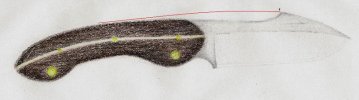
I found some of my kids' colored pencils and whipped this up, after weeks and weeks of changing it on paper and pencil and cutting cardboard. I won't ask if this looks like anyones, cause I'm sure there's 200+ knives just like it.

I wanted a carver that could possibly serve as a companion knife for a Beck WSK that I eventually want to do. I originally put the point on the spine for a possible gut hook in the future (when I figure it out), but I like the look and might just keep it there.

I plan on using 5160, sanding to a rough 800 grit, then doing the bevel up to maybe 1500-2000grit. The scales will be african blackwood with stabilized white holly. After seeing it in color, I might go with silver rivets and lanyard holes. I know the handle is complex, I'm not to worried about it, lots of learning to be had, haha.

Total length is 8 1/4", blade length is 3 5/8".

No blanks have been cut yet, so if anyone can offer criticism, and tips...I'm wide open.

 
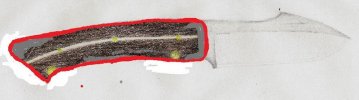
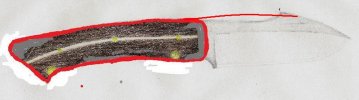
I would move the grind up towards the tip a little higher so it follows the belly of the blade rather than terminating at the tip like you have here. Like so...

The drop point blade profile has an inherently strong tip design; there is no need to reinforce it in such a manner. Plus, the thick tip of the knife would make piercing cuts and such a bit harder. However, you could also keep your current grind idea and add a simple swedge to streamline the point a little more.

Excuse the amateur paint drawings :o
Of course these are just suggestions. It looks like a pretty decent looking knife already.
 
I'm not sure I understand the first pic. I was going to do a spine bevel on the tip like your second pic, but then I saw this last night, http://www.bladeforums.com/forums/showthread.php?t=758261 and I don't really want to look like I copied someone.

*edit* nevermind, I understand the first one now. I really like that. I might do another sketch with that bevel and see how it looks. Thanks
 
Last edited:
No problem. I wouldn't sweat it too much if you think your knife looks a little similar to another's. There are only so many knife patterns out there and unless you truly invent something revolutionary like the Woodsmans Pal or something some designs are going to get recycled. Does Stanley change their hammer design because it looks like Craftsman's?
Anyways, ignore my little tangent there and good luck on your first!
 
Make the knife. My guess is that you will be surprised at how hard it will be to match the design so just go for it.
 
I would try a wooden mock-up of the design just to see if it feels in the hand the way you think it should. It is easy and quick to do if you use a piece of soft pine or some such scrap and the belt grinder. On a new design I like doing this and invariably I end up changing some of the dimensions based on the way the model feels in the hand. It is a whole lot easier to find out you need a longer handle or something before you have already made a blade from good steel.
 
Forgot to mention I'll be using 3/16" 5160.

To make a wood mock up, I'll have to either wait till I pick up by belt grinder/sander this weekend, or till my brother in law gets back in town to use his. I've cut up a lot of 1/4" cardboard, and it feels decent like that. I probably will end up doing one just so I don't waste steel...I'm really restricted in terms of finances. Going to the Woodcraft in Spokane, Wa tomorrow to pick up the wood.
 
I agree with blgoode. When I was just starting out, I put very little effort into design and just made as many knives as I could. I firmly believe that you learn more by doing this than you do by agonizing over the design of your early knives. The designs will come naturally as you figure out what you like and what you are able to make.

- Chris
 
One thing that was suggested to me (and I'm glad it was) is to make your design fairly simple. It's hard enough making a knife as it is starting out, complicating it more will likely lead to frustration and quitting. Bear in mind I'm still very new to this but here is my constructive criticism, do what you wish with it.

I would suggest this: Keep the basic shape of the blade however I would get rid of that curved part in the back. Keep the tip area as it is but rather than have that curve in the blade keep a nice flowing line back into the handle area. So it won't look as though someone took a bite out of the back of the knife.

Second would be to get rid of that belly towards the guard, it's going to be uncomfortable. The natural contour of the hand when it grabs something it's preferred to be tapered where the thumb and index finger meet and flare out a bit from there. I also think the placement of the pins looks a bit clumsy, 3 across the center would be fine, I'd eliminate the 2 underneath them.

Get a piece of cardboard and cut the shape out and "use it" for a few days and see how it feels. It's cheaper to waste cardboard than it is steel. One thing to keep in mind is: What is the purpose of the knife going to be? Hunting, everyday carry, fantasy, tactical, etc. IMO it's better to have a comfortable, functional knife over something that "looks cool".

I had to spend a lot of time on here as well as cut up a lot of cardboard to really have that sink in ;). I'd be willing to be a lot of makers have.
Something along the lines of this for the blade, then whatever you decide to do on the handle.
 

Attachments

  • scan0002sw.jpg
    scan0002sw.jpg
    27.3 KB · Views: 31
Second would be to get rid of that belly towards the guard, it's going to be uncomfortable. The natural contour of the hand when it grabs something it's preferred to be tapered where the thumb and index finger meet and flare out a bit from there.

I forgot to mention that. Like Fletch said, that "hump" or whatever you want to call it towards the front of the handle would made holding the knife kind of awkward. I would just level it out like this:
 
I would try a wooden mock-up of the design just to see if it feels in the hand the way you think it should. It is easy and quick to do if you use a piece of soft pine or some such scrap and the belt grinder. On a new design I like doing this and invariably I end up changing some of the dimensions based on the way the model feels in the hand. It is a whole lot easier to find out you need a longer handle or something before you have already made a blade from good steel.

+1 on making the model. If you've read the WIP I have going in this forum, the first picture is the second wooden model. The first one showed me some problems with the thumb placement and scales. It only took about 20 minutes to whip out the first one and less than that for the second.

I like the shape of that blade. The handle, maybe not. :)
 
One thing that was suggested to me (and I'm glad it was) is to make your design fairly simple. It's hard enough making a knife as it is starting out, complicating it more will likely lead to frustration and quitting. Bear in mind I'm still very new to this but here is my constructive criticism, do what you wish with it.

I would suggest this: Keep the basic shape of the blade however I would get rid of that curved part in the back. Keep the tip area as it is but rather than have that curve in the blade keep a nice flowing line back into the handle area. So it won't look as though someone took a bite out of the back of the knife.

Second would be to get rid of that belly towards the guard, it's going to be uncomfortable. The natural contour of the hand when it grabs something it's preferred to be tapered where the thumb and index finger meet and flare out a bit from there. I also think the placement of the pins looks a bit clumsy, 3 across the center would be fine, I'd eliminate the 2 underneath them.

Get a piece of cardboard and cut the shape out and "use it" for a few days and see how it feels. It's cheaper to waste cardboard than it is steel. One thing to keep in mind is: What is the purpose of the knife going to be? Hunting, everyday carry, fantasy, tactical, etc. IMO it's better to have a comfortable, functional knife over something that "looks cool".

I had to spend a lot of time on here as well as cut up a lot of cardboard to really have that sink in ;). I'd be willing to be a lot of makers have.

Something along the lines of this for the blade, then whatever you decide to do on the handle.

The two bigger ones that look like rivets are actually lanyard holes. I'm not sure where I'd prefer it, but I've almost dropped knives before with a lanyard hole near the butt, and the first thing I've thought is that it would drop tip first and swing into my leg or something...so I was going to try putting a lanyard hole in the center of balance area so I dont have to worry about the blade hitting me.
 
I would not worry as much about the blade design, you know the old saying "different strokes..."

I have found that no matter how cool a handle looks on paper it isn't neccesarily so in life. A few have commented on the front swell in the handle, that would also be my biggest criticism. Based on the measurements you gave the fore and little finger will have less purchase because of the larger diameter at the front and rear. IMHO this would be very awkward in extended use.
 
I just drew it out with a smooth/flat spine that flowed into the handle, and removed the bulk near the ricasso. It looks like a kitchen knife, haha...oh well, i'll keep messing around with it, and maybe do a couple wood mockups this weekend.
 
I am a big fan of what I term the Loveless style handle (mostly where I see it). I tried it out on your knife I think it looks pretty good.
 

Attachments

  • scan0002sw.jpg
    scan0002sw.jpg
    27.1 KB · Views: 25
I am a big fan of what I term the Loveless style handle (mostly where I see it). I tried it out on your knife I think it looks pretty good.


I kind of like that with having the blade flow into the handle like this.... Naturally there are some humps in the MS Paint mock up. Again Emph it's your knife and make it however you want. But just some suggestions to consider.
 

Attachments

  • scan0002sw.jpg
    scan0002sw.jpg
    27.8 KB · Views: 21
I've made a lot of changes. I also just completed the rough mock up out of wood, and I think I like it...I'm attempting a pretty challenging handle made out of gaboon ebony and stabilized white holly. I have enough for two shots at it, I have two back up scales of macassar ebony that should be relatively easy to shape. Also going with 2 3/16" stainless steel rivets and a 1/4" stainless steel thong hole tubing for the lanyard hole.
 
Flow is very important in a knife. As has already been mentioned, funky protrusions might look cool on paper, but don't necessarily make the knife function better.

That 'loveless' handle re-design looks absolutely right, imo. Easy to grip from any position, gloved or not, and it flows right into the blade.

My biggest worry, though, is having the pins right along the joint between the woods. You've basically cut the holly into four pieces, not a problem, and don't have any support for the top piece of ebony. I'm not saying you're glue joint will fail, but if it does, you lose part of the handle.

Thong tubes? I actually prefer them in the middle or just slightly forward. With a short thong wrapping your wrist, you can intentionally drop the blade and not have to go looking for it when you want it back. Just drop your hand and it's right back into a usable position.
 
+1 on that last comment. All issues of style or even ergonomics aside, I would worry a bit about the placement of those rivets leading to handle failure. Just my $0.02.
 
After all the design flaws my initial design had, I can't help but completely agree with everyone here. I do like the Loveless handle but I really want to develop my own style. After I actually made the wood mock up I've been considering a few other changes as well, but I think those will emerge when I finally get my hands dirty.

I'm also considering saving the holly and gaboon ebony for my next knife an just using the macassar ebony for my cherry popping knife.
 
Back
Top