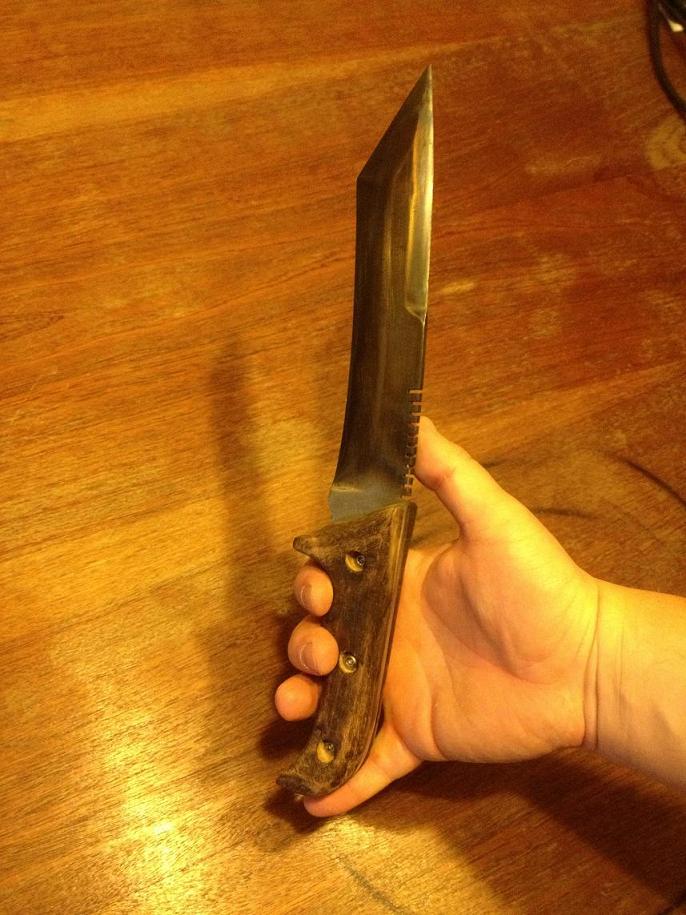
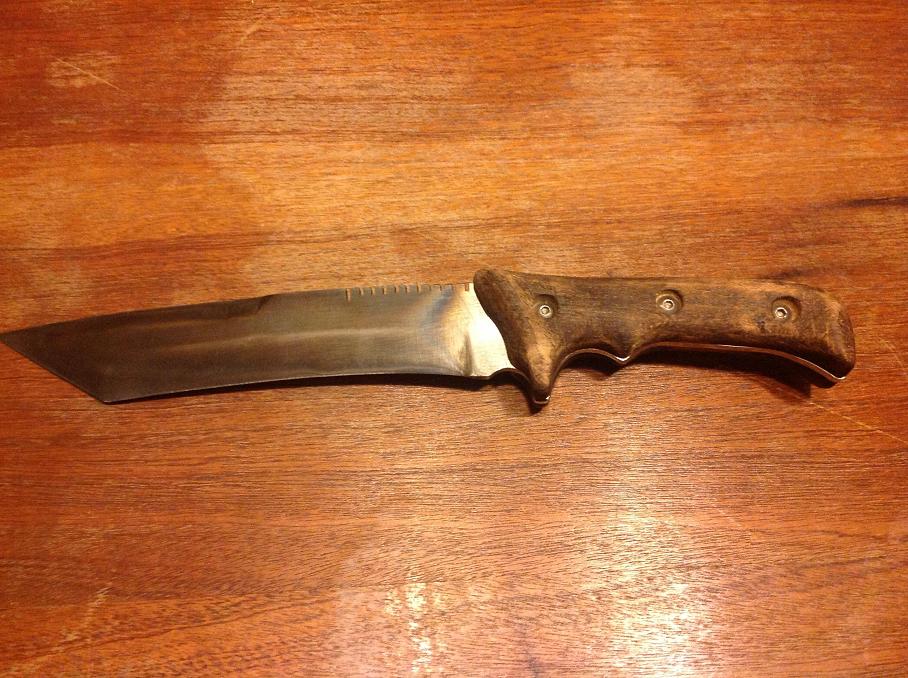
first knife, first handle, first experience!

Joined
Apr 19, 2013
Messages
15
Everybody here knows how great knife making is, and all things that come with it. So it took me some time to finish the piece, and a lot of nerves, because many things didn't happen quite the way I wanted them. I'd appreciate any critiques and comments over my work!

1.jpg

2.jpg

3.jpg
 
more info please. materials, method of manufacture, h.t..
Without any of that, first i'd say that the jimping looks like a possible weakness. Its very deep and looks like on a knife that size, which seems meant for chopping and hard use, that there will be stress riser issues.
I like the profile and overall shape, but personally I'd reshape the handle so there was a palm swell in the middle and it tapered fore and aft. If you feel that handle is comfortable for you I'd just finish it using a higher grit paper which will bring out the character of the wood better. Soak it in boiled linseed too. I assume its not stabilized wood. I like it overall. Its just rough around the edges. That takes time. Keep making em.
 
Good first try

I'd skip the groves in the spine, if it breaks it will be at one of those notches.


What's the handle made from ?
Looks like softwood from here, try hardwood or micarta it will be easier to work fine grained material to a thinner outcome.
 
Steel - steel from the outer bearings' ring (don't have any idea on the exact type)
Wood - no idea either, I just know that, when I tried to cut it with a saw it took me 20 minutes of hard work...
HT - Can't say the exact degrees, but I tested the blade: chopping wood, cutting meat, cutting thin nails, even I accidentally dropped it on a couple of stones, and yet nothing happened to the blade.

Method of manufacture: Hand made! The only thing that was a machine, was the grinder, and that heavy duty angle grinder (don't know if it's the exact word), and a drill to make the holes in the handle.

About the groves that that weaken the blade.. probably yes, but on a 5mm thick steel knife, I thought it could bear an experiment :) even if it's that bad.

I ran out of patience for the finishing touch for this one. Still collecting stuff for the workshop.

Thanks for the replies, please don't be shy and say more :)!
Best regards!
 
Last edited:
Steel - steel from the outer bearings' ring (don't have any idea on the exact type)
Wood - no idea either, I just know that, when I tried to cut it with a saw it took me 20 minutes of hard work...
HT - Can't say the exact degrees, but I tested the blade: chopping wood, cutting meat, cutting thin nails, even I accidentally dropped it on a couple of stones, and yet nothing happened to the blade.

Not trying to sound critical but I am curious about the process...
When you say the steel is from the outer part of a bearing (I assume you mean the 'race', what the outer ring the balls roll in is called) was it once round and you forged it flat?
For the wood do you mean 20 minutes to cut out the shape or just cross cutting? Soft wood would probably take that long to cut out, or a dull blade cutting across. If it is from the hardware store it is probably pine unless it said otherwise. If it is I would suggest using hard or stabilized wood in the future.

Heat treatment... Did you heat treat the blade? If you were able to drill it, it was most likely annealed. If you didn't HT the steel after working the blade in that state it is still annealed and will never hold an edge. As for the drop on stones, I wouldn't expect any steel that was just dropped to have any damage. That's not an indicator of hardness. Edge holding ability is what we are looking for in a heat treatment. If your scales are removable you can still HT, if not... I hate to say it but I would sacrifice the scales to have it truly hest treated so as to not have all that work in a blade and it won't hold an edge very well. Its a very neat design and that would be a shame...
Sorry if that sounds like a critical barrage, but I jist don't want you to step onto the wrong path so early in your knife making...
 
No ofc. it doesn't sound critical at all, that's exactly what I need.

1. Yes, the race was forged straight (there are some words, that I still can't translate in english :) )
2. The wood is very hard. I don't buy new things, I just use stuff I found in the garbage, and that was an old painted peace of wood.
3. HT yes, at first the blade was annealed, right after the shaping process. I thought there were 2 ways for HT: 1. the entire knife; 2. surface HT; I chose surface, because it's a big knife, and often bears some brute force, so I thought HT of the whole knife would make it harder, but maybe fragile. Still trying the black oxide cover with ammonium nitrate. This would be the final touch
 
I am not familiar with 'surface' heat treatment. Do you mean edge quenching? (i.e. heating the edge to bright red and quenching the edge)
 
I noticed you said you ran out of patience for the finishing touches. The finishing touches are what make custom knives stand out from others. What I like to do is have a few blades that I am working on in different stages. If one is getting tiresome, work on another one. Don't skip any steps, they are all important. Come back to it when you have more time and patience. It will come out better, in the end.
 
Looks great for a first knife, and that is a very ambitious design. Now go make more!

I would suggest using a known steel next time, and sending it out for professional heat treating.

This will end up saving you a lot of time and effort.
 
That's not a bad first knife. The overall design isn't my cup of tea but it does show that you've got a pretty good sense of proportion.

In addition to what's already been said, I'll add that the handle looks too clunky, especially at the top. You could sand it down some more and fix it. Also, the scales don't exactly match up with the tang. Next time cut the scales a hair oversize and sand sand them down to the tang once they're attached

I would suggest using a known steel next time, and sending it out for professional heat treating.
+1
When you add up the time, blood, sweat, and tears then $25 spent on good steel, heat treating, and good handle materials is just chump change.

Keep up the work. Don't rush yourself. You've got some potential.
 
They're made of many different steels. It's anyone's guess whether or not it'd be an appropriate steel for a knife, then you have to experiment with the heat treat because you wouldn't know exactly what regime it needs.
If your time has any value and if you want a good end product then it's a lot easier to spend $7 on a piece of 1084.
 
Most people consider bearing races to be 52100....but they can be many types of steel.

thejazz,
Good first knife. The handle is too big, and could use more sanding, but most first knives have a large and blocky handle.

Fill out your profile so we know where you are. That helps us give better answers. Often folks overseas have a problem with a specific word, but someone else can easily translate a word or technical term for you if they know where you are and what language you speak.
 
Your first knife is a bit rough, but you know that. There are some good knives, going to come from you, it shows in this one.

Using a known steel is a must. If you are looking to make the best blade possible you have to know what steel you are dealing with so you will know and understand the heat treating that is required. Other wise its just guessing.

Hope to see another one from you soon, Fred
 
Thanks for the kind words everyone! For my next knife (after a month) I plan to use a 4x13 stainless steel. I can't afford to use professional heat treatment that's why I'll find another way for doing such. I have some questions for forging the blade itself. Should I use this 4x13 and bend it couple of times, so it becomes multilayer or should I use it as it is. I don't think someone in my country could find me 440C at a good price or at all if I may say.

Best regards.
Gerdjikov
 
Back
Top