First Knife from Scratch Seeking Advice

CDHumiston

Gold Member
Joined
Feb 17, 2009
Messages
1,464
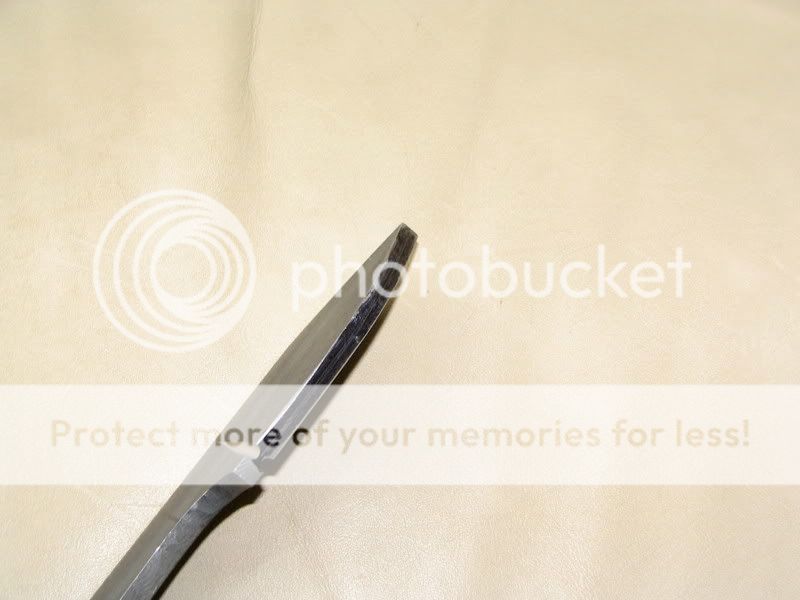
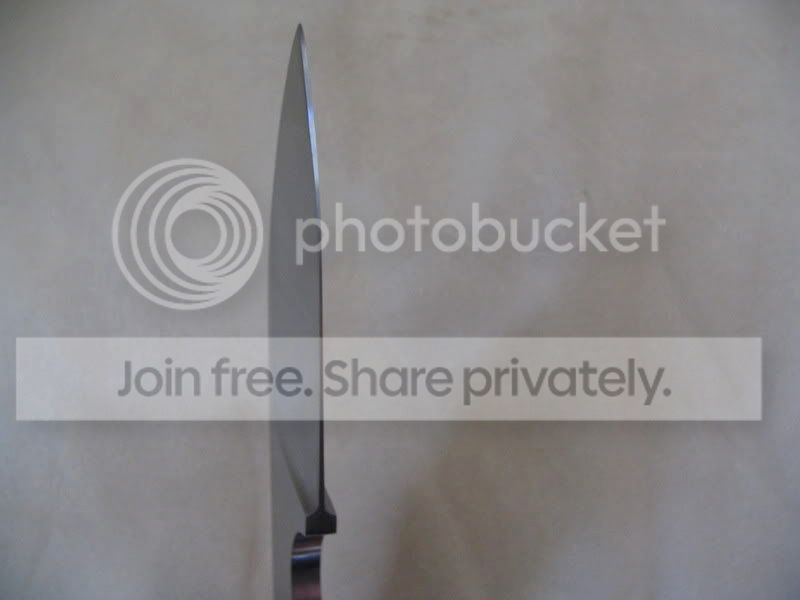
I have just started my first knife from a piece of 1/8" x 1 1/2 440C stainless steel. Cutting it out was OK, smoothing the edges no problem, but getting the plunge lines is killing me. I practiced a few times on some scrap, but I'm still having a heck of a time.

I am using a pretting sturdy Wilton 1x42 grinder, I know I need a 2x72, but I can't afford one yet so it will have to do. I am getting a lot of chatter against the platen and I really don't feel like I can see what I'm grinding off?

I'm attaching a few pictures, suggestions please...

Chris
 
Last edited:
Use a machined or cobbled-together file guide and hand-tools to set your plunges. Even clamping the blade in a simple vise and using a file with a "blind-side" ground smooth (smooth part goes against the vise or guide) can help a lot.
 
That looks halfway decent to me for a first try and with a less than optimal grinder. It looks like maybe the edge is a bit thick and could be worked down along with bringing the grind up higher on the blade. In my (limited) experience, it will improve somewhat as you get higher as it gets easier to feel on the platen.

What specifically are you asking for help with?
 
That looks halfway decent to me for a first try and with a less than optimal grinder. It looks like maybe the edge is a bit thick and could be worked down along with bringing the grind up higher on the blade. In my (limited) experience, it will improve somewhat as you get higher as it gets easier to feel on the platen.

What specifically are you asking for help with?

I left the edge thick so I could post pictures before I screwed it up too bad. I'm looking for help on how exactly to grind/file a nice straight plunge line and get them even on both sides.

Thanks,
Chris
 
What James mentioned above is about the most foolproof method; otherwise, I think lots of practice is the key. Here are a couple of pics of my first knife I made all by hand with files and sandpaper, and I used James' method of a cobbled together file guide and a round file to create the plunges before I filed in the bevels. Hope that helps.

IMG_0845.jpg

IMG_0872.jpg
 
Use a machined or cobbled-together file guide and hand-tools to set your plunges. Even clamping the blade in a simple vise and using a file with a "blind-side" ground smooth (smooth part goes against the vise or guide) can help a lot.

Thanks for the advice, looks like I need to be patient and use some elbow greade instead of trying to grind everything to death.
 
I dont have a file guide per say, but I clamp a lathe bit onto the plunge.
 
Looking at the pics its looks like you have ground in 4 different places, mark the edge with magic marker, dont take any more off the firt 1/4". the second grind mark looks like it about in the right spot to move your grind up without effecting the edge or spine. Take a good look at it, try to get that spot on the belt and slow and easy pull across, not much pressure, just try it increase that flat. Once you find that flat continue until it joins with your majic marker. You should be close, just real easy and slow, dont stop for any reason.

You can fix the plunge with a file before or after belt grinding if you leave enough steel. If you do it before clamp a piece of metal to the blade that will touch the edge of the platten preventing you from going to far.
 
Looking at the pics its looks like you have ground in 4 different places, mark the edge with magic marker, dont take any more off the firt 1/4". the second grind mark looks like it about in the right spot to move your grind up without effecting the edge or spine. Take a good look at it, try to get that spot on the belt and slow and easy pull across, not much pressure, just try it increase that flat. Once you find that flat continue until it joins with your majic marker. You should be close, just real easy and slow, dont stop for any reason.

You can fix the plunge with a file before or after belt grinding if you leave enough steel. If you do it before clamp a piece of metal to the blade that will touch the edge of the platten preventing you from going to far.

Thanks for the advice, I think I'm going to try and get the plunge correct by hand filing and then work on the grind. I'll make sure and clamp the blade in some steel when grinding so I don't screw it up.

I'm not sure I understand where you are suggesting I mark with the marker?
 
Looking at the pics its looks like you have ground in 4 different places, mark the edge with magic marker, dont take any more off the firt 1/4". the second grind mark looks like it about in the right spot to move your grind up without effecting the edge or spine. Take a good look at it, try to get that spot on the belt and slow and easy pull across, not much pressure, just try it increase that flat. Once you find that flat continue until it joins with your majic marker. You should be close, just real easy and slow, dont stop for any reason.

You can fix the plunge with a file before or after belt grinding if you leave enough steel. If you do it before clamp a piece of metal to the blade that will touch the edge of the platten preventing you from going to far.

I see what you mean about grinding in 4 places. I got a piece of glass for my platen and glued it on this weekend. Grinding is much easier now without all that chatter.

Here are the latest pictures. How much thinner should I get the edge before I start hand sanding the blade horizontally for heat treating?
 
I'd get it between a nickel and a dime thickness pre-ht. I'd also try to smooth out the high spot in your grind or you may get a warp to that side during HT.
 
I like the profile of that blade. You have a good sense of style with that one. Your grinding appears to be coming along. In those second pics I can definitely see you have the right idea. Here are a few things that help me to grind with more consistency:

Try to keep your elbows locked in at your sides and grind evenly with a rocking motion at the hips. Don't "poke and look" a lot. Try to take a full length, even, fairly light pass from plunge to point , then observe the results.

Once you get a good flat pass established by adjusting your angle, bring the blade to the belt every time with a somewhat "loose" grip so that the blade instantly self adjusts to the flat you already have established. Doing this so that the edge is very slightly leaned into the belt when you first make contact will save the spine side of the grind (which is much harder to correct) from a lot of dings and grinding mistakes.

Grind the edge with a 45 degree bevel almost down to the desired edge thickness, nice and straight, then with intermediate flats work the grind up towards the spine. You can rough grind your plunges in and leave a little room for cleaning them up with a finer belt, grind most of the blade and then you can push your plunges back a little with a sharp 220 belt, also working on keeping them even and shaping the radius at the top corners of the plunges/grind line.

This works best with a flexible belt such as a J-Flex, (not sure what's available in 1x42) which you can track over the edge of the platen a little so that it folds around the edge. It helps this process a little to break in the edge of the belt a bit by applying the corner of an old file or something to the edge of the belt while it is running.

There's nothing wrong with filing in plunges, it's a smart idea, but it's really worthwhile to develop good freehand grinding skills and don't be discouraged if you make mistakes while learning. It's unavoidable. Hope any of this helped.

 
I like the profile of that blade. You have a good sense of style with that one. Your grinding appears to be coming along. In those second pics I can definitely see you have the right idea. Here are a few things that help me to grind with more consistency:

Try to keep your elbows locked in at your sides and grind evenly with a rocking motion at the hips. Don't "poke and look" a lot. Try to take a full length, even, fairly light pass from plunge to point , then observe the results.

Once you get a good flat pass established by adjusting your angle, bring the blade to the belt every time with a somewhat "loose" grip so that the blade instantly self adjusts to the flat you already have established. Doing this so that the edge is very slightly leaned into the belt when you first make contact will save the spine side of the grind (which is much harder to correct) from a lot of dings and grinding mistakes.

Grind the edge with a 45 degree bevel almost down to the desired edge thickness, nice and straight, then with intermediate flats work the grind up towards the spine. You can rough grind your plunges in and leave a little room for cleaning them up with a finer belt, grind most of the blade and then you can push your plunges back a little with a sharp 220 belt, also working on keeping them even and shaping the radius at the top corners of the plunges/grind line.

This works best with a flexible belt such as a J-Flex, (not sure what's available in 1x42) which you can track over the edge of the platen a little so that it folds around the edge. It helps this process a little to break in the edge of the belt a bit by applying the corner of an old file or something to the edge of the belt while it is running.

There's nothing wrong with filing in plunges, it's a smart idea, but it's really worthwhile to develop good freehand grinding skills and don't be discouraged if you make mistakes while learning. It's unavoidable. Hope any of this helped.

Thanks, this is just the kind of advice I am looking for. I'll work on the blade some more and update with new pictures. Everytime I get some good advice I seem to do better the next time I'm at the grinder.

I'm hoping to get a KMG soon!
 
you could use a chain saw file and guide to file them in.

jake

That's what I used to get them where they are now. I wanted to get a reference to start grinding from. Should I use a larger file and make them more pronounced?
 
OK, I ground on it a little more, and tried to clean up the plunge line. I rough sanded it, how's it looking?
 
I think it is looking mighty fine, and you should be proud of your knife.
Get rid of those few grinder marks so you will not have to sweat over them once the blade is hardened. Remember to go a little back on the blade into where the scales go as well.
Cheers Ron.
 
I think it is looking mighty fine, and you should be proud of your knife.
Get rid of those few grinder marks so you will not have to sweat over them once the blade is hardened. Remember to go a little back on the blade into where the scales go as well.
Cheers Ron.

Thanks,

I'll make sure to clean up the grind marks real well before heat treatment. I have to do some decorative file work on the spine as well. I recently finished a kit knife and man was doing file work on that harded steel a bear!
 
Last edited:
Back
Top