
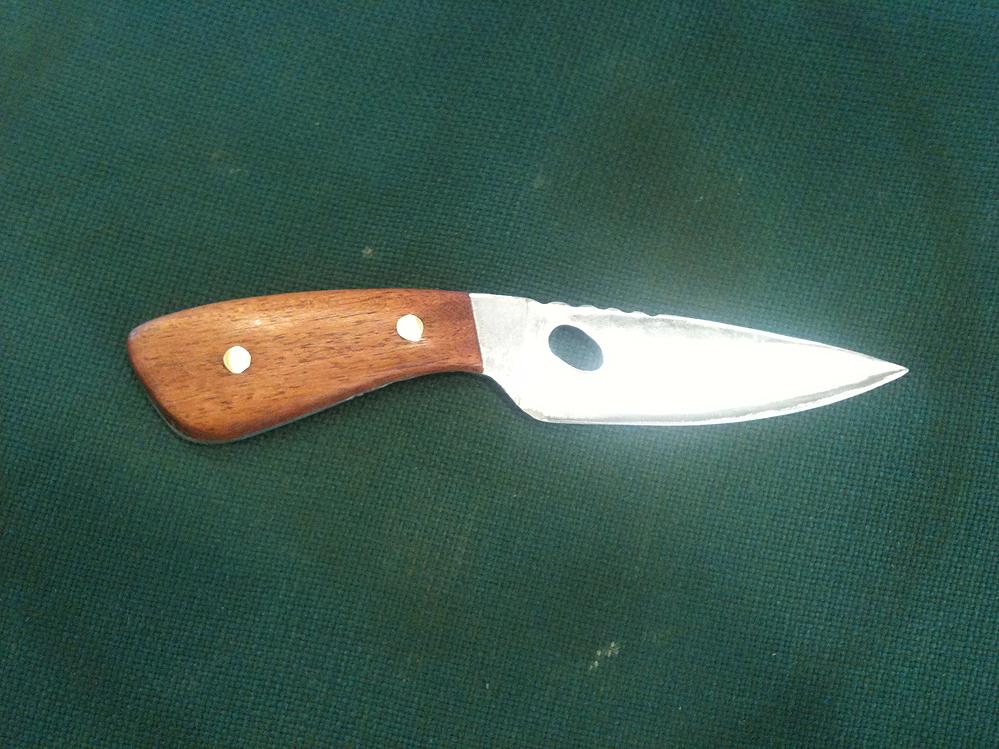
First knife in half a year, rather proud of a few things.

Joined
Jul 19, 2014
Messages
92
6xI7DbY.jpg


I took 7 pictures of it from different angles, but the light was just bad when I was finishing up.

This knife was made from unknown steel.
At the time I didn't have my new order of 1084 yet, so when I saw an old lawnmower that somebody had pitched into our scrap metal bin I pulled the blade off that to use.
The knife is forged mostly, I did to a lot of stock removal later but I did make a point to forge it as close to shape as I could which is more then I would normally do, but I've missed forging.

I've lost count of how many I have done now, more then 25, less then 50 I'd say is a safe bet. I am still not nearly as good as some of the guys who come on here with their "5th knife" posts, I just am not very handy, but I still try.

Anyways I haven't done anything at all really for at least 4-6 months, but I found a burst of motivation recently, and had some extra cash.
So I went and got a few things to upgrade my homemade forge, like a bag of some cement which is supposed to contain/reflect heat. Also, 6 10lb bags of charcoal, a new hairdryer blower and an extra backup blower for when I burn the first one out.
I got some vegetable oil for quenching, and an extra "mini oven" which one would use in a kitchen for pizza. I have 2 half inch plates I place in there and heat up for an hour at 450 until the plates are the same temp and hold that heat (verified by temp gun it is in tempering range.)
After quench, about 5 minutes later I place my blade in between the two heated plates in the oven for the appropriate time.

Really looking forward to getting back into this and swinging some serious hammers.
 
Oh wow, 100 views and no comments. I suppose I did something wrong...

Can you guys at least try to give me an ID of the wood I used for the handle?
I have several strips of it which I tore from an old dresser, it was sitting beside a dumpster in the ally (lol). It looked like nice wood though so I took what I could use. It certainly finished up decent, IMO...
It was a rather hard wood, the files I used to shape didn't seem to like it much, and it had a natural dark red color to it.
Once I had it sanded to 2000 grit it lightened up quite a bit but the grain was still clear and it had a reddish hue yet.
The oil I rubbed in after darkened it to almost it's original color again.
Not much to go off of, but I know a lot of you know a thing or two about wood and can perhaps identify it. I was told "mahogany" by one guy, but I don't know if he has any idea what he is talking about.
 
Can't help on the wood type. I do like the blade it looks very practical and like it would have good ergos. I'm curious what the hole is for though?
 
Can't help on the wood type. I do like the blade it looks very practical and like it would have good ergos. I'm curious what the hole is for though?
The hole has no real purpose honestly...
I know spyderco's have a circle hole in them a lot, I've always liked their style. I wanted to add some character to the blade so I did that, and then decided to, uh "oblong" the shape a bit in my own style.
Does it make it look bad, or compromise the blades integrity in anyway?
 
It looks cool, I like the look of the hole. wish I could use a forge ( bad lungs) keep up the good work !
 
IMHO, a hole in a blade is a place for it to break. I know Spyderco uses that as a trademark, but there are many things on the market done primarily for looks and not so much for strength or engineering.

It could be the photo, but the edge looks sort of indistinct or polished out, and the blade finish looks a bit lacking. Again, this may be a fault of the photo, which has too much reflection.

The jimping actually has a use on a blade like yours, but it also looks over buffed and "rounded over".

As to the wood, it is hard to tell from just a photo, but Osage orange and several other woods darken considerably with age, and turn much lighter when cut and sanded. It could be cherry, a flooring wood (ipe, teak, Brazilian cherry, etc.), or any of a number of woods.

The other suggestion I have is to put your handle scales together ( off the knife blade) and shape and sand the front end to the final grit. This makes sure they are even as well as finished after they are mounted on the tang. The rest of the handle can be shaped and sanded after assembly, but the very front isn't accessible without marring the blade surface. Your very straight handle front would look a lot better with a slight curve. Also, it seems slanted the wrong way. Usually it is a tad more forward on the top than the bottom, with the edge curving down from top to bottom just a bit.
 
I like it, as others stated, the ergos are nice. I pretty positive the handle is Oak.
 
I like it, as others stated, the ergos are nice. I pretty positive the handle is Oak.

Ha! I'm pretty positive that it is NOT oak, I don't see any signs of the grain being ring-porous and oak typically isn't that brown unless stained. My first thought on the wood was mahogany.
 
I would have guessed mahogany as a possibility by the grain, but when re-reading his OP, he said it was really hard to work and file, and that it came a dresser. Mahogany is most often a veneer wood in dressers in modern days, and works rather easily. Cherry could be a solid wood from a dresser....who knows.


Gendry,
I didn't mention it in my earlier post, but one reason there probably were many views and no comments was the lawn mower blade thing. When someone says they made it from a lawn mower and are proud of it, most of us just avoid the argument and say nothing. Lawn mower blades will make a fair to poor knife in most every case. there are some who defend their use for one reason or another, and that has caused some disagreeable threads in the past. It would be a good idea to make future blades from known steel. In learning, simple steels in the 0.70% to 0.90% carbon range forge and HT well. 1070, 1080, 1084, O-1, and 5160 all are good and low cost.
 
Back
Top