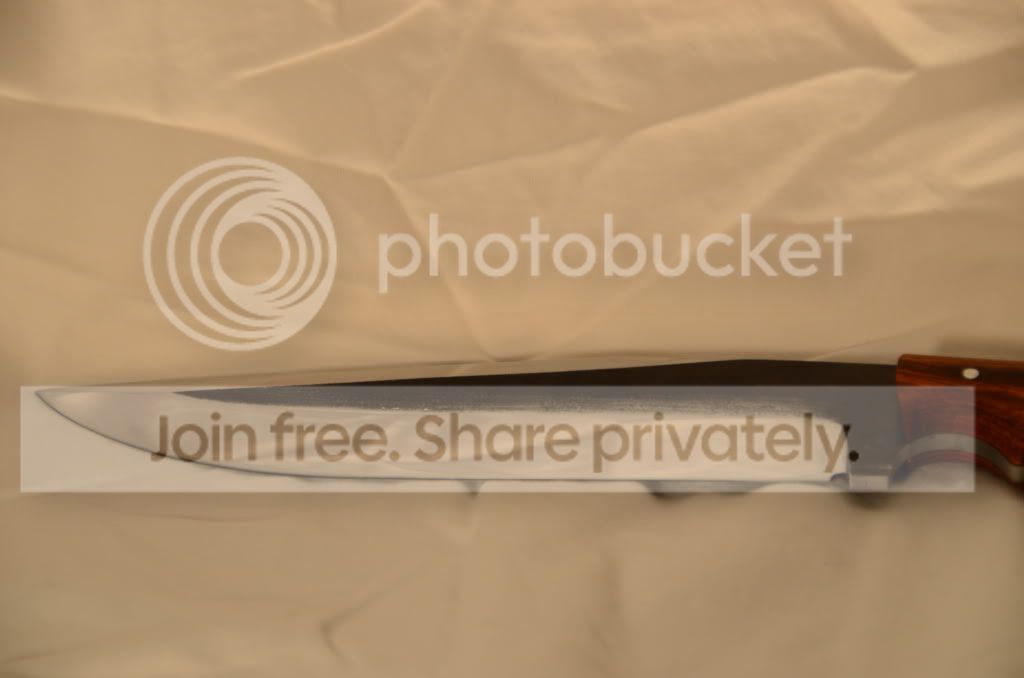
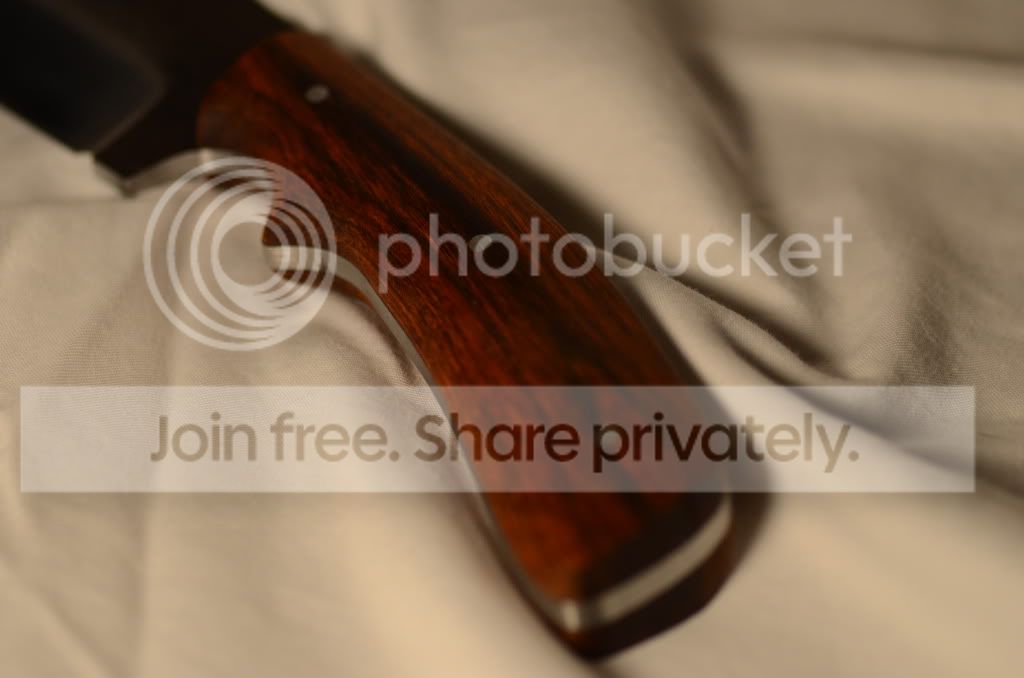
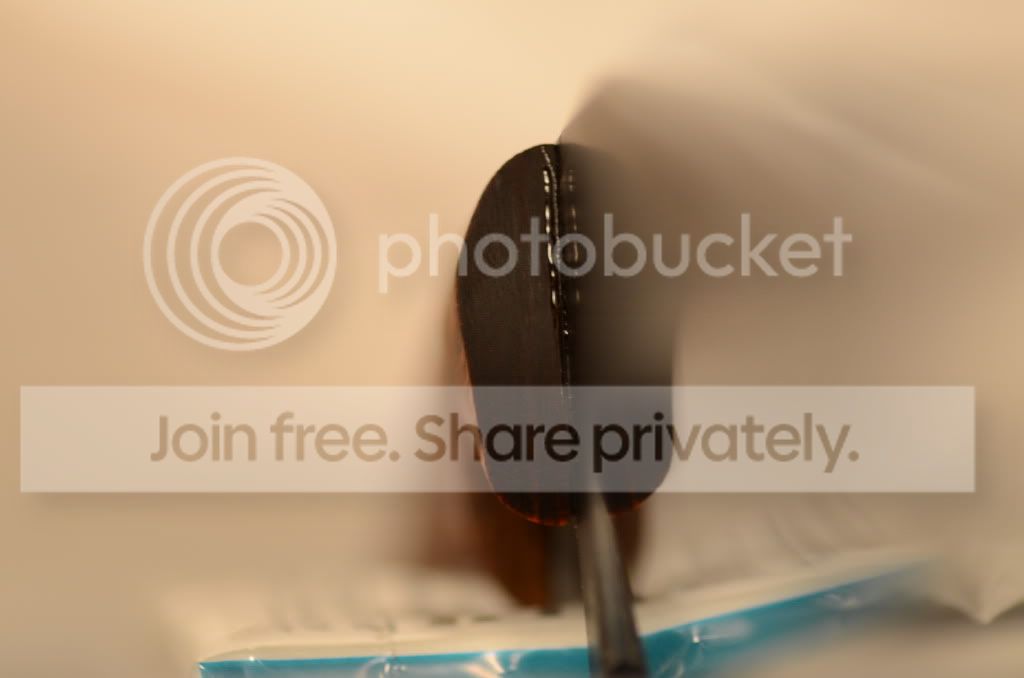
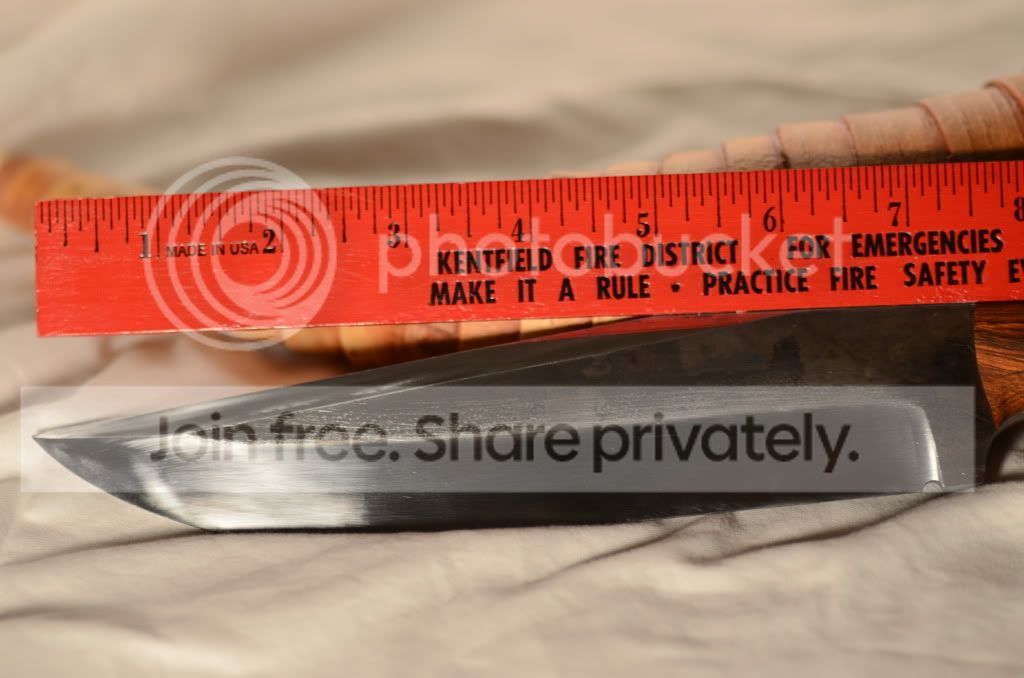
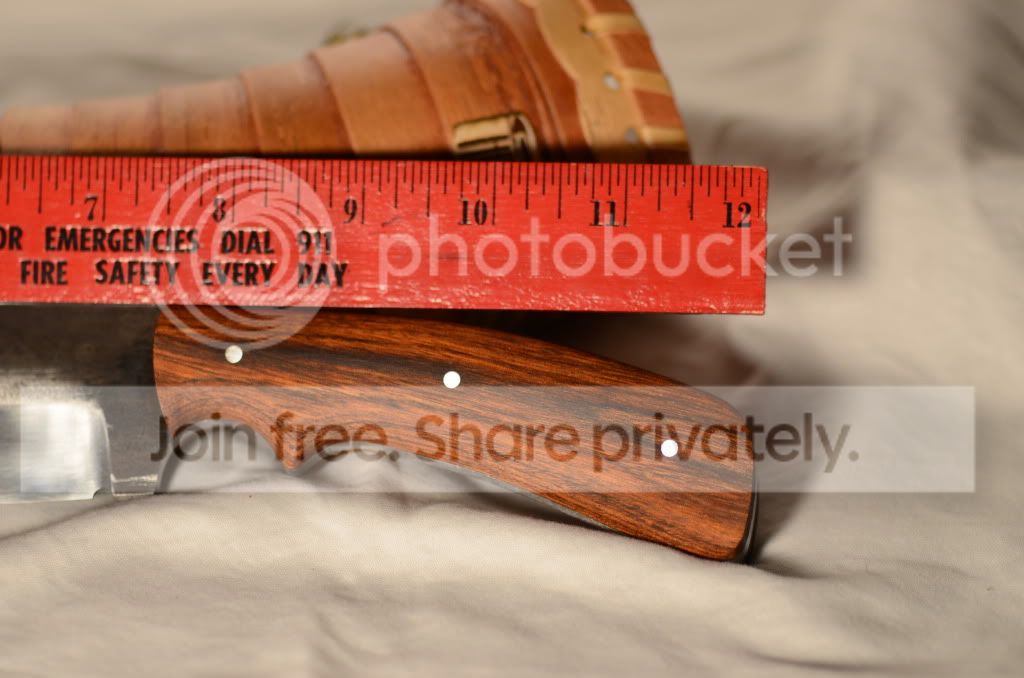
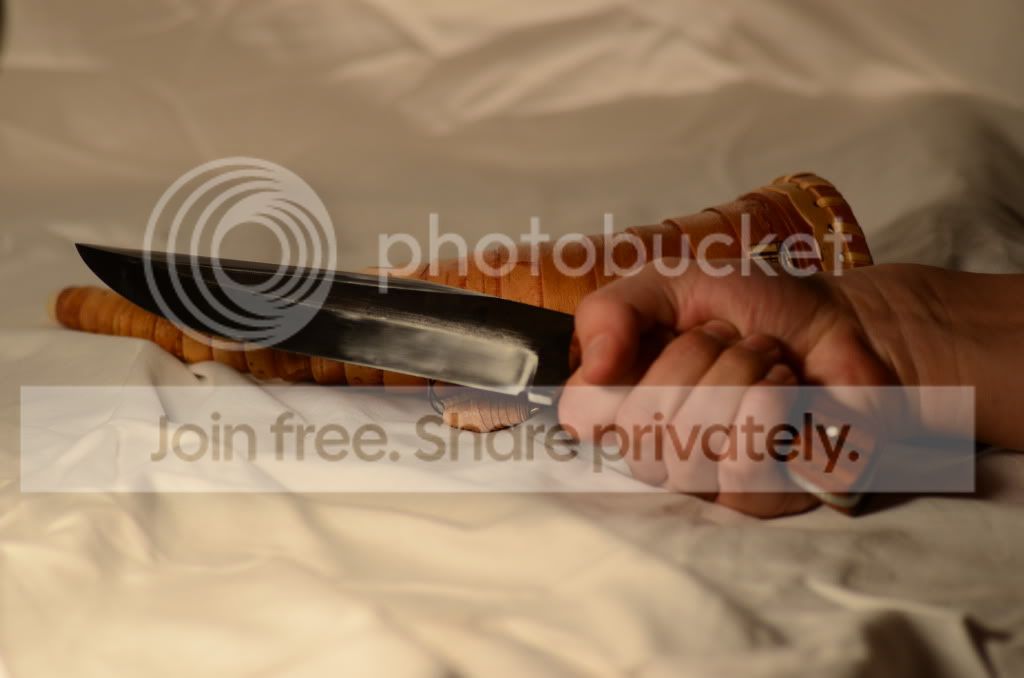
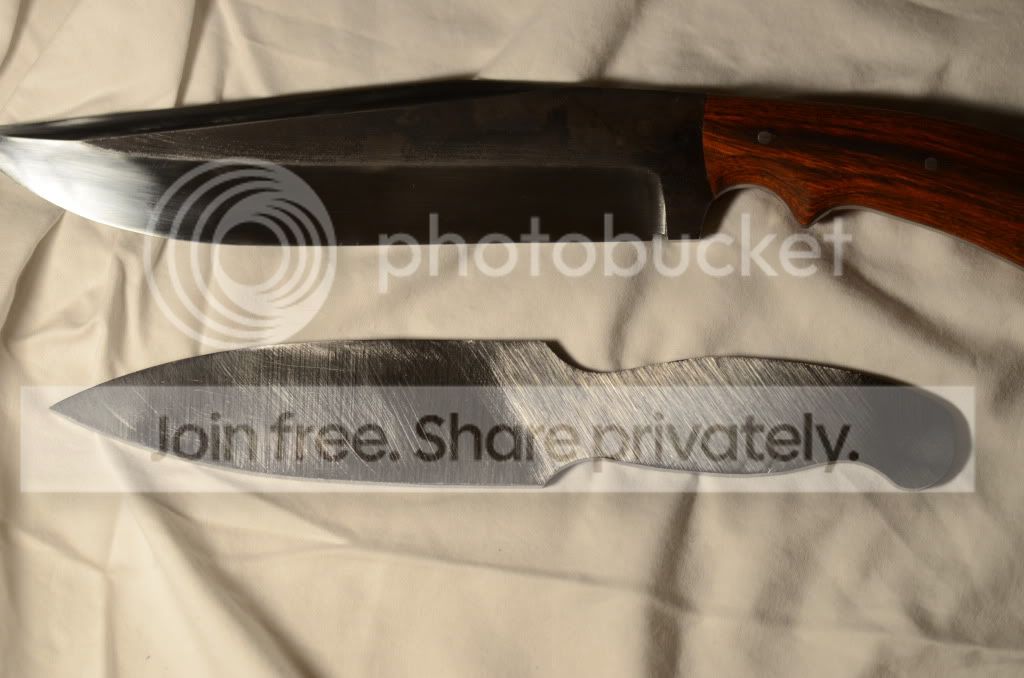
First knife just about complete

Joined
Feb 3, 2012
Messages
87
Well, after my blade was returned from heat treatment this weekend (thank you Jeff Mutz from Tru Grit, I recommend him heartily), I finally managed to put together what resembles an honest to god knife. All that remains is hand sanding the spine and putting on the edge.
It may have been unwise to start with as large a blade as I did, but I feel as if it came out all right.

Edit: The smudges on the blade are from fingerprints or something, but the hand rubbed finish is still foggier than I'd like. Any advice in that regard is more than welcome, I've been using my approximation of Nick Wheeler's technique, but my results aren't quite what I want.

Specs first-
Steel: 1095 from Jantz, ~59HRC heat treat by Jeff Mutz
Finish: 2500 grit hand sanding on bevels and swedge, heat treat oxides left on flats
Handle: Stabilized Cocobolo, SS pins
OAL: 12"
Blade: 7.5"
Handle: 4.5"
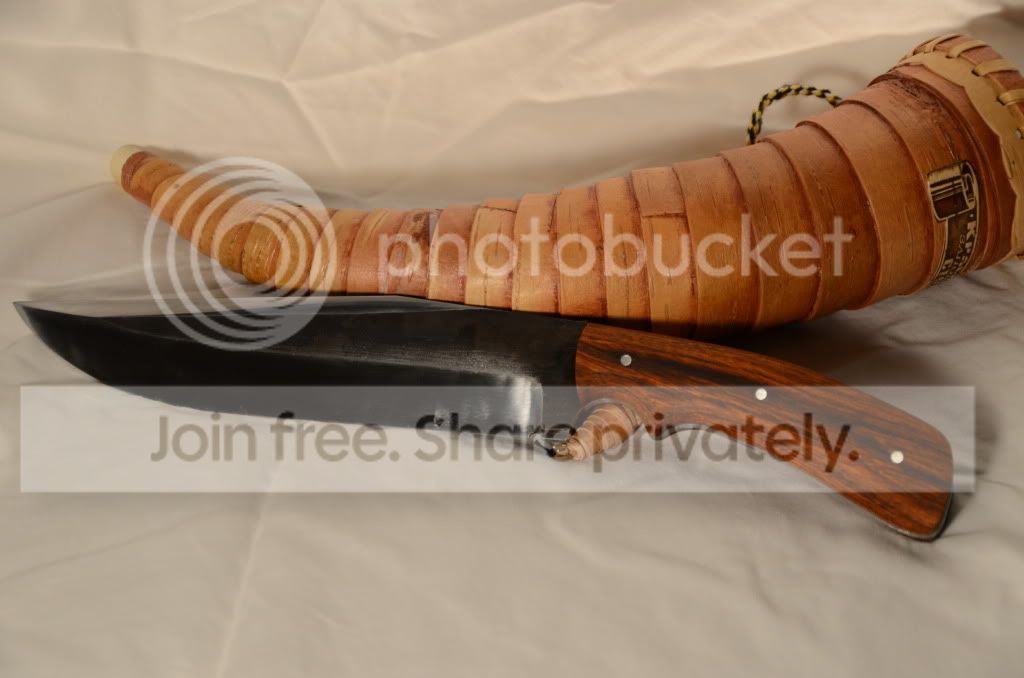
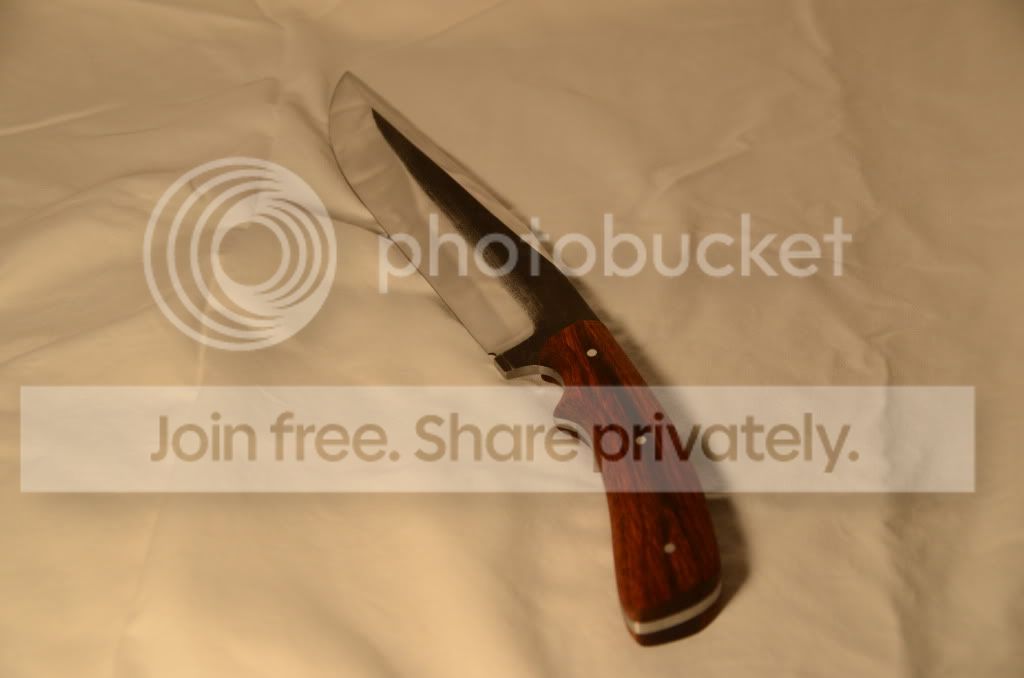
DSC_0169.jpg

DSC_0170.jpg

DSC_0177.jpg

DSC_0183.jpg

DSC_0182.jpg

DSC_0194.jpg

DSC_0195.jpg


And of course, in hand
DSC_0192.jpg


And I've got a good dozen more on my photobucket account detailing my mess ups, if you want to criticize, check em out here: http://s1268.photobucket.com/albums/jj577/t_davis925/
 
Last edited:
Outstanding first knife! It really is looking great.

You asked about the finish, I think you are seeing what is left of earlier scratches. It is hard to guess what grit by looking at the photos but maybe 120 or so. To solve this problem on later knives just use a marker in between grits or change angles at each grit so you can see your progress. The scratches are no big deal on your first knife, it really looks good!

Keep up the great work!
 
That's your first????? Do you have like 25 cast-offs somewhere???

SUPER JOB!!! :thumbup: :cool:

I really can't tell from the photos what's going on. I mean, there are definitly some "start-stops" but I can't tell if that's all there is or not. To avoid those, use long, smooth, consistant "pulls" from plung to tip. It sounds easier than it is, when you're first learning to do it. I recommend pulling by drawing your bodyweight back on the final pulls, not by using your arms to do the pulling. On your sanding block face, something that's got just a little give can help, and is essential if you have some convexity to your bevel.

IMHO- You have an eye for flowing lines and ergonomics that many don't ever get. Can't wait to see what you come up with next. :)
 
Earlier scratches are almost certainly the culprit... I don't think I took long enough using the middle grits when I was hand sanding. My grit progression was 80, 120, 220, 320, 600, 1000, 1500, 2500. Is 320-600 too big of a jump? And thank you for the advice, I'll certainly be trying all this in the future. Nick, do you have any recommendations for sanding block material? Right now I'm using a flat piece of mild steel with the back end rounded and the front with a sort of chisel grind, much like the one you use in your hand sanding video.
 
For the very last pulls, I use a block that's shaped a lot like that the one in the video, but it has really wide handles so it doesn't "skid." And I glued some really hard rubber to it. Since I'm not sure where you can get that particular rubber, my next choices would be thin leather, or plumbing gasket. Just gotta be careful to not get the stuff that's super soft, as it can wash out crisp lines.

What paper are you using? With Rhyno I usually go 320, 500, 800 and so on.

Some advice you didn't ask for---- ;) I'd recommend you shoot for 500 or 600 for now, and try to really, really nail it--- super clean and consistent. A super clean finish, even at something like 220X can look awesome IMHO.
 
The lines are great and the overall package is excellent.

Taking the blade flats to 400 grit would greatly improve the look. Other than that there is little to critique.

Question - Stabilized cocobola? Any details on that?
 
Yep on the stablized coco? I too really like the flow of this knife.
 
You'll be making more knives :)
I realy like the looks of the knife.
I go 320- 600 or 280-400-600
Just make sure to be strict to have removed ALL the prefious sandmarks. I've used a loupe to check a few times.
 
Looks like there's some epoxy left on the fronts of the scales. It's best to wipe off all you can with acetone and a rag before it sets up, but you can scrape it off even afterwards (I almost always have to do that). Use a small piece of brass square or round stock, ground to a chisel "point". It will scrape off the dried epoxy but won't scratch the blade or handle if you're careful.

Other than that - carry on! :thumbup:
 
Nick- I'm using Rhynowet from 600 up, and Norton 3X for the lower grits. The Rhyno is great stuff, really glad I invested in that. I might try a piece of pine, or alder attached to the steel bar in the future, see if that works.

Stacy- I like the contrast between the kiln scale and the polished bevels, so I left it on the flats.

James- I knew I'd have some squeeze-out, and I planned on taking a q-tip and some acetone to it, but as luck would have it my dad had moved the acetone under a pile of crap, and I didn't find it until too late. I was being impatient and used 5 minute epoxy, stupid me. I would scrape it off, but it would probably scratch the scale.

I had a feeling the stabilized cocobolo would raise some eyebrows- I got it from Jantz, and it's definitely cocobolo, and definitely stabilized. I know now that stabilizing cocobolo is unnecessary, but I didn't at the time of purchase, and there's really no downside, so whatever- I can't remember the price exactly, but it was certainly inexpensive.
 
Here's a pic of my next blade profiled out, if anyone wants to critique... I wish I had made the handle a little more downswept, and plan on doing a full flat grind.

DSC_0199.jpg
 
Back
Top