
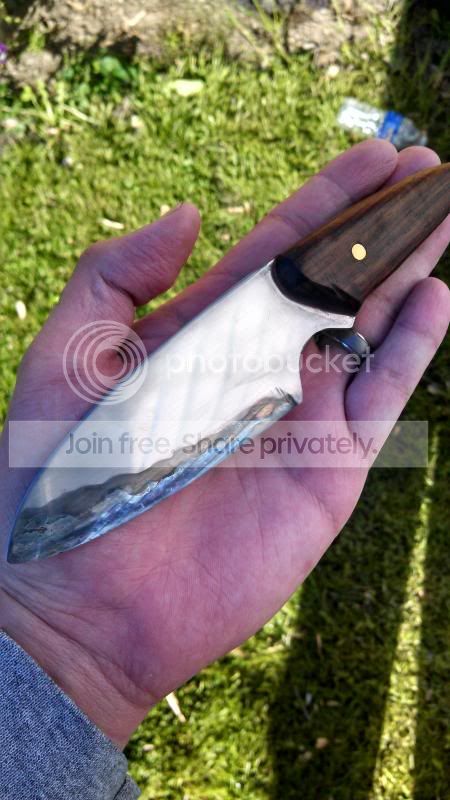
Finally finished one free of forge slop and cold shuts!
Been forging over a year now but never heat treated one. I am extremely grateful to the forge I trained at but I I was only permitted a coal forge, outside, with no shade and no heat measurement tools to speak of so it seemed like a waste of time to attempt even normalizing by sight alone in those conditions.
Blade started out as a kitchen knife but I dropped it into the fire while dodging bullets and lost the entire tang.
Recently I had a talk with the law (wife) and acquired the tools for a small operation including a small gas forge.
Aldo's W2 circa last summer
Shape was freehanded
Triple normalized to non-magnetic and a far bit of change with stepped decrements at each cycle.
Quenched in mineral oil.
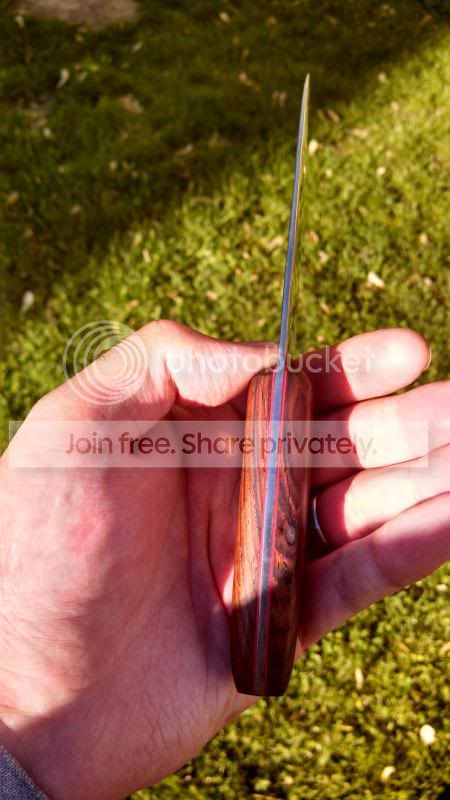
Brass pin, red spacers, cocobolo handle.
Obvious sins a chump with a cheap belt grinder on the handle but not as noticeable in person.
Forced patina covers up some sharpening slop but I have vowed to use this knife every day so over the course of a few sharpenings it will have a Mirror polish on the cutting edge and I will abandon the forced patina.
About 1.75mm (guess) @ the ricasso..
I know the handle seems small but it is very comfortable and should be up to handling up to fairly moderate tasks.
Comments and criticisms more than welcome!
Been forging over a year now but never heat treated one. I am extremely grateful to the forge I trained at but I I was only permitted a coal forge, outside, with no shade and no heat measurement tools to speak of so it seemed like a waste of time to attempt even normalizing by sight alone in those conditions.
Blade started out as a kitchen knife but I dropped it into the fire while dodging bullets and lost the entire tang.
Recently I had a talk with the law (wife) and acquired the tools for a small operation including a small gas forge.
Aldo's W2 circa last summer
Shape was freehanded
Triple normalized to non-magnetic and a far bit of change with stepped decrements at each cycle.
Quenched in mineral oil.
Brass pin, red spacers, cocobolo handle.
Obvious sins a chump with a cheap belt grinder on the handle but not as noticeable in person.
Forced patina covers up some sharpening slop but I have vowed to use this knife every day so over the course of a few sharpenings it will have a Mirror polish on the cutting edge and I will abandon the forced patina.
About 1.75mm (guess) @ the ricasso..
I know the handle seems small but it is very comfortable and should be up to handling up to fairly moderate tasks.
Comments and criticisms more than welcome!
