First Knife - Sheepsfoot WIP!! - (Pic Heavy)

Joined
Aug 2, 2009
Messages
525
So I just got finished with my two year long belt grinder build. :D It really did not take two years of work, just two years of sitting before finally getting it all completed this past weekend.

You can check it out here:

http://www.bladeforums.com/forums/showthread.php/908014-The-VHG-Belt-Grinder-Build-%28PICTURE-Heavy!%29

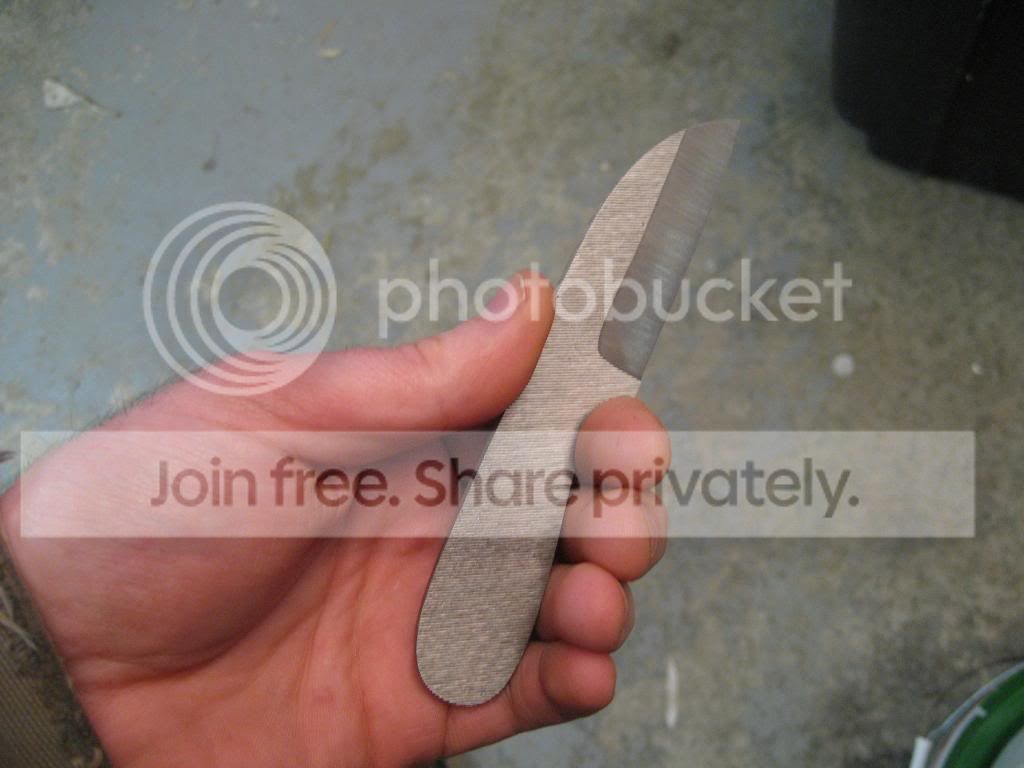
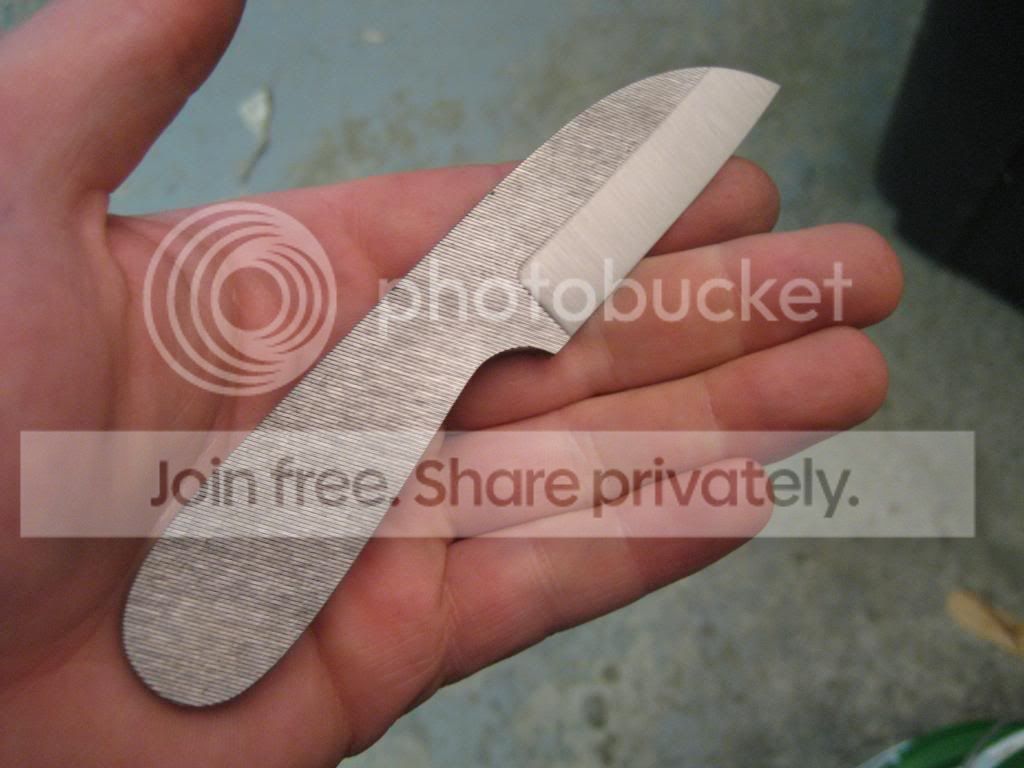
Anyways to get started on my first knife I felt like making a small sheepsfoot style knife. Something that I could make fairly quick and get into the process of grinding blades. I was going to get some 1084 flat-stock ordered for NJ Steel Baron, but they are backlogged, so I just used an old worn Nicholson file from my shop. One of these days it would be nice to get an order in for some 1084, but until then I will make a few knifes from the pile of old files I have in my shop. Only problem with that is it limits the size of knives I can make.

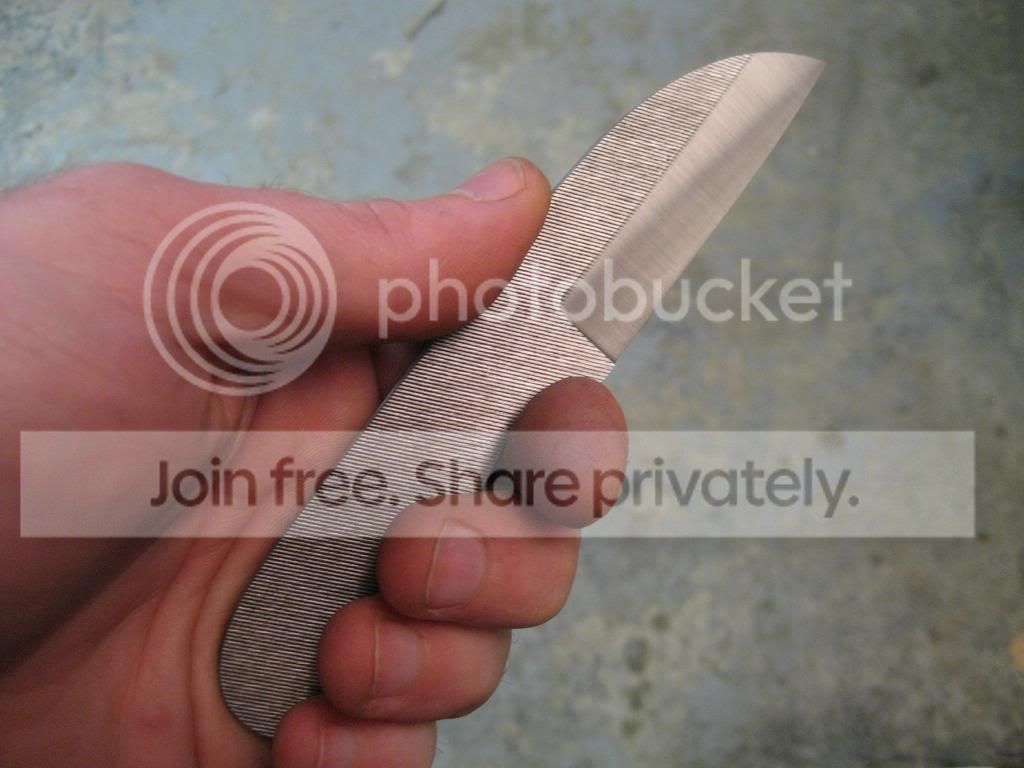
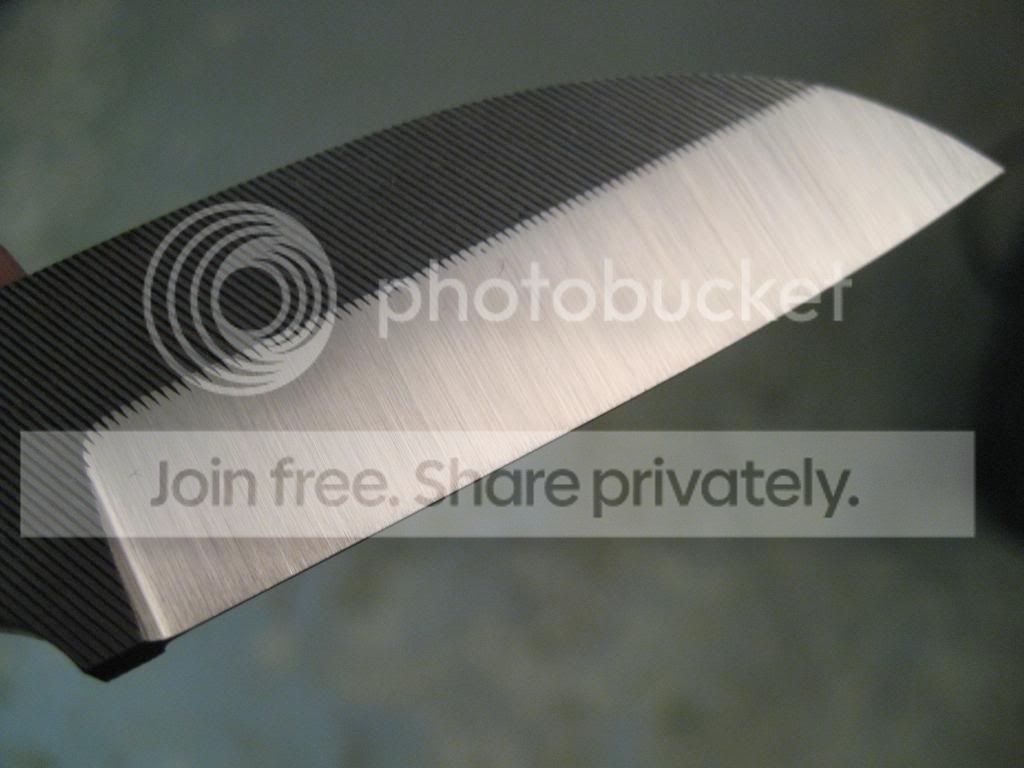
Anyways here is what I have so far. I wanted to leave some of the old file marks to show the knifes pedigree. Maybe it would be better to grind them off but I think it adds a little pizazz.

Here is where it is as now.
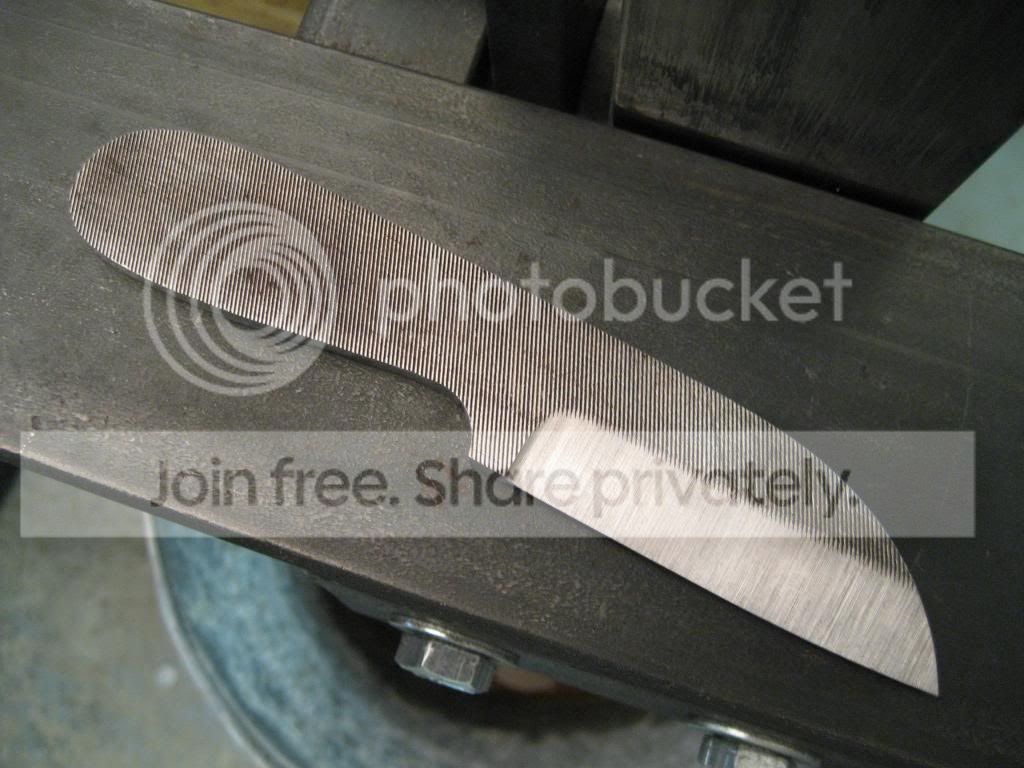
IMG_7883.jpg


This was before hitting it with a 120 ceramic belt.
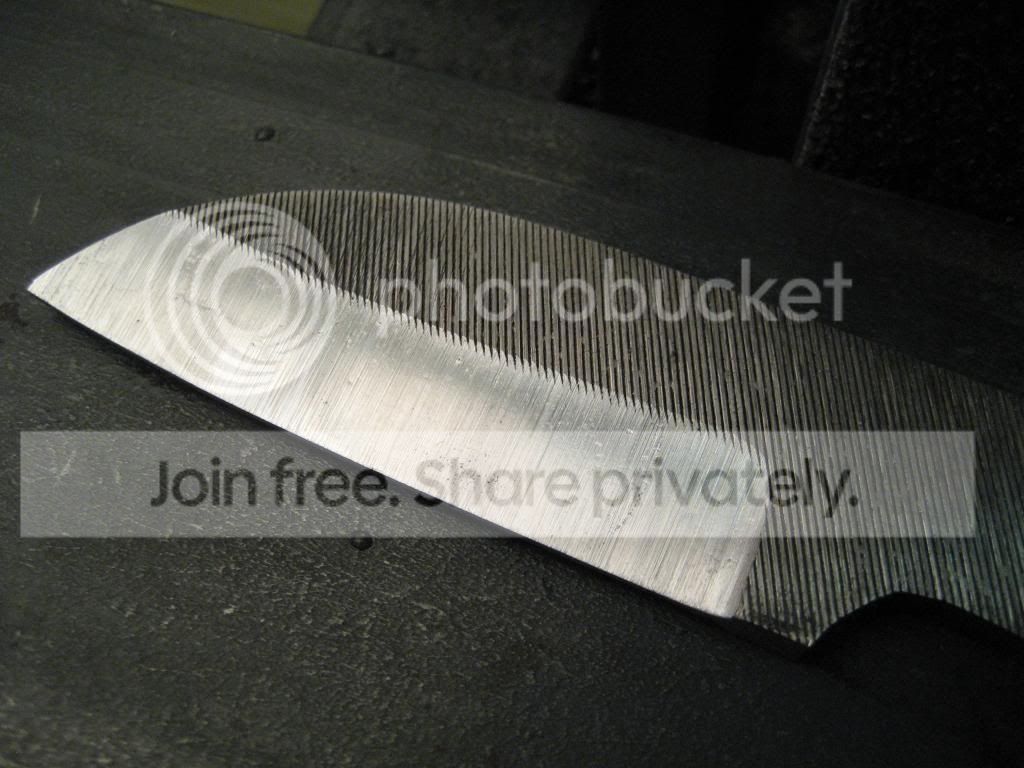
IMG_7872.jpg


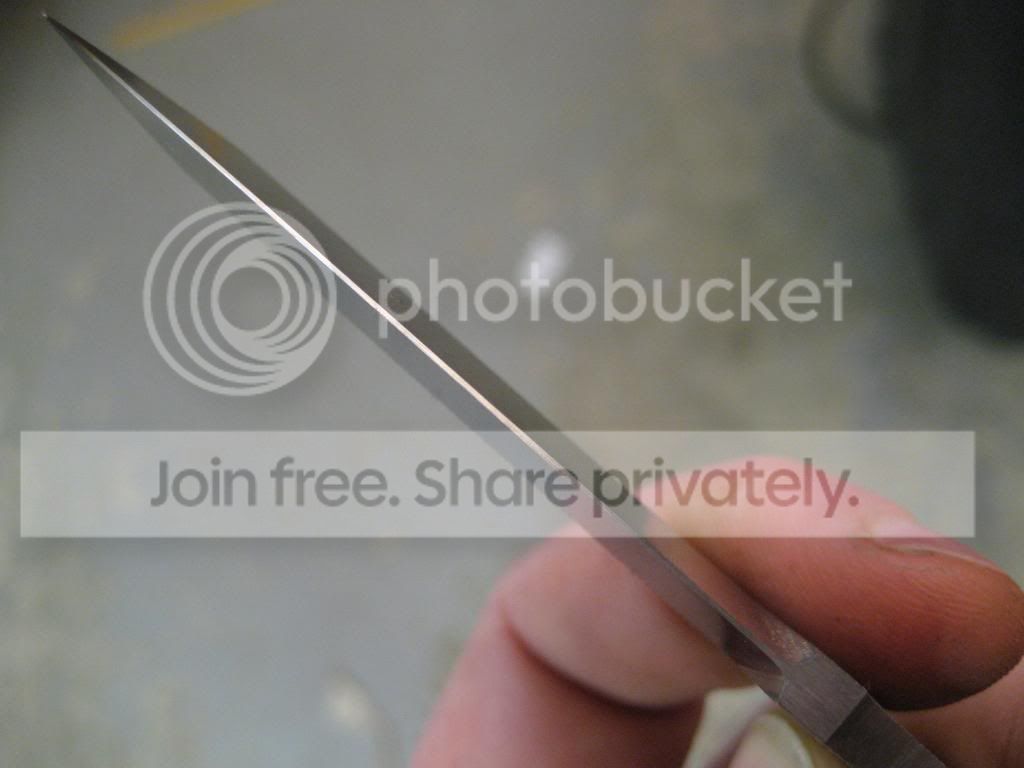
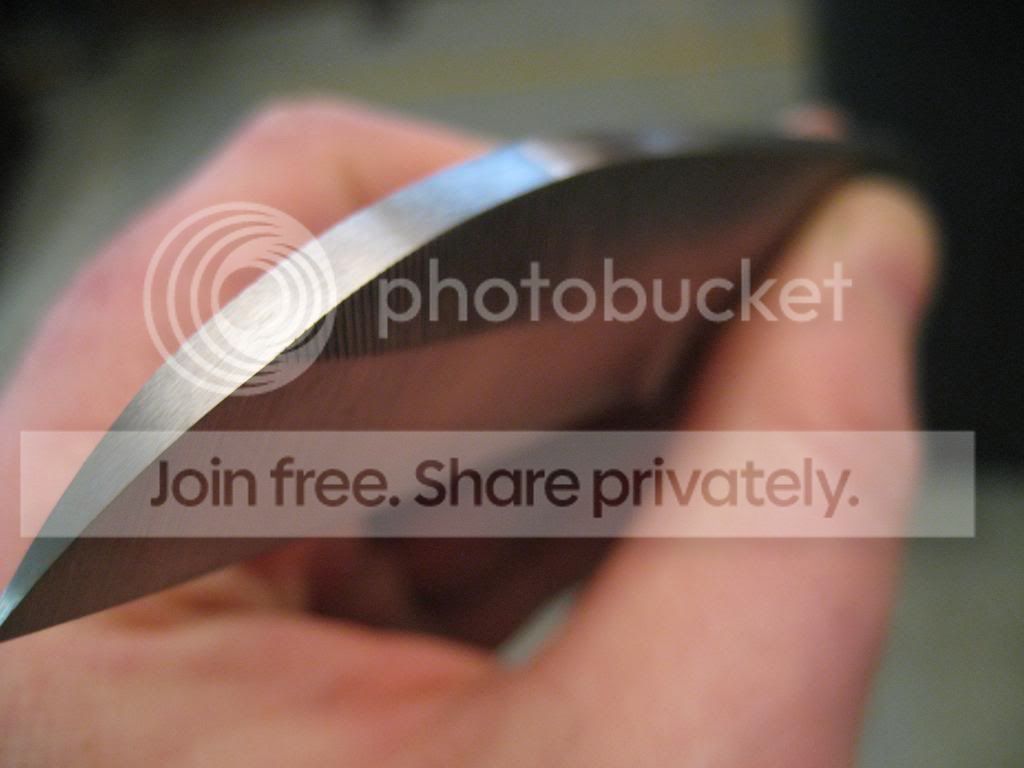
Picture showing the grind so far. Is this far enough before heat treating?

IMG_7879.jpg


Here is a shot showing the general size.
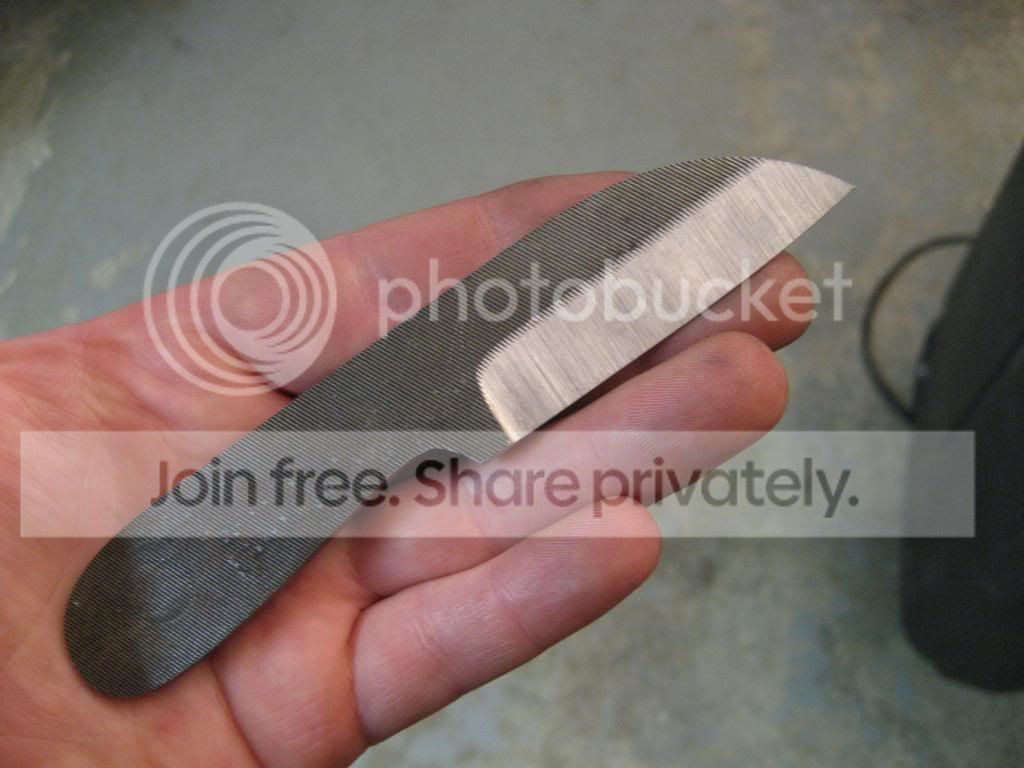
IMG_7881.jpg


Comments and constructive criticism is appreciated.

Thanks,
Dave
 
Last edited:
I have a few questions as well.

I was thinking of putting on some wood handle scales, but where I live there are no local sources for anything besides oak and pine. Don't think either of those is what I want to use. Do you guys have some suggestions of good handle material that I might be able to find without having to order something? I am also considering just drilling some holes and doing a para cord wrap, but not sold on that idea at the moment. I would like a more professional look to this knife.

Also I have read that the old Nicholson files were made out of 1095 or maybe W-1. Is this correct and if so what would be the best procedure for heat treating. I have heat treated 4140 and lots of O-1 in my machine shop so I am not completely new to the process, however this will be my first real knife to heat treat so I could use some pointers.

Thanks a lot,
Dave
 
Hey Dave -

Glad to see you working with your new grinder. Killer job there BTW. Thanks for the 2yr follow up on that thread – was starting to think aliens got you or something.:eek:

Your file knife looks solid so far. Great grinds for a first go-round on that machine. I’ll offer some thoughts and your may use or toss at will.

Most knives, even at this small scale, can benefit from a continuous slight curve to the spine; from point to butt. It’s both functional and aesthetic in many cases. Study.

The choil at that radius will likely tell your index finger to lose weight if you work this one hard. Suggest you open the choil to a 0.75”+ minimum radius.

Your current edge can go a lot thinner depending on your HT resources. Most makers will take CS edges down to 0.015 to 0.020” and finish laterally to 400 to 600 grit before HT. There’s a lot of variance in this setup among makers and it doesn’t seem to matter as long as you understand why you do what you do IMHO.

That steel in unknown so the ideal HT will just be an educated guess at best. What HT and quench resources do you have at hand now? That makes all the difference as I’m sure you have already figured.

Finally, look at how far the file’s tooth cuts make their way onto your bevels as is. On top of that the steel beneath each cut is seriously jacked with during original production. You will likely find the diagonal tooth “tracks” extending further into your fresh ground bevels upon a simple FeCL etch. That tells you something about whether they should ideally be removed or left for character. Also tells you about the value of a solid normalization protocol before quench. More study.

My easy guess is that you are very competent in the shop and just have to keep patiently working till your personal vision catches up with your hand skills. In the meantime become your own worst critic and never ignore a known problem, error or shortcoming on a tool if it is intended for another person (whether a gift or a cu$tom). You may not be able to do anything about it this time but there’s always the next one.

Looks great and keep running!
 
You got some excellent advice above.......................

My 2 cents worth is this:

I have a real affection for knives made from files and wharncliffe/sheepsfoot style blades so you get thumbs up for styling. I think the handle is a bit short but it depends on what you, ultimately, use if for. I'm sure you know that this sucker will rust madly if you're not careful!

I wish my first knife making attempt had looked this good. I think you're putting that grinder to good use.

One final thought, before you heat treat this blade, don't forget a couple of holes in the handle for bolts and maybe a third for a lanyard. If you decide to do a cord wrap you're gonna want more I think.

Corey "synthesist" Gimbel
 
Hey Dave -

Glad to see you working with your new grinder. Killer job there BTW. Thanks for the 2yr follow up on that thread – was starting to think aliens got you or something.:eek:

Your file knife looks solid so far. Great grinds for a first go-round on that machine. I’ll offer some thoughts and your may use or toss at will.

Most knives, even at this small scale, can benefit from a continuous slight curve to the spine; from point to butt. It’s both functional and aesthetic in many cases. Study.

Thanks for the compliment on the grinder. I still need to post more of the build pictures but now I am sidetracked with putting it to use. Hehe. Yes I see what you mean about having a slight curve on the spine. I had thought about that but was unsure if I should take more off the handle as it is already fairy narrow due to the limited steel width from the file. Maybe I could take a little more off of the blade side and a smidge on the handle side to give it a little more curve.

The choil at that radius will likely tell your index finger to lose weight if you work this one hard. Suggest you open the choil to a 0.75”+ minimum radius.

Right now it is has a radius of .280" as I used a sanding drum of .560" diameter. I do not have a small wheel attachment at the moment for the grinder, but I think I could manage a larger radius with a small sanding drum in my Foredom rotary tool. You mention a .75 radius. So you are suggesting a 1.5" wheel to make the choil? That seems awfully large. Or do you mean a .375 radius / .750" diameter wheel?

Your current edge can go a lot thinner depending on your HT resources. Most makers will take CS edges down to 0.015 to 0.020” and finish laterally to 400 to 600 grit before HT. There’s a lot of variance in this setup among makers and it doesn’t seem to matter as long as you understand why you do what you do IMHO.

OK, I was thinking it could go thinner but did not want to take it too thin before asking here. I believe I measures it at .058", or somewhere around that as I didn't write it down. So I can thin it out to about a third of what it is now.

That steel in unknown so the ideal HT will just be an educated guess at best. What HT and quench resources do you have at hand now? That makes all the difference as I’m sure you have already figured.

I am limited to just a charcoal forge and a Ody-Acetelyne torch. I usually use the forge for most of my heat treating needs.

Finally, look at how far the file’s tooth cuts make their way onto your bevels as is. On top of that the steel beneath each cut is seriously jacked with during original production. You will likely find the diagonal tooth “tracks” extending further into your fresh ground bevels upon a simple FeCL etch. That tells you something about whether they should ideally be removed or left for character. Also tells you about the value of a solid normalization protocol before quench. More study.

I am not sure what you mean when you say the steel was jacked with during original production. I can go pick up some FeCl at Radio Shack and etch it so see what the file teeth cuts look like if that would be helpful. I do not know what I would be looking at though after the etch as far as the normalization goes.

My easy guess is that you are very competent in the shop and just have to keep patiently working till your personal vision catches up with your hand skills. In the meantime become your own worst critic and never ignore a known problem, error or shortcoming on a tool if it is intended for another person (whether a gift or a cu$tom). You may not be able to do anything about it this time but there’s always the next one.

Looks great and keep running!

Thanks a lot for your feedback. I appreciate it. I can use all the help I can get into this new venture. I grew up working metal and wood so I have a head start there I suppose. Being a user of knives helps as well. I have always wanted to make knives since I was in high school and bought the newly released book "How To Make Knives" by Barney and Loveless back in '95. It has taken a long time to get here though and I have a long way to go till I can call myself a knife maker. I would love to be able to do this on a small custom basis.

Thanks again,
Dave
 
You got some excellent advice above.......................

My 2 cents worth is this:

I have a real affection for knives made from files and wharncliffe/sheepsfoot style blades so you get thumbs up for styling. I think the handle is a bit short but it depends on what you, ultimately, use if for. I'm sure you know that this sucker will rust madly if you're not careful!

I wish my first knife making attempt had looked this good. I think you're putting that grinder to good use.

One final thought, before you heat treat this blade, don't forget a couple of holes in the handle for bolts and maybe a third for a lanyard. If you decide to do a cord wrap you're gonna want more I think.

Corey "synthesist" Gimbel

Thanks for the compliments on my first attempt. The short handle was to make this kind of like a neck knife style three finger set up. Seems pretty comfy despite the lack of handle scales. We will see. I have never owned a small knife like this so it is a first for me.

I was thinking of doing a forced patina after heat treating. I have done this on numerous knifes and I like the look as well as the rust protection it offers.

Yeah I have yet to decide on a handle material so I was holding off drilling it until I decide on pinned scales or just milling a slot for a para cord wrap. Leaning towards something more finished like handle scales.

Thanks,
Dave
 
One other thought about the handle scales is to use bone. Just outside of our small town (pop. 6000) we have a small slaughterhouse what would have lots of free cow thigh bones which I could cut into pieces for handle scales on the bandsaw. I have a vacuum chamber so I could vacuum stabilize them so that they wouldn't shrink and crack over time. I think bone would probably look nice on this knife.
 
You're gonna do well at this Dave... I can smell it from here!

Haha you're right of course on the choil, I thought drum diameter but wrote radius/nonsense instead. Getting the choils and chamfers sized right can go a long way toward usability in a small knife.

On the steel itself; it's an unknown alloy any way you slice it. Considering your heat treat gear you can still do a fair job with either source and with more study. Especially issues about HT of hypereutectoid steels without reliable temp controls. Big challenges there but gotta start somewhere eh?

So suggest enjoying the process right here and expect a great user/keeper in the end. Craft is time spent and hopefully from the heart. You can maybe sell it later but you can't buy your way in up front (ie. it's not just about the tooling).

As far as the file being jacked up; the cutting operation to form the original file teeth was harsh enough that the steel several thou below the tooth gullets is affected. Guessing maybe micro fractures but don't honestly know. I do know they survive a quality HT intended for fast steels. Drives you nuts because you'll sand them out then on next etch/patination/etc they show up like new. Grind back .03" or so and they'll go away. Normalize too. Some say it's a potential comb of stress risers leaving teeth on a file knife but are you likely to get enough leverage with that handle to test it?

Forget the bone. It's nasty oily from the packer and takes more time and prep than you might expect and is known for failure anyway. Message me if you want and I'll send you some scale material. Also look around for good stuff you can resaw. Good news is your knife tang should be near flat and parallel already.

Hope that helps.
 
You're gonna do well at this Dave... I can smell it from here!

Haha you're right of course on the choil, I thought drum diameter but wrote radius/nonsense instead. Getting the choils and chamfers sized right can go a long way toward usability in a small knife.

On the steel itself; it's an unknown alloy any way you slice it. Considering your heat treat gear you can still do a fair job with either source and with more study. Especially issues about HT of hypereutectoid steels without reliable temp controls. Big challenges there but gotta start somewhere eh?

So suggest enjoying the process right here and expect a great user/keeper in the end. Craft is time spent and hopefully from the heart. You can maybe sell it later but you can't buy your way in up front (ie. it's not just about the tooling).

As far as the file being jacked up; the cutting operation to form the original file teeth was harsh enough that the steel several thou below the tooth gullets is affected. Guessing maybe micro fractures but don't honestly know. I do know they survive a quality HT intended for fast steels. Drives you nuts because you'll sand them out then on next etch/patination/etc they show up like new. Grind back .03" or so and they'll go away. Normalize too. Some say it's a potential comb of stress risers leaving teeth on a file knife but are you likely to get enough leverage with that handle to test it?

Forget the bone. It's nasty oily from the packer and takes more time and prep than you might expect and is known for failure anyway. Message me if you want and I'll send you some scale material. Also look around for good stuff you can resaw. Good news is your knife tang should be near flat and parallel already.

Hope that helps.

Thanks Andy. I did some more work on the knife and was going to post some pictures but my camera battery died. So I will get some up tomorrow.

Anyways I opened up the choil to a 13/32" radius which is a 13/16" size drum. I actually just used a 1/2" drum in the rotary tool and nailed a perfectly round radius. Good eye I guess. It feels better now.

Not knowing if it is 1095 or W-1 I think I will just do an oil quench and check for hardness. If it is W-1 it will not get as hard since it is a water quench steel, but it might be best to play it safe. If it does not get hard enough it might be W-1 or 2 and need to be quenched in water. I guess I wont know until I try.

I took the file down in thickness a little bit more. I still kept the file cuts but they are a lot more shallow now. I do not no much about Michael Morris, but he makes a lot of knives like this with apparently no ill effects.

Thanks,
Dave
 
Oh, by the way the edge is actually ground down to .025" not whatever I said previously. :rolleyes: So I should probably be good stopping there for heat treating?
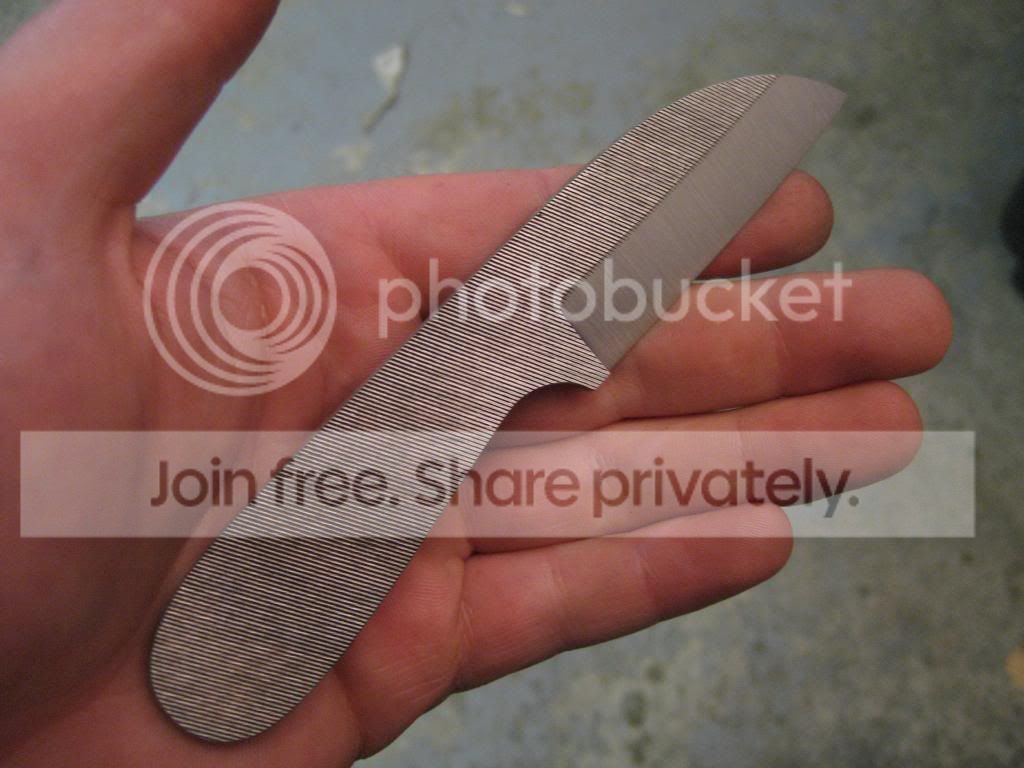
Thanks
Dave
 
If it is a fully hard enable steel, and not case hardened, it is probably about 1% carbon or a bit higher. A fast oil would be the best, but canola oil heated to 130f will work almost as good. If you have temp control, such as a kiln, then soak it at 1465-1470 (don't go much above 1475 if you can avoid it) and quench. temper at 400f for an hour and check for chipping or edge rolling. If chippy, then temper at450f for an hour. Keep going higher by 25f each temper until you are satisfied. If it didn't harden. Try the same temp with brine, and hope you avoid the ping.
 
Willies right. I have made some from old Nicholson files and have done about the same thing he described. The first few i made couldn't hold a good edge, but the ones I have been making lately are holding an outstanding edge and sharpen fairly easily. I haven't had one chip or break doing it that way, and I have been known to abuse my knives
 
If it is a fully hard enable steel, and not case hardened, it is probably about 1% carbon or a bit higher. A fast oil would be the best, but canola oil heated to 130f will work almost as good. If you have temp control, such as a kiln, then soak it at 1465-1470 (don't go much above 1475 if you can avoid it) and quench. temper at 400f for an hour and check for chipping or edge rolling. If chippy, then temper at450f for an hour. Keep going higher by 25f each temper until you are satisfied. If it didn't harden. Try the same temp with brine, and hope you avoid the ping.

Thanks for the advise. I will give this a try. It might be hard for me to hit that temp range as I do not have a temp controlled heat treat oven. I guess a red to bright red would get me close. Soon I am going to check into making either an temp controlled gas furnace or maybe an electric heat treat oven with PID control.
 
Willies right. I have made some from old Nicholson files and have done about the same thing he described. The first few i made couldn't hold a good edge, but the ones I have been making lately are holding an outstanding edge and sharpen fairly easily. I haven't had one chip or break doing it that way, and I have been known to abuse my knives

Good to hear you are getting nice results with old files. I hope this one turns our well. Thanks.
 
Ok so here are some updated photos. I have the bevel and edges sanded down to 400 grit and the edge thinned out even a little more. I need to drill the handle for the scales. Not sure if I just want to use pins or Loveless bolts. I am leaning towards the Loveless bolts for more durability. I was thinking of doing the opposite of what is typical and do a brass screw with stainless sleeve. Just to be different. :D

Here are a few more pictures.

IMG_7893.jpg


IMG_7891.jpg


IMG_7896.jpg


IMG_7899.jpg


IMG_7904.jpg


IMG_7889.jpg


IMG_7892.jpg


Thanks again for checking it out and feedback or suggestions are more then welcome.

Dave
 
Greebe, you've got some scales headed your way.

Cool that is awesome. Once I get the handle scales I can get the holes drilled and get the heat treatment done. Then I can work on the leather sheath. Man this is fun.

Thanks a lot for send some material my way.

Dave
 
Dave,
I think that looks awesome. Fantastic grind lines - looks like you've done this sort of thing before. I didn't think I would, but I really like the file lines you left behind.
I have no idea on HT - but a buddy at work has done a 1/2 dozen or so file knives. I'll see if he's done any on a Nicholson and has any advice.
He generally epoxies a wrap over the tang. I think wood would look and work a bunch better, but he's resluctant to grind his own scales. (Or, maybe, buy a piece of wood?)

Your choil cleaned up nicely. In the first shot I thought the guard was a little big - flows more nicely now.
I know you were thinking r.75 on the choil is big. I tried using a 1" D drum on my BK"151" 11 Necker mod, but it didn't hit it right. I wound up using a 2" D Drum, for a 1" radius. It's a little bigger than necessary, but it looks good to my eye and feels great, if excessively roomy, to my hand. I'd love a .75" radius choil. But I have big hands, and can be a little clumsy.

Fantastic first effort. I'd be very proud of that little guy. I hope you get the HT nailed down so it serves you well for a good long time.
 
Back
Top