
First knife WIP feedback wanted

Joined
Oct 17, 2011
Messages
9,412
Here is an update on my knife. Drilling the holes gave me fits. It is 1084 Aldo and I think I may have work hardened it. Any way I got the holes done and I am wondering if its time to heat treat? I would also like any suggestions as to what I can do to make it come out as nice as possible or suggestions on mistakes I have made so I can do better next time. Thanks a bunch.

DSCN1725.jpg


DSCN1724.jpg


DSCN1723.jpg


DSCN1720.jpg


DSCN1721.jpg


DSCN1722.jpg
 
It looks like you have an edge on that blade???? If so, you need to file/sand it back a bit until the edge is about .030 thick.
 
It looks like you have an edge on that blade???? If so, you need to file/sand it back a bit until the edge is about .030 thick.

Yes, 1+ :thumbup:

Certainly make sure that your cutting edge is filed back until it's at (About) a dime's thickness.
This will prevent warping, especially if your doing the HT yourself.
 
It sort of has an edge. I was doing a full convex I tried to stay away from the tip but lost some of it. Ok so about as thick as a dime guess its going to be a bit shorter yet :) So how do I grind a full convex and stay away from the edge?
 
It sort of has an edge. I was doing a full convex I tried to stay away from the tip but lost some of it. Ok so about as thick as a dime guess its going to be a bit shorter yet :) So how do I grind a full convex and stay away from the edge?
I would say that if you start to have an edge on it just grind it back a little until its about .030 again.
 
A dime is a lot thicker than most folks think. about .05", IIRC. About half a dime is OK.
 
The way you stay away from the edge is by scribing lines.

There's a couple ways to do that. One is to measure the thickness of the material. Say it's 3/16". Take a 3/16" drill bit, lay it on a flat surface(granite plate) and use a sharpie, or dykem to cover the edge. Then holding the drill bit flat draw the steel past the tip of the drill bit. If you use a drill bit slightly smaller than the steel, and flip the blank over it will leave two lines along the center of the blade. When you file DO NOT CROSS THE LINES....

You can also buy a pair of calipers. Measure the steel. Say .250 then adjust the calipers to .110 and scribe a line. Flip the blade and scribe again. It will leave a .030 wide double line.

The flatter the steel the better. Use a granite plate to flatten the blade before laying out the lines.

Hope this helps
 
For a first knife, it doesn't look bad. You're on the right track. I'd suggest buying a file guide to help you keep your plunge lines straight. Most knife supply companies have them. Personally, I'm not a big fan of straight lines in the profile. I'd add a little more curve to the bottom of the handle. In that one pic where it's facing to the right, it looks like there may be some flats in your curve.

But really, overall it looks like you're headed the right way. Just don't get in a hurry to move on to the next step. The little extra time you take now will make the next steps a lot easier. Trust me, it's almost always harder to go back and fix something than it is to take care of it when you first do it.
 
You can bring the point by grinding away a little material from the spine.
 
I like it. It looks great for a first knife. Just thinking out loud here, so do what you want. I would give the spine side of the handle just a slight curve. Think curves like a woman. Much more fun to handle/look at. Make the top and bottom flow in one nice long curve. Maybe I'm not making any sense. It's kind of late/early and I've been up a while now.
 
looks nice dude. Agree with the handle curvature, think izula, it will also be easier to clean up after ht, plus it looks like you still have some grind marks at the bottom of the handle. Keep everything smoth, and get rid of the edge by going edge first into the sander/grinder until u see it thickens. After ht and tempering you can carefully bring it back just using the slack of the belt.
 
I ground the edge off, redid the sharpening choil and changed the handle shape some. Im not sure I like the dip on top but agree that the straight line across the top was too long. I think if I had it to do over I would have made the butt drop a lot more but since the holes are drilled all ready it would have looked bad I think.

DSCN1729.jpg


DSCN1726.jpg


DSCN1727.jpg
 
Looks real good for a first effort. You should be proud of it. Maybe work on your plunge line on your next one. The file guide is a good suggestion. Id move the pl on this knife a little forward to about the middle of your choil. But its to late for that. Be sure to put a champher on your holes. Keep up the good work. Keep us posted on the progress!
 
Looking good. :D Finish this one up then take what you learned and use that knowledge on the next one.
My suggestion,or should I say Brian Fellhoelter's is to make 5(10?) of the same knife to refine your skills.

I currently am making a batch of 5 of the same knives following his advice. If making five of the same is boring to you I encourage you to make at least your next knife the same with what you've learned from this one... :D

If you start with wider stock you can add more of the flow/curve to the knife. The other option is using a small firebrick forge to heat up the steel and adding the curve with an anvil or improvised anvil.
Forging in the curve adds a huge learning curve though as you then have to straighten/flatten the steel.....

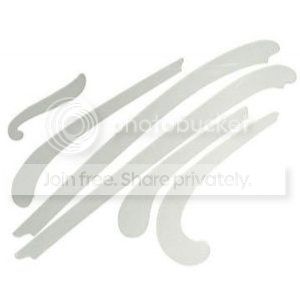
I bought a set of ships curves to aid in my drawing and it made a huge difference. One great thing is that they have no straight lines so every knife I draw is curvy.
ShipCurve.jpg


I agree with TMHunt, I'd increase the size of the ricasso. Good luck. Looking forward to seeing it completed.
 
Very nice first knife! What are you thinking for the handle scales?

Im going to use micarta. I made some with old jeans and olive drab pants, but if I dont like how that looks I bought some green micarta for plan B :)
 
Psyop, if you haven't hardened the blade, just drop the butt a bit anyway and drill a new hole. It's not a big deal. Make the handle as ergonomic as possible, even if the pins aren't spaced exactly perfect on this one. Then make the next one the same shape but fix the pin spacing and choil placement/plunge line placement.
 
I read somewhere that your fastest drilling speed should be 120 rpm. I sometimes go faster than that, without apparent work hardening. With a thicker bit, you can add more pressure but you have to reduce rpm. With a thinner bit, you have to reduce pressure, but you can increase rpm. The combination of speed and pressure will produce that self-defeating heat. I sometimes stop the drill, and carefully touch my material to see how hot it feels.

Also, when drilling, longer shavings mean your bit is closer to an exact 90 degree angle.

That looks like a good knife to have, if you are miles from the nearest road, and you need to build a shelter, and dress out an elk, and build a fire and a spit to roast it with. :-)
 
Back
Top