Thanks for the thoughts, Pohan, but I don't know everything. I read about four hours a day to learn as much as I can.The Internet has made that both enjoyable and less costly.What I pride myself in is being able to learn. That is a skill they don't teach any more in school. We learned the "Scientific Method" in school when I was a kid ( actually ,I was taught it at age four by my physicist grandfather). It still is a reliable system.
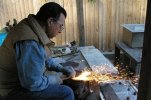
In a PM referring to the sparks from the grinder I thought I would post some of the reply:
The sparks come from small particles of steel sheared off the parent material (blade/bar of steel). The coarser the grit on the belt,the more sparks you get.Hardened steel sparks much more than annealed.Some alloys spark less, due to the alloying ingredients.
What make the sparks is shearing of small pieces of steel. When the abrasive grit grabs a microscopic piece of the steel, it starts to tear it away from the bar/blade. The energy required to do this transfers from the grinder to the material, and changes from kinetic energy ( moving belt) to thermal energy (heat). If the steel comes off easy, it does not absorb much energy,and the tiny pieces are not hot enough to glow. Add more energy (faster, harder grit , more pressure,etc.), and the pieces will get hot enough to glow. Add more carbon to the situation, and the pieces get so hot they start to burn as they come off the blade.If the carbon is high enough, the tiny pieces actually explode into multiple fragments ( those pretty "Fourth of July" type sparks that 1095 and similar steels are known for). This is what a spark test is all about. Since the belt speed,grit size, grit type,grinding pressure,power of the grinder, steel hardness,steel composition, and other factors affect the amount of spark, a spark test is only an indicator, it is not a reliable test for steel grade and composition.
You should see only tiny sparks (or none) when grinding with a 400 belt, due to the smaller particle size of the removed material.
When grinding hardened steel, the heat transfered to the blade is an unwanted by-product, and must be carefully monitored ( and cooled frequently) to avoid ruining the temper.
I was grinding at full speed ( around 4-5000SFPM) on a 2HP unit, using a 36 grit Blaze belt, leaning into the belt hard, on 1095. That is why there are a lot of sparks.
Stacy



 Great work and glad you didn't pass up the chance. I agree, too, spending a day with a seasoned maker will teach you more than a year on your own. You need to attend Ashokan up in NY this fall if you want to really soak in some knowledge! Lookinf forward to seeing the final piece as well as the tanto