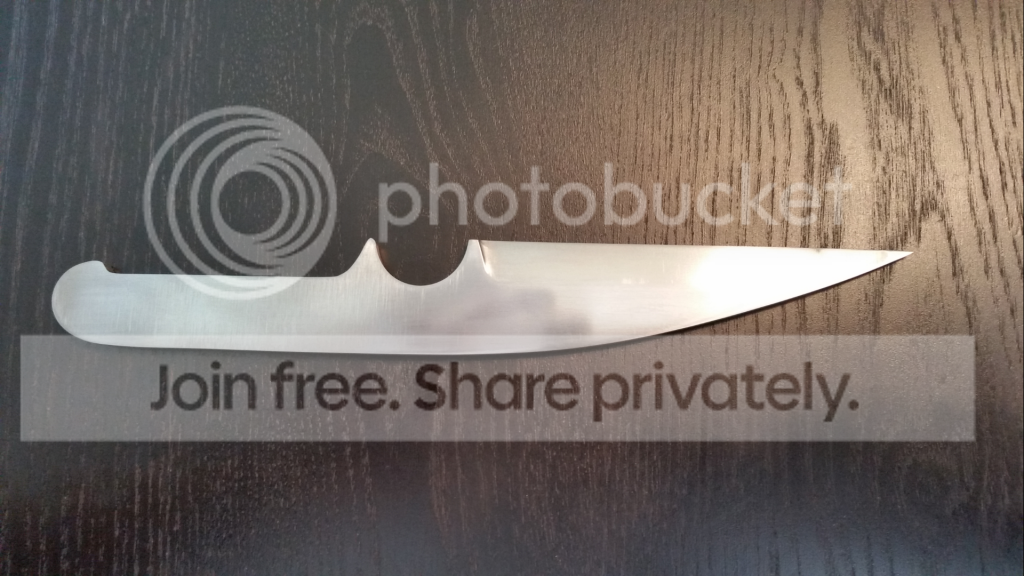
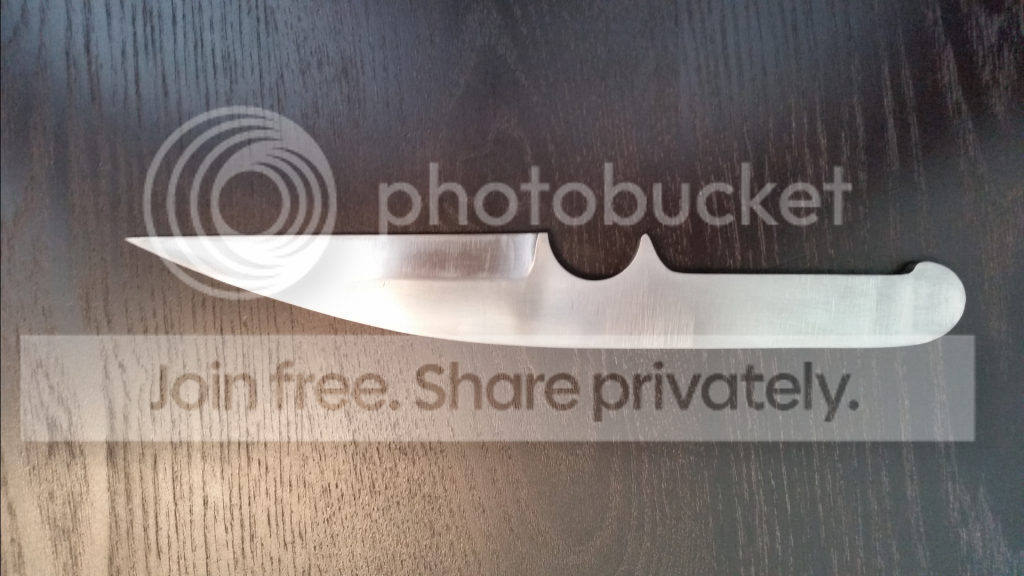
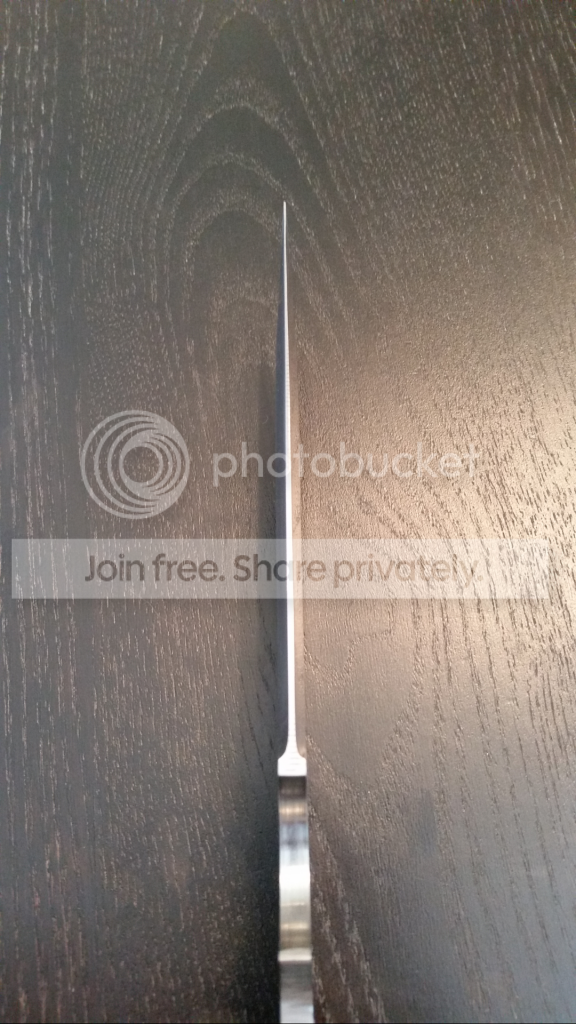
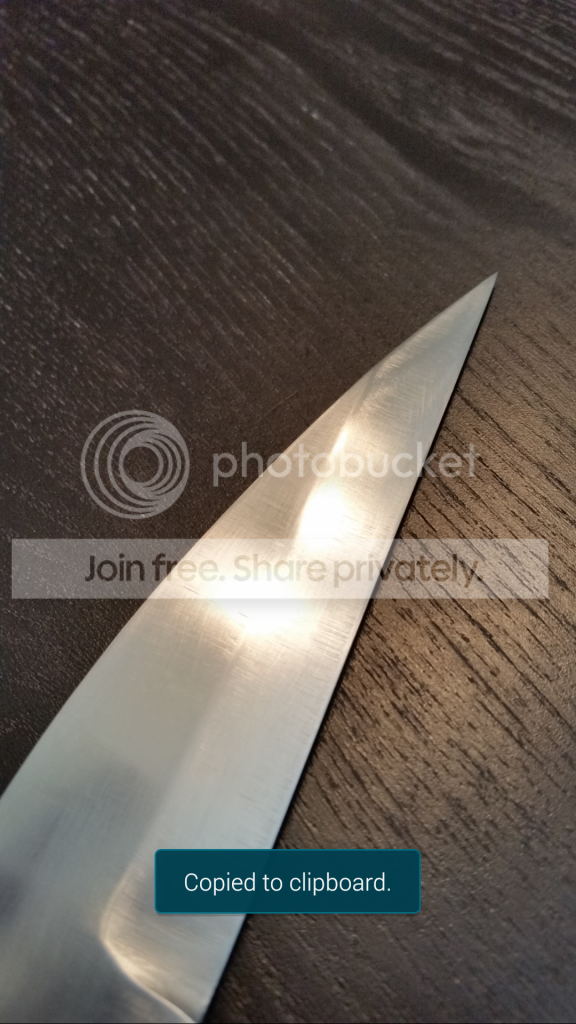
Excellent job on the filing and sanding.
On the next knife do some planning on the shape and features before shaping the metal:
1) Decide what function the knife will perform. If it is a cutter, what will it cut? If it is a stabber, how will it be used?
A "stabber" will be most likely used in a reverse grip part of the time. That will make the large point in the handle a problem. Also, a stabber may encounter hard objects, like bone. That very thin tip will break easily. "Stabbing" knives should have strong and thick tips, and normally have smooth reversible grip handle shapes. Take a look at a "chute knife" fro how this combo works -
http://www.sandownforge.com/Sandown_Forge/Chute_Knife.html
What you have is a basic Wharncliffe style ( AKA, Wharnie). These are used as slicers for softer things normally. It is also used on "slashing" knives. The tip can be rather frail, so use it gently. Other than the "stabber" nomenclature being the wrong description, your knife should be a super sharp cutter for rope, food, and cardboard. I would say that the tips on most wharncliffe knives don't last long. I have re-shaped dozens for people over the years when the point breaks off.
2) Think about how the handle will interact with the hand. This is called ergonomics. That point will chafe the two fingers a lot. If it is made half the size and rounded it will still perform its task in creating a firm grip, but won't be so uncomfortable. Also, adding a small amount of palm swell to the bottom of the main handle area will make the grip better and more comfortable. Both these changes can still be done to this knife. After taking down the point on the finger grip half of its height, grind/file in a little more behind the finger grip and before the bird's head. Make that into a smooth curve so the middle of the handle bulges a tad. Feel it and adjust as needed for a smooth grip. It only takes a tiny palm swell to make a nice grip. 1/8" is plenty.
Hopefully, one of the photoshop/drawing guys will draw what I described on the handle.