First Slip Joint

Sorry I have been really busy the past month with my normal job. Below is my progress.

I decided to use precision ground "1/8 A2 for my slip joint.
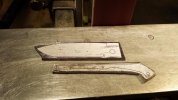
Grinding to size. I glued my template to the steel...and did a rough fit up.

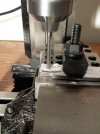
Drill undersized then reamed all my holes.

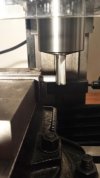
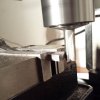
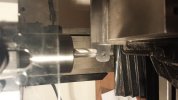
Milling the tang and spring. Oh and I'm making 4 total slip joints.
 

Attachments

  • uploadfromtaptalk1413661896263.jpg
    uploadfromtaptalk1413661896263.jpg
    58.3 KB · Views: 58
  • uploadfromtaptalk1413662552365.jpg
    uploadfromtaptalk1413662552365.jpg
    34.4 KB · Views: 51
  • uploadfromtaptalk1413663102250.jpg
    uploadfromtaptalk1413663102250.jpg
    21.3 KB · Views: 50
  • uploadfromtaptalk1413663151389.jpg
    uploadfromtaptalk1413663151389.jpg
    32.9 KB · Views: 54
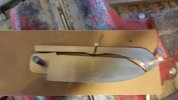
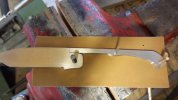
Milling the tang. and trying some fit up.
 

Attachments

  • uploadfromtaptalk1413663499915.jpg
    uploadfromtaptalk1413663499915.jpg
    35.1 KB · Views: 72
  • uploadfromtaptalk1413663543300.jpg
    uploadfromtaptalk1413663543300.jpg
    34.3 KB · Views: 88
  • uploadfromtaptalk1413663585606.jpg
    uploadfromtaptalk1413663585606.jpg
    42.5 KB · Views: 92
Looking good!

No it doesn't.

You're going have issues. Look at your second picture there. There is no tension on the blade by the spring. Your spring needs to touch the tang of the blade at two places. When it's all sitting there like that there should be tension on the spring. You don't have that at all.

Also, speaking from experience, your tang shape is going to make for a sloppy walk and talk. Pick round or square, but that half and half stuff makes a sloppy opening and closing.

Seriously, maybe keep working on it, but I'd just stop before spending any more time on it and go buy Don Robinson's book "Slipjoints My Way." It has a lot of information you don't know you don't know. It will completely change your outlook on slipjoints. Plus Don is a really nice guy.

I hope I don't come off as the south end of a north bound donkey. I'm not a big fan of wasting time and I don't like to see other people waste it either.
 
Last edited:
Thanks for the advice.

I will need to fit up. I made the mistake of using an over sized reamer. I just ordered 1/4" bushings with an 1/8" inner diameter.

That is the reason why you see a gap at the tang and the spring. Is because the hole was drilled oversize.

I will check out that book.

Also one question I have.

Do I make adjustments to the spring tension by moving the spring down, before heat treat or after?

Thanks

Nick
 
a lot of your questions were answered in the first part of this thread. go back and read and this time use some of the advise that was given instead of asking questions and then going along like you had never asked for or gotten any advise at all.

this forum can be a great asset but if you are not going to use the advice you're given then why bother asking for it?
 
Slip Joint knives are some of the hardest knives to make. I made knives for twenty five years (fix blades) before I started making folders.
When I started, I did them like when I did fix blades, from scratch, no patterns. And it still took me over three hundred knives to get good at them.
Now that I've made over a thousand of them, all from scratch. I can make one (from scratch) and do it right. I used bushings on about a hundred knives and then went back to no bushing. When you use a bushing, it will help on pinning the knife. When you pin the knife it will want to close up.
And with a bushing over sized on thickness, it will help, and you can pin it better.

I think I have done ever thing to a slip joint that can be done. When I started, I broke so dam many springs trying to adjust them for tension.
Knocked them around to get the blade to close just right. When you use pins, you got one shot at getting it right. I had to learn to get all the parts
"FLAT". Cause as you make the parts, they bend from heat and hitting them. Putting on bolsters, pinning the shield and what not. You have to
make sure everything is flat and true. At first you will do a lot of slacking and as you get better, you won't have to do as much.

Something that helped me a LOT. Was during the twenty five years doing fix blades, was that I made miniature knives from my drop.
And doing that over time helped me perfect grinding small blades. ( I do all my grinds free hand) Most makers use a pattern and most use
jigs or what not to grind with. You don't have to go to those extreme's as I did, you can use patterns and jigs to grind with, they would help.

I remember showing Alistair Phillips my knife destruction test. As you get into making the knives, don't be scared, always try new stuff.

Doing more knives over and over helps a lot. Stay focused and good luck.

 
Slip Joint knives are some of the hardest knives to make. I made knives for twenty five years (fix blades) before I started making folders.
When I started, I did them like when I did fix blades, from scratch, no patterns. And it still took me over three hundred knives to get good at them.
Now that I've made over a thousand of them, all from scratch. I can make one (from scratch) and do it right. I used bushings on about a hundred knives and then went back to no bushing. When you use a bushing, it will help on pinning the knife. When you pin the knife it will want to close up.
And with a bushing over sized on thickness, it will help, and you can pin it better.

I think I have done ever thing to a slip joint that can be done. When I started, I broke so dam many springs trying to adjust them for tension.
Knocked them around to get the blade to close just right. When you use pins, you got one shot at getting it right. I had to learn to get all the parts
"FLAT". Cause as you make the parts, they bend from heat and hitting them. Putting on bolsters, pinning the shield and what not. You have to
make sure everything is flat and true. At first you will do a lot of slacking and as you get better, you won't have to do as much.

Something that helped me a LOT. Was during the twenty five years doing fix blades, was that I made miniature knives from my drop.
And doing that over time helped me perfect grinding small blades. ( I do all my grinds free hand) Most makers use a pattern and most use
jigs or what not to grind with. You don't have to go to those extreme's as I did, you can use patterns and jigs to grind with, they would help.

I remember showing Alistair Phillips my knife destruction test. As you get into making the knives, don't be scared, always try new stuff.

Doing more knives over and over helps a lot. Stay focused and good luck.

Tod, there is some great advise here, thanks.
I have just started making slipjoints. Made 5 of them so far, with mixed success.
May I ask, why don't you use bushes anymore? Any advice why it is that after I peen the pivot, without a bush or shims, the blade runs smoothly and the pin is well hidden is the bolster, the pin starts showing, and the blade seems to become stiff?
 
I've done a couple of slipjoints with bushings. I don't see a big advantage to them. Bill, Todd, and Don got it right
get a junker take it apart and remake the knife. On the first one I'd keep all the parts as simple as possible,
and as few as possible.
Ken
 
Why don't I use bushings?

I don't need them. The bushing's will wear out sooner than steel......
 
Make sense Todd. Any advice on the issues I'm having with the pin becoming visible and the blade stiffening up?
 
Stefand,

I assume the pins become visible and the blade stiffens is after some use? If so, i would guess the pins are sticking out of the bolster, since the blade is getting stiffer. I have had this issue and the reverse issue of the pins sinking in.

If the pins start sticking out, it is because there are gaps between the liner and spring, and with use your hand is squeezing this gap closed. If there is no visible gap and this is still happening, then the gap isnt along the back edge but the belly. By that i mean your scales are spread apart like a taco. I resolved this issue by using a spacer inside the knife and keep blade open while peening. Sometimes you get a back whack with a hammer and bend a pin, i just grind the head off and pull it out and try again. Just before the pin starts getting tight and you can still move it around in the pivot hole, you can mess with it and if it is bent you can tell.

Also peening so the pins dont bend is crucial, they need to be flat on the end when you start, half a diameter sticking out, form a good head, and peen straight down. I use a small hammer like what you use to hang a picture hanger on a wall, forgot the weight, and it has a flat face that i periodically resurface and make very smooth.

If you have the problem of pins sinking in then you just need to chamfer the pivot hole more and make sure you dont sand the bolster too deep to where it removes the chamfer.
 
Chavez,

When i first joined this forum i asked a lot of questions, and still do, and i have received excellent advice and have taken about 95% of it. From what tools to get to building my own heat treat oven to slip joint design and standard practices. It has made a world of difference in my work. There is a wealth of knowledge here and plenty willing to share.

I personally hate using templates. I am a rare breed i guess, and that accounts for almost all the advice i have been given that i dont follow. I use a drawing program called inkscape now, and use it to get a good mental image that i use to stay focused on what i am doing. And i make all the parts by eye. I can make 6 springs and twelve blades my way and hold them all up to each other and they are nearly interchangeable, but if i use a template they arent even close. It is the strangest thing.

But anyways, about that spring-blade gap. I recommend drilling the center spring hole in your block first. Then position the blade onto the spring in the open position and clamp down. Drill the pivot hole. Then loosen the clamp and hold it all tight and draw a pencil line along the back of the spring. Remove the blade and rotate the spring so it moves away from the pencil line. How much you need to rotate depends a lot on your dimensions. Rotate it a bit and then clamp down on the end opposite the pivot. While held tightly in a vise you can try to bend the spring and load it onto the blade and test the stiffness. When it feels right, clamp the spring down at the pivot end and then take it all out of the vise and then you can drill the third hole. If your pins are loose in the block you will have a hell of a time getting the tension right. It is better to be a bit too stiff as you can always grind the spring between the center and pivot end to weaken it. I highly recommend you place both liners between the block and metal parts as you are clamping and drilling. Hole misalignment causes lots of preventable issues.
 
Thanks guys, I really appreciate all the advice. Guess I will still make plenty of mistakes before I get this right every time.
 
Back
Top