
-
The BladeForums.com 2024 Traditional Knife is available! Price is $250 ea (shipped within CONUS).
Order here: https://www.bladeforums.com/help/2024-traditional/
You are using an out of date browser. It may not display this or other websites correctly.
You should upgrade or use an alternative browser.
You should upgrade or use an alternative browser.
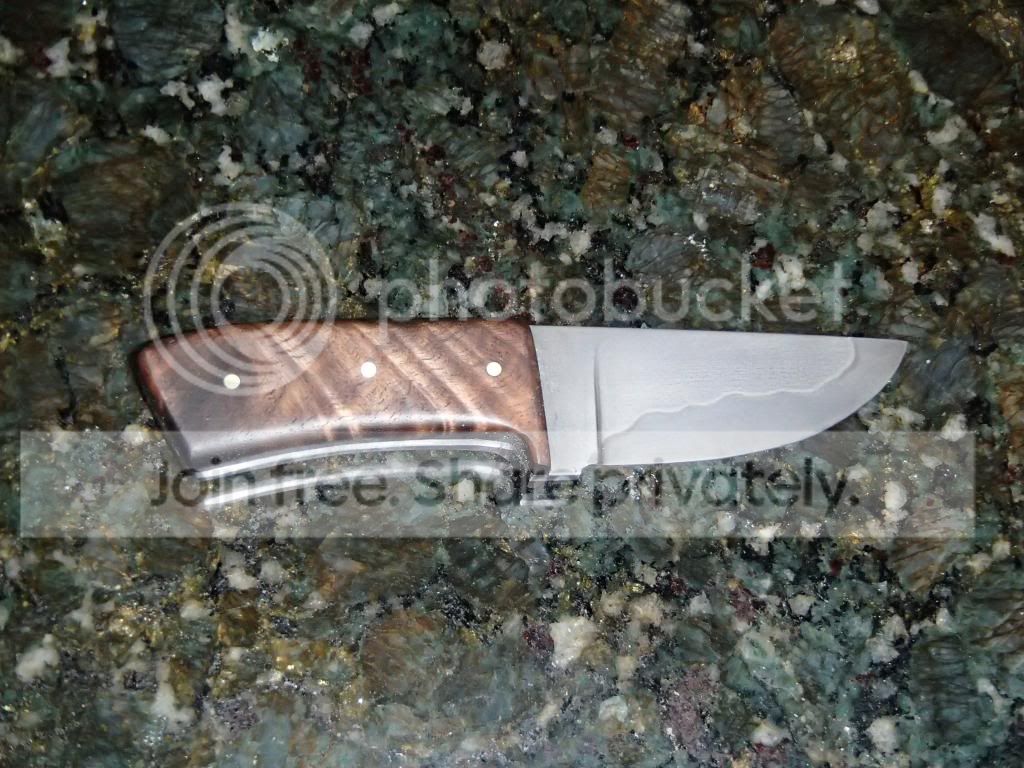
first successful attempt at a Hamon
- Thread starter lratclif
- Start date

- Joined
- Aug 11, 2012
- Messages
- 810
Nice! I love seeing a Hamon line!
- Joined
- Oct 10, 2011
- Messages
- 713
That Hamon turned out awsome great job.:thumbup:

- Joined
- Aug 8, 2011
- Messages
- 1,918
Great job! You would never know this was your first one by that pic. Thumbs up

- Joined
- Dec 18, 2008
- Messages
- 760
nice - what kind of steel is that?
Now, the fun and hard part. Learning to enhance that with polishing techniques. If you take your next blade to the point you have that one, and then rub the bejesus out of it with FF pumice on and below the hamon, with periodic etchings in vinegar, you will get a very bright, very white, transition line along with more activity. Use Mother's mag and aluminum polish to remove the oxides from etching above the hamon after each etch. It takes about 5 cycles of etching and rubbing. Rub the pumice lengthwise, in very small, wiggly strokes, pushing hard with either a finger or a piece of wood with leather pad to emulate a finger.
The mild etchant (lemon juice will work, too), and the abrasive counter-polish, make a huge difference in final appearance. In the long run, you will get a tool kit together of different abrasives, metal polishes, polishing pads/sticks, and such. Learn what each does and doesn't do. Each hamon is different, and there will be different ways to bring each one out.
Another tip: if you like to make traditional looking blades like the Japanese and Chinese, so that there is a visible grain structure (hada for Japanese) as well as a heat treatment pattern (hamon for Japanese and shuangxue for Chinese), then do what I suggested above. When you have the hamon like you want, give a 10 sec dip in dilute ferric chloride. This last etch will not change the hamon much if any, but it will make the underlying grain from pattern welding stand out more.
welcome... it is beautiful and challenging. Good news is the results along the way are enticing enough to make the journey worthwhile.
Keep at it, and keep posting!
also, good job on handle scales.
kc
Now, the fun and hard part. Learning to enhance that with polishing techniques. If you take your next blade to the point you have that one, and then rub the bejesus out of it with FF pumice on and below the hamon, with periodic etchings in vinegar, you will get a very bright, very white, transition line along with more activity. Use Mother's mag and aluminum polish to remove the oxides from etching above the hamon after each etch. It takes about 5 cycles of etching and rubbing. Rub the pumice lengthwise, in very small, wiggly strokes, pushing hard with either a finger or a piece of wood with leather pad to emulate a finger.
The mild etchant (lemon juice will work, too), and the abrasive counter-polish, make a huge difference in final appearance. In the long run, you will get a tool kit together of different abrasives, metal polishes, polishing pads/sticks, and such. Learn what each does and doesn't do. Each hamon is different, and there will be different ways to bring each one out.
Another tip: if you like to make traditional looking blades like the Japanese and Chinese, so that there is a visible grain structure (hada for Japanese) as well as a heat treatment pattern (hamon for Japanese and shuangxue for Chinese), then do what I suggested above. When you have the hamon like you want, give a 10 sec dip in dilute ferric chloride. This last etch will not change the hamon much if any, but it will make the underlying grain from pattern welding stand out more.
welcome... it is beautiful and challenging. Good news is the results along the way are enticing enough to make the journey worthwhile.
Keep at it, and keep posting!
also, good job on handle scales.
kc
Thanks for all the great tips KC, I will def be getting some FF pumice and trying the method you wrote about. The steel is 1095, I purchased some specifically to start doing differential heat treating but have noticed its a fickel steel and really requires a lot of attention in the heat treating department to get the most out of it. For this one I did 3 different etchings in ferric chloride, used 2000 wet dry to remove the oxides and then polished with rottenstone over the whole blade. The last etch was very short and I did not use the 2000 wet dry, just polished with the rottenstone and this is what I ended up with.