
First sword, Step 1: Design.

The steel i am using is a damascus billet from Delbert Ealy, http://ealyknives.com/ and i do believe he makes his damascus from O-1, L6 and pure nickel.Since i am going with damascus, not too concerned with the hamon....I will do that with the next one :) , Gary, the idea with the two pieces os steel is a good idea, will try that with the next one....hoping to get this one HT in salt baths so i think that might help minimize the warping...hopefully lol. If not, i will set up my hydraulic press to get it straightened out.
 
The steel i am using is a damascus billet from Delbert Ealy, http://ealyknives.com/ and i do believe he makes his damascus from O-1, L6 and pure nickel.Since i am going with damascus, not too concerned with the hamon....I will do that with the next one :) , Gary, the idea with the two pieces os steel is a good idea, will try that with the next one....hoping to get this one HT in salt baths so i think that might help minimize the warping...hopefully lol. If not, i will set up my hydraulic press to get it straightened out.

I'm sure someone's going to contradict me, but I'll offer this anyway...

First:
I would request Delbert NOT use pure nickel or mild steel in the mix. It will only detract from performance.

Do not grind to finish before HT a PW sword blank. Rough in any fuller and primary bevels but leave some meat, especially on the edges.

IMO, the best HT protocol for a sword in carbon steel is Martempering if you have 2 sword length salt pots or Isothermal Quench if you have 3. I do both, but usually just go with Martempering.

The best time to do a little straightening is after the final quench, but while the blade is still hot---too hot to touch. Since you're essentially making the sword a hard spring, it is very difficult and risky to try to straighten cold, unless it's HT softer than it should be. This will be trickier with O1/L6 than it would be in 1084/15N20.
 
Joe, thanks for the info :D I plan on talking to Delbert in the next day or two to find out exactly what he plans on using. As far as the using aspect, not sure how much this one will get used....I am sure i will get frisky one day and go outside and chop a few things, but i don't intend this is a big user. This is one i am designing for me to prove to myself i can do this, and am not crazy. If this works out, the next one i do will be a full tang user sword to beat the life out of lol. I think this one will be a wearing piece for the Renaissance Fest here in MI, maybe with a matching dagger to go with it. Dont get me wrong...I have every intention for this to be a "Fully functional at heart" but have no intentions of beating the hell out of it. Might do the next out of W2, as i think i can get my hands on a piece of that.
 
I'm sure someone's going to contradict me, but I'll offer this anyway...

First:
I would request Delbert NOT use pure nickel or mild steel in the mix. It will only detract from performance.

Do not grind to finish before HT a PW sword blank. Rough in any fuller and primary bevels but leave some meat, especially on the edges.

IMO, the best HT protocol for a sword in carbon steel is Martempering if you have 2 sword length salt pots or Isothermal Quench if you have 3. I do both, but usually just go with Martempering.

The best time to do a little straightening is after the final quench, but while the blade is still hot---too hot to touch. Since you're essentially making the sword a hard spring, it is very difficult and risky to try to straighten cold, unless it's HT softer than it should be. This will be trickier with O1/L6 than it would be in 1084/15N20.

J,
Why would any of this be "trickier" in O-1/L-6 than it would be in 1084/15n20? O-1/L-6 is perfect for Martempering, I do it all the time. Mike already stated He would not be doing the heat treating. As for mild steel, no one mentioned that, but the nickel, thats up to Mike. Swords are for 2 purposes, to hang on his side at fairs, or to kill people, I doubt Mike is going to be worried about any performance issues caused by a small amount of nickel. I know many people feel strongly about nickel in damascus, on both sides. I have done testing and I stand by my product.
Del
 
J,
Why would any of this be "trickier" in O-1/L-6 than it would be in 1084/15n20? O-1/L-6 is perfect for Martempering, I do it all the time. Mike already stated He would not be doing the heat treating. As for mild steel, no one mentioned that, but the nickel, thats up to Mike. Swords are for 2 purposes, to hang on his side at fairs, or to kill people, I doubt Mike is going to be worried about any performance issues caused by a small amount of nickel. I know many people feel strongly about nickel in damascus, on both sides. I have done testing and I stand by my product.
Del

Didn't mean to disparage your fine work.
He mentioned PN would be used in the mix and I advised against, as I would mild steel, which as I'm sure you recall, was done by various makers quite a bit not long ago. I didn't mean to imply you use mild steel.

I too have used PN in the past and have since decided that performance is FIRST and LAST even if the item is not intended for use.

Obviously folks have different priorities. I'm just expressing mine, and my reasoning goes like this:
You know the work in forging and finishing a sword --- it's considerable ... If the sword is as thin and light as it's supposed to be, I believe the material should be in as high-performance a state as possible. Material compromises for aesthetics alone just don't make sense to me in a sword --- but If he's making a thick, heavy thing, maybe it doesn't matter so much.

Regarding the 'trickier' comment, I was referring to straightening with residual heat. IMO, L6/O1 is less forgiving when manipulating as it's cooling than the 1084/15N20 mix, which is very forgiving and seems to remain ductile longer. IMO, L6/O1 is just a little trickier to manipulate than 1084/15N20 under these circumstances. It's a fine performer, though.
 
Last edited:
Just a curiosity question....Where can i find wrought iron? Might instead use that for the d guard and the spacers....I like the vintage look of it once it is etched...Anyone sell this as a square stock or flat stock? Also i would assume this can be forge welded, correct me if i am wrong.
 
Just a curiosity question....Where can i find wrought iron? Might instead use that for the d guard and the spacers....I like the vintage look of it once it is etched...Anyone sell this as a square stock or flat stock? Also i would assume this can be forge welded, correct me if i am wrong.

I have some of that as well.
Del
 
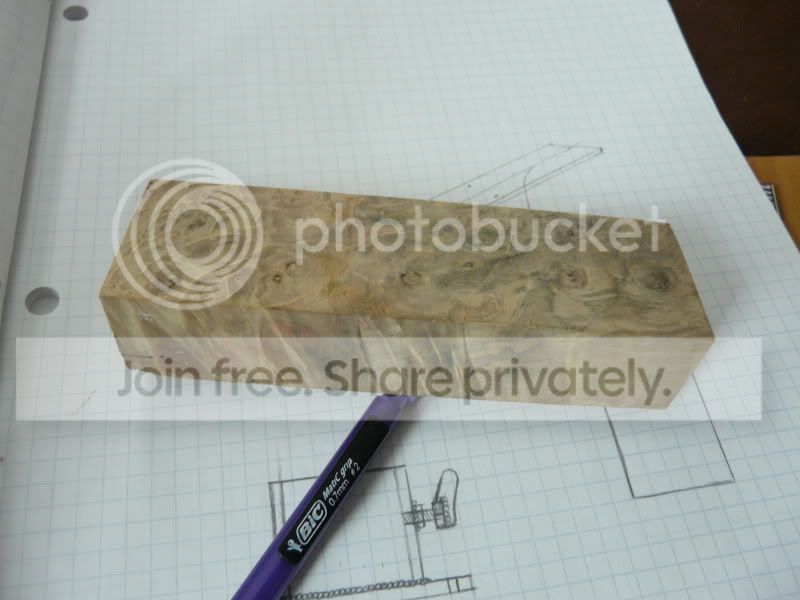
Ok....So after some thought, i have narrowed it down to 2 pieces of wood for the handle. It will be either this piece of stabilized box elder burl, or it will be a nice piece of figured walnut i have, let me know what ya guys think!
P1020527.jpg
 
Back
Top