First WIP, seat of ye olde pantaloons

daizee

Knifemaker / Craftsman / Service Provider
Joined
Dec 30, 2009
Messages
11,176
Hi Smiths,

With the acquisition of an old belt sander and a renewed sense of purpose, I decided I would try my first knife.

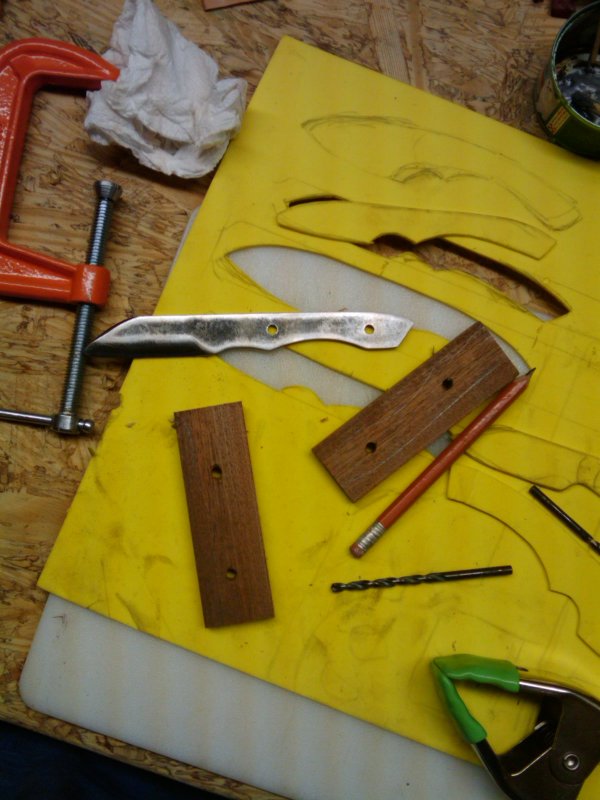
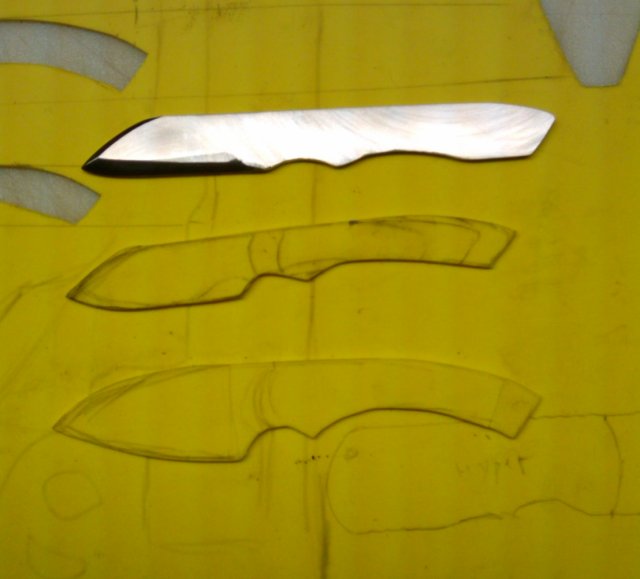
The material is just an old Nicholson file which is a reasonable thickness (1/8"?). In the picture below are some craft foam patterns. I REALLY wanted to do the big one, but figured I'd learn faster on a smaller piece first.

Gee, removing this material is hard and slow, hence the shallow shaping compared to the pattern. I have a dremmel with a cutting wheel that was used for the gross cuts, and some "toothing" of the curved areas to speed up sanding. The "primary grind" (hahahaha) is merely started, and nothing is sharp yet. The back of the tip will be a false edge.

So far this has been a useful way to learn about the limits of my tools, if nothing else.

I've read the sticky on quenching, but I have some questions about the heat treating process in general.

This file must be pretty hard and brittle.

Should I be softening this somehow before sanding/grinding? would that make it easier?

Should I try to undo the current heat treatment and start over? Any tricks there?

Is this material totally useless for a knife?

Please excuse the lousy cell phone pic.

Thanks for any advice you can offer.

-Daizee
knife-number1-1.jpg
 
A file can make a decent knife but you have to choose whether to preserve the original hardness for the blade or to anneal it first and re-harden/temper it after shaping.
If you want to retain the hardness from the original heat treatment then you have to work very carefully so as to not heat the metal up beyond a reasonable tempering temp. If you have let the piece get very hot while grinding then you may have softened it a little too much.
Grinding the file in an already hardened state will eat abrasives and take a relatively long time to grind down. Ideally you should keep it below about 200 degrees while grinding and temper it in an oven, since a file is a bit too high in hardness for a using knife edge, you want to reduce the hardness a little, but in a controlled manner.
If you have made it this far without over-heating the edge then you might just as well keep at it and see how it turns out. You've already done a good bit of it the hard way
:)
If you can/wish to anneal it and start over with the heat treat after you rough grind, you will make most of the grinding much easier and faster but obviously have the added complication of having to re-harden and temper it after getting it shaped. If you plan to drill any holes in the tang then you will have to anneal at least that area.
 
Last edited:
An idea that had not occurred to me before would be to do a variable temper using a torch, with the area that will form the edge of the blade immersed in water, before you start grinding. This should allow you to soften a good deal of the steel to some extent to aid in grinding, but leave the edge hard from the original HT. You would still want to oven temper to draw the edge hardness back a hair but this might make it a little easier to do the bulk of the grinding without requiring re-hardening of the blade. This is right off the top of my head but might be worth a try from where you're standing.
 
Hi Justin, thanks for the replies.

I am not in love with the current heat treat on the file. In fact I'm glad to know that the grinding can go faster. Doing the "right" process with less grinding is more likely to keep me interested than hours at the sander.

The file/blade probably did get too hot to have remained in its original state, though its current state is anyone's guess. I suppose tempering it would be a sensible thing to do, then grind some more to see the difference, then heat treat with a bucket of oil or something.

I have a toaster oven in the shop which has 500deg marked on the dial (never calibrated), which I have used for pre-heating steel moulds for casting silver bullets. Would this work for a simple temper, and how would I go about that? just heat it up, let it sit for a few minutes, then air cool?

thanks again!

-Daizee
 
Tempering in a toaster oven will only reduce the hardness a fairly small amount-enough to make it less brittle and better suited to a knife edge but not enough to make a huge difference in grinding. Tempering is done at much lower temperatures than most other heat treating processes and is done to adjust the final hardness to suit the intended use.
If you want to anneal it and re-heat treat it you will need to be able to heat it to the neighborhood of 1500 degrees F, and slow cool it in ashes or vermiculite to anneal it, the after shaping the blade you will need to heat and air cool it (normalize) at least once, then heat it once more and quench it, then temper it as the last step of the heat treat.
The torch and water tempering idea was based on the fact that with the edge immersed in water and protected from heat, you can temper the rest of the blade to a much greater degree than a typical oven temper, and maybe soften it enough to make a real difference in grinding. I am unsure how well this would work though, I have never tried it. If you have already over-heated the edge while grinding then there isn't much point anyway.
 
Hmm, maybe I should toast it anyway, to at least bring it closer to knife-hardness then, no?

I have a plumbing torch which strikes me as too small to be useful. And also a small propane tank with one of those weed-burning attachments. A slow-cooling medium, however, is missing.

What if I go primitive and throw it in the woodstove? I could stick it in the main bed of coals for however long, then rotate it towards the outside to cool down some, then...? Dunno how hot that gets in there when the outside of the stove is, say, 350deg.

Oh... I've got a metal bucket of wood ash on the porch. If I can get it hot enough it could be just stuck in there and left for a couple days? Hmmmm.....

Like I said, seat of the pants. :-)

-Daizee
 
Last edited:
Progress:

Last night I stuck the blade-so-far into the toaster oven, put it on high, and went to fiddle with some scrap. The blade turned blue, but I didn't watch the color progression.

After letting it cool for a bit I went back to the belt grinder. It was definitely easier - not a LOT, but noticeable. I got a shape I liked and worked on the edge. The edge is tough. My belt grinder doesn't have a rigid flat backing. I'll have to improvise something. The edge grinding is super convexy.

I tried to drill pin holes in the handle again. The last time I barely marked the surface and the drill bit just danced around (using a press). This time I actually made a mark, but it only went so far.

My conclusion is that I only managed a surface tempering that was sufficient to let me work out and edge and finish my shaping. I'll probably have to do this more seriously, or anneal and harden again. In fact, I think I'm in this goofy situation where the surface is softer than the core, which will make for a silly edge.

I read about tempering in a modern blacksmithing book which seems to have good info and isn't loaded with superstition. A proper tempering or annealing is now necessary if I'm ever going to drill holes for the handle anyway. I have a bucket of wood ash to cool in. Maybe I'll try this in the wood stove, but I'll need to get an idea of the max temperature at the core, and I don't have a measuring device. The infrared thermometers that go up to 1400deg are very expensive. The more affordable ones only reach about 1000, which I suppose is fine for tempering.

-Daizee
 
Last edited:
I threw it in the woodstove.
The stove thermometer read about 300-350, I forget. I put it near the front under a burning log on top of some hot coals and left it for awhile. When I went in after it with a large pair of pliers it was a dull red - maybe little more than dull at first. I grabbed it by the back end and shoved it tip-down into the can of ashes until it was fully covered.

Roll forward 24hrs. The knife came out of the ashes, room temperature, it appeared, and black and ugly.

Back to the shop....
This time I was able to drill the 3/16" handle holes without difficulty! Wow! So a little more grinding on the edge to thin it some more, and then I cut some scales from a piece of mahogany. A new belt on the sander made short work of rough-shaping the scales.

This time I knew to drill the holes first, then shape to the outlines after... Don't trust that you'll be able to drill the holes correctly *after* shaping. HA!

I'm back in uncharted territory, if anyone's reading:

1) Did I anneal or merely temper this blade? It took on a wicked edge and whittled well, shaved some hair, etc. I wacked it against some wood and the edge didn't roll, chip, or dent. I seemed a reasonable sharpness after some light abuse, but not as razor as when first off the 600-grit.

2) In what order does the handle shaping steps go? Do I pin the scales to the knife, shape to the blade on the grinder, and then... grind down the sides and the pins? (I've never pinned before). I see lots of people use epoxy - we'll see about that. Or do I fit, THEN pin? If I pin first, how to set the pin depth? Just estimate, then grind down?

I'll definitely do the woodstove trick BEFORE I start the next one.

-Daizee

knife-number1-2.jpg
 
It sounds like you got it hot enough to anneal to some extent or you would not have been able to drill the tang.
Whether or not you can re-harden it in your stove is questionable, if you decide to try to re-do the HT. You may have better luck using a single firebrick forge with a mapp torch to just heat and quench the edge.
The scales are done pretty much in the order you have them.
 
Justin, do you think the tang would be drillable after being hardened in the normal fashion?
I really don't have any mechanism for testing or comparison of hardness.

-Daizee
 
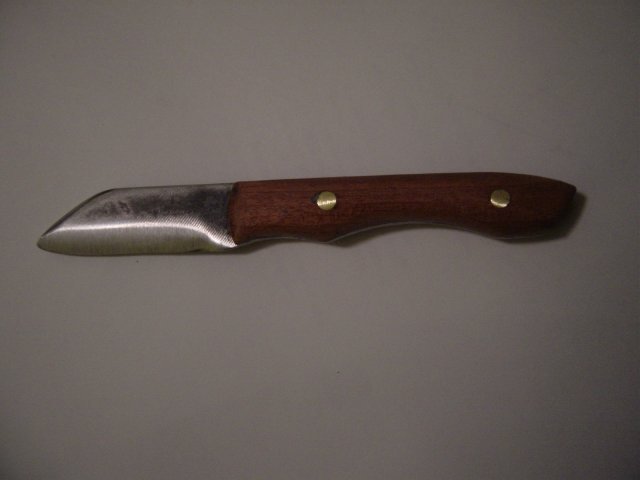
It's done! (except for some tung oil on the wood, which I'll do after the epoxy is fully set).

I decided to finish it up despite the uncertain heat-treat state and to just see what happens. I doubt I can heat treat just the edge after the scales are done if it turns out to be too soft, but mostly this was an experiment to learn what this is all about.

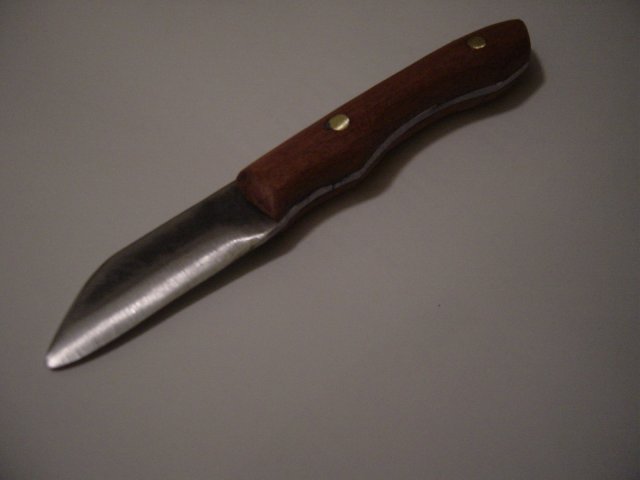
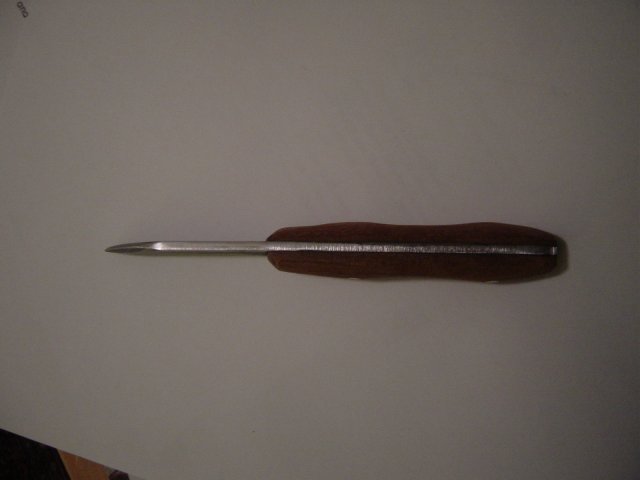
The scales are mahogany. The pins are 3/16" brass rod. You can still see some of the file tooth pattern on the flats of the blade because it's really hard to grind something flat without a backer to your belt... hm.

The glue for the grips/pins is a two-part metal powder 20-minute 3300lb epoxy. It's a bit like JB Weld, but in larger quantities and not as strong. It seems to grip things pretty well. I also tried to peen the pins - dunno how well that worked.

It's symmetrical enough to satisfy me for a first crash-course freehand attempt at all this.
It's crude, but functional, and it has a wicked edge at the moment (we'll see how long that holds up).


knife-number1-3.jpg

knife-number1-4.jpg

knife-number1-5.jpg

knife-number1-6.jpg


-Daizee
 
Last edited:
well done. if your woodstove got it up to a dull red, then you will likely be able to harden with it as well. almost certainly with some forced air application. (hair dryer, heat gun, etc). looks like a very functional shape. keep it up
 
Thanks, Savage!

A little later I took a round file and put a 1/3-round divot at the base of the edge. It looks more finished that way, and shows me where the tail end of the edge is when I choke up on the blade.

I wonder what temp it reached in the woodstove. Typically the airflow is choked way down, so I doubt it reached true annealing/hardening temperature. For the moment I'm going with the theory that I tempered it.

-Daizee
 
I had to run out of town for work for a few days right after finishing the knife.
It sat in the block on the counter.

Today I reheated some sesame chicken for lunch and when going back for a knife decided to try this goofy little thing.

WOW, it is SHARP compared to a regular table knife. I usually use eating knives that are sharper than your average table knife, but this was a whole different level. It sliced through that chicken like butter, leaving incredibly clean cuts. No sawing, tearing, whatever. And because of the beveled back of the tip, it was very effective for pushing the leavings around on the plate and onto my fork. Very little pressure was required, just a drawing motion, really.

Then I shaved up a magazine subscription card (still sharp), then I opened a bunch of mail (still sharp), and finally cleaned, waxed, and put it away (still sharp).

I dunno what it's niche is, but it's effective, if not pretty.

Once the woodstove is fired up again I'll throw in some more files so I can start on the my next attempt.

-Daizee
 
Back
Top