
Firstish WIP

Joined
May 8, 2013
Messages
81
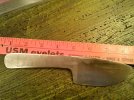
Getting it ready for heat treat, but have a couple questions. There are some scratches on the blade, should I take care of them before HT? Finished to about 180 grit. Secondly, I'm going to do g10 handles with 3/16 pins. Do I drill the pins the exact size or go slightly larger. Next, the edge is about .028 inches, is that in the danger zone for wrapping? I plan on sending to Peters for heat treat. What do you think of the design? Any improvements you would suggest? Thanks! Its 1/8th inch 1095.
 

Attachments

  • CAM00366.jpg
    CAM00366.jpg
    89.1 KB · Views: 33
It seems you have done a pretty darn good job. Yes all scratches should be removed before sending to heat treat if you are doing hand work and not machine grinding. The edge may be just a bit on the thin side. You can drill the holes the true size of the pins but either measure them or drill holes in some scrap wood and see if a pin will go thru easily. I understand Peter's does a great heat treating job. Frank
 
You want to get as near finished as possible, leaving about .010 (about a third to half a dime width) at the edge, not a final sharpening. I go 400 grit (meaning NO scratches bigger than 400) or better before HT. Using a pro, your blade will return nearly ready to furnish, edge and go.
I HT my own in a gas forge with a muffle pipe and have never had cracking/warping at the edge with 1095 if quenched properly at that thickness.
As for pin holes, most pin stock comes a little fat with the idea you will rough it up... I drill dead on the appropriate size, I test fit and make sure it is tight as possible. I drill one scale while clamped, first one hole, then put a pin in before the next hole and so forth. Same with the other side.
Good luck. Oh, and I guess you probably now, drill holes pre-HT.
 
Some pin material seems to fit good and some seems to be a little snug. You will have to try what you have. The holes in the scales should be a close fit so there are no gaps when u sand your handle but the holes in the tang can be a little looser. Not sloppy just enough so the epoxy will fill the gaps. This will also help your scales sit flat. I use the same size drill bits as my pin material then I use a round file and make the holes in the tang just a tad bigger.
 
...but the holes in the tang can be a little looser... This will also help your scales sit flat.

I have never had a problem with my scales sitting flat and I drill my tang dead nuts on.?. Rounding the edge, or not ensuring the tang is truly flat makes for gaps... Loose holes are just an invitation for something to shift during epoxy setting. I finish the front and rear of my scales prior to affixing to the knife. I use loose (relatively speaking, i like for it to take a rubber mallet to get them in place and a drift to get them out) fit scales and pins to get the top and bottom 90% there. By ensuring there is no pin play, I can assure myself my dead even front and rear edge of the scales will stay dead on without worry... I then finish it all out to flush.
But yes, pin size will vary slightly from as advertised.. Imho, fitting the pin to a hole size is better than fitting a hole to pin size. Drill bits (good ones, in a drill press) are precise. Filing something that small and round rarely is. Second, if you take off too much pinstock, get more. If you file out your holes wonkey, start over... I'll take pinstock replacement...

If others feel differently, please chime in. Thats just how I do it.. doesn't mean it's right by any means...
 
Thanks for all the help. I'll go for a snug fit on the holes then. And I will definitely get it back to the sander then to clean it up a bit.
 
Back
Top