fishing

Joined
Oct 29, 2005
Messages
512
I see alot post about bobs and EDC kits and most if not all of them contain at least some fishing line hooks and sinkers, but I don't think I have seen any information on the task of fishing itself.

Im not very knowledgeable about fishing other than putting a worm on a hook so how about some fellow members who have the knowledge start a thread on basic fishing tips?

knot tying, baits ect ect
 
Live bait is the way to go, if you can find it. Here in Northern Alberta we dont have worms in the ground. So its on to bugs and what not.

As to knots, I dont know how to explain, or even show the ones I make, its more of a jumble, but my god it holds.

But in my eyes, you just catch what ever you can, wether it be perch or mud suckers. Anything is fairgame in a survival situation. knowing where to fish is also a big part, calm areas of rivers, as well as pools in lake are great for minows, or along the beach, they love the warm water.
 
I have had good success using my hands under overhung rocks to feel for and pull out trout. I pulled a 17 inch trout I saw in near the bank one day doing this, as it just wouldnt bite my worm. I have had "some" success spearing them, its hard to get them pinned, not too hard for me to hit them.
 
Its wise to learn a few fishing knots. the hook knot, and the double fisherman (for joinging to lines together) both are great knots for fishing.

I like live bait as well but have had success with plastics and spinners.
 
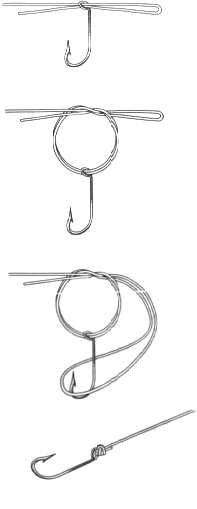
I use the uni knot, almost exclusively. It can be used to tie two lines together, to tie a hook or lure to the end of your line, or to tie a loop in the end of your line. I have never had a falure with this knot, and you can fish your whole life without knowing how to tie another knot. The only other knot I use is an overhand loop, if I want a loop on the end of my line. Here are a couple of sites that illustrate how to tie this knot.
http://www.in-fisherman.com/magazine/guides/cg2003Sp_Uniknot/
http://www.killroys.com/knots/duncan.htm
Animated:
http://www.animatedknots.com/uniknot/index.php?LogoImage=LogoGrog.jpg&Website=www.animatedknots.com


As far as fishing strategy. Use live bait that you find locally, like worms, crickets, frogs, crawfish.

A lot depends on what species of fish you are after, but if you are on a lake, your best bet is to be patiant and bobber fish with sinking bait like a worm, or sinker fish with floating bait, like powerbait, or marshmellows.

If on a river or creek, or body of water with a currant, target slower moving water, like the bend of a curve, the bottom of a pool, behind large rocks or fallen tree trunks, etc.

Trout seem to be open water fish, and can usually be caught in many different areas of a lake from open water to cover near shore, top of the water, to way down deep near the bottom. Most other species though, such as bass, bluegills, and crappy are usually found near cover. Underwater bushes, trees, rock piles, points, etc. are good places to target.

As mentioned before, live bait is best, but if it's hard to come by or if you just aren't catching anything, you can use lures if you have them, or if you don't, just about anything shiny will work: earings, wedding rings, aluminum foil, etc. Think of shiny objects as small fish/minnow immitations, and should be fished in a way that gives them movement. While it may work, it will not be the most effect way of using these items if they just suspend in the middle of the water, or just sit on the bottom of the lake.

I hope that kinda gives you an idea, it's hard to teach someone fishing without taking them fishing. A lot of fishing knowledge comes from just plain experience and is hard to teach someone. When you have literally fished your whole life, some things are just instictual, like you just know there is fish there, you may not be able to explain why, but you just know they are there. Or, sometimes you just know which color or lure will work at this specific lake or river, because you know that particular body of water. Sometimes, what knocks 'm dead at one lake, won't even get you a bite at another lake.

Like I said, I hope this helps, but the best teacher is experience, and I advise you to go fishing if you want to learn how. NOt only is it a good survival skill to have, but you will find that it is one of the most enjoyable past times that there is.

 
Read up online then go down to the local mart store and buy a zebco 33 combo outfit for about 30 dollars, hooks and sinkers, maybe a float, and a tub of nightcrawlers and go fishing. Experience is by far the best teacher, I have been fishing for over 30 years and I learn something new every season and there is no way I can begin except to say go do it. Chris

Picture099.jpg
 
Good catch.....I want one, to eat. :-)
I agree with everything you said!
 
All of G-d's critters like edges.
Mouse on the edge of the room.
Deer on the edge of a field.
Fish love edges too.
The edge between deep & shallow, weeds & no weeds, moving water & still water, warm & cold, sun & shadow...

90% of the fish are in 10% of the water.
Use edges to eliminate unproductive water.

Oh, and get out there and fish :D
 
I prefer lures to live bait. But in a survival situation, you are not doing it for sport. Use bait then and set out a couple lines. I throw all my fish back, mostly trout. I have not kept one in a long time unless it's hooked bad and that is rare. Ice fishing rig works well for a portable set up and you can still cast.
 
Fishing requires the following skills.

Being able to swear.

Being able to drink.

Being able to lie.

If your trying your best and you can't catch anything swearing can help. If it doesn't, start drinking. When you return home you can lie about why you didn't catch anything.
 
SAS Survival Guide by John "Lofty" Wiseman has great survival fishing info in it to include night lines, fish nets, fish traps.

RickJ
 
Thanks for all the suggestions.

Stingray thanks for the link on the knots, I printed out the info looks like a execellant knot.


This post was not just for me, I was hoping it would help others as well. I think information on hook sizes, line weight, knots and other small details would be important.
 
This post was not just for me, I was hoping it would help others as well. I think information on hook sizes, line weight, knots and other small details would be important.

It is a very broad subject and is very hard to answer anything but specific questions. If you let me know what type of fishing you are wondering about I might be able to help you out.

For example, fishing for wild brookies in a clear mountain stream is barely the same sport as catfish in a big slow southern river. Line size and hooks are going to vary a great deal. As a general rule you should be able to catch something with some 10 pound test and #8 hooks, remember you can catch large fish on a small hook but it is very hard to catch small fish on a large hook. Chris
 
Lovin that pic RB, and don't those Rapallas get the job done too. Bueno.
 
Hey Guys...

Heres my favorite knot...
Very Easy,,Very Strong....

Great for braids..

polamar.gif
 
Based on some years of fishing, I'll make one observation about catching fish, keeping in mind that you're starting from scratch. In my opinion, you'll get more food in most places where there's water by going after the smaller, dumber fish. That means your survival fishing tackle (mainly just line and hooks) must be purchased and packed with little fish in mind. #12 hooks with just a speck of bait will catch big minnows and tiny fish often, #8 hooks are my favorite size for bream, and a small assortment containing some #6, 4, & 2 hooks should be more than adequate for everything else. I've always preferred Eagle Claw brand hooks. 6 lb. test line is good for little fish, and 12 lb. should handle most of the rest you'll encounter. You won't need much in the way of sinkers. Often you'll catch more fish in still water without even using a sinker. Floats can be useful, but you can make your own right at the water. Check online and find yourself copies of two older books by Euell Gibbons: Stalking the Wild Asparagus, and Stalking the Blue-Eyed Scallop. Besides tons of other useful stuff on eating what you can collect outdoors, each book contains some information on very basic fishing, the first in fresh water, the second in salt water. Gibbons took a very simple, basic approach to fishing, as he did to most other aspects of his life. We can still learn a lot from him I think.
 
Lovin that pic RB, and don't those Rapallas get the job done too. Bueno.

Thanks, you dang right Raps get the job done, if someone told me I could only fish one lure for the rest of my life it would be a J-7. :thumbup::thumbup:

Just for variety.:D
Picture889.jpg
 
Back
Top