
Fitting bolster to a curved handle scale?

Joined
Jun 16, 2012
Messages
368
It appears my scales ended up being a bit short and it looks sort of odd not having them cover the entire handle. All I can think to do is get rid of the bevel at the top of the scale and add a bolster. Should I straighten that curve in the scale and add a bolster or try to fit the bolster to the curved top of the scale? (do you lap them together somehow?).

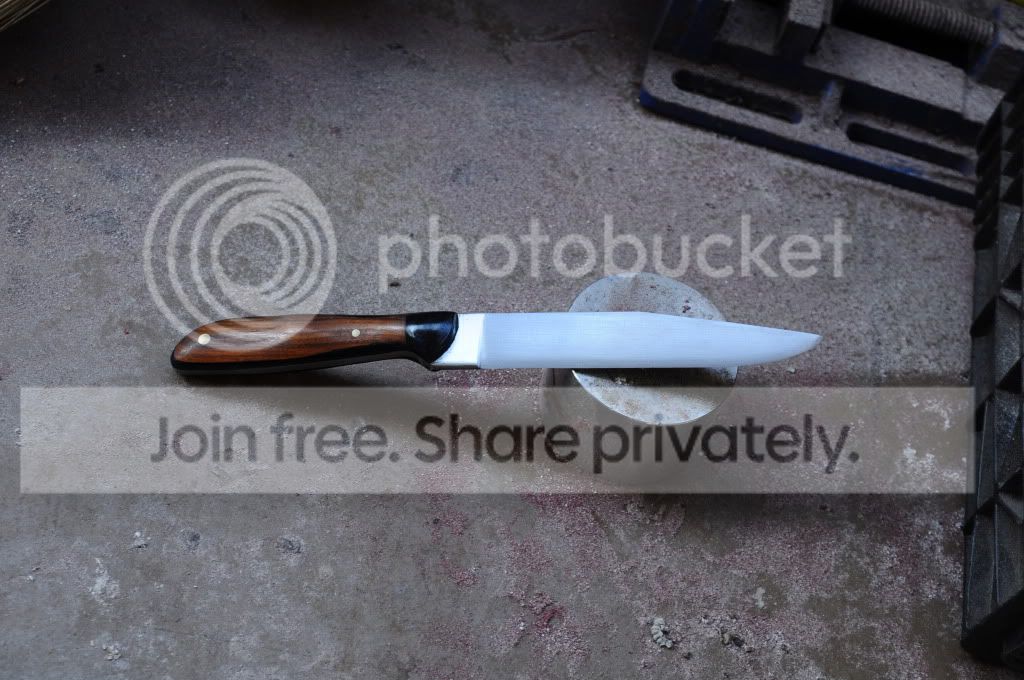
v8ezqa.jpg
 
If the steel is already hardened, you would have a hard time drilling through it to add pins for the bolster. If you were to drill through it with carbide tipped blades, you could add bolsters that either curve around the preshaped scales, or cut the ricasso end of the scales flat and line them up with flat bolsters. Or you could cut them flat and add dovetailed bolsters.

Of course, you could start over with the handle, but that looks like stabilized wood, which ain't cheap.
 
How about a micarta liner/bolster. I'm by no means a great knife maker but below is one I did because of a similar situation. Made a sheet of micarta. Sanded up the surface a bit once it was fully cured and epoxied the handle scales to it. Then I soaked some of the same fabric with resin, compacted it around the area that I wanted the bolster, and clamped it in place until it cured. Seemed to work out ok.

DSC_4061.jpg
 
Nothing so expensive as stabilized wood, just some cheap horn. Trying to save it if I can though, I like the striations in it. That's how I lost material and got them too short too, rotating them so the striations would match the handle form.
I'm trying to figure out though if I do a bolster, and match the shape to the rounded top part of the scale, how do you make them match up perfectly flush? is it time, luck, and skill thing? or is there a process? I should probably stop thinking about it and just grind that edge flat lol. The micarta is an interesting idea though, if I had the proper resin I would probably try it.
 
Save those scales and make a smaller knife to fit them. Use some new handle material and do this knife right.

When you start to compromise or modify a knife to save a few dollars in handle material, the trade-off is rarely a good one.

A good practice is to not fully shape the scales until the final fit-up.

The old rule is - "You can easily take some off....It is hard to put any back on".
 
Save those scales and make a smaller knife to fit them. Use some new handle material and do this knife right.

When you start to compromise or modify a knife to save a few dollars in handle material, the trade-off is rarely a good one.

A good practice is to not fully shape the scales until the final fit-up.

The old rule is - "You can easily take some off....It is hard to put any back on".


This.

I only shape the front of the scales as the last op before glue. The rest of the edges are very proud.

It's hard to say without seeing the rest of the tang, but that knife actually might do well with short scales. You could choke up and hold the blade flats for control, or move back for chopping.
But if it looks wrong to you, then it is.

-Daizee
 
They ended up being long enough on their own without a bolster. I'm glad to be done with that knife. Its my second knife and when I started it I really didn't grasp the fact that a scandi grind on a very thick knife thats shaped sorta like a kitchen knife probably wouldn't be optimal lol.

eqz0uc.jpg
 
Back
Top