Fitting Scales on a (Distal)Tapered Tang

Joined
Feb 20, 2016
Messages
158
After several searches I have not found a good how to or instructional on this. What I have so far is that the pin holes will need to be drilled at an angle for good fit. Should the scales be grinded at an angle or with their own matching taper? To end up with a flat side. Or are the scales just glued on flat and later the handle ground to level it out. Specifically thinner scales towards the end and thicker towards the ricasso for an overall level or equally thick handle from each end?

make sense?
 
Hey good questions. I have done a few tapered tangs and also struggled (in my head) with the geometry and angle of the holes and pins.

Here's how I do it.

1) drill pin holes before you taper the tang.
2) taper the tang lengthwise while using a welders magnet.
3) to fit the scales, I place the tang on top of one of the scales. I put it flat on my drill press in a vise. Then i place a pin through one of the pin holes so it sticks up. Then I shim the back of the scale, until the pin that sticks up is at 90° to the bottom of the vise. Clamp your scale in place with the shim underneath. Then remove your pin, and drill the holes through your scale. This will create the correct angle in your scales.
4) flip the knife over and do the second scale in the same manner.

I use full thickness scales then shape them once they're on the knife. Make sure your pins aren't a press fit through the tang and scales, or you'll have a hell of a time fitting it all together.

Hope that helps you.
 
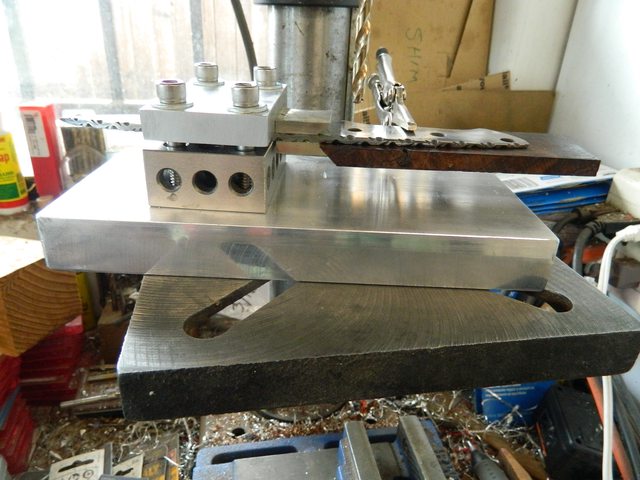
Here's one way to do it: Taper you tang all the way up under your bolsters if you want bolsters. Make sure you drill your holes for pins before you taper the tang. After fitting your bolsters you may use a little super glue to tack one side of your scales to your blade and then clamp into a jig like this. I copied this one from David Sharp. Drill your holes and break the scale off the blade and then glue the other scale to the blade turn over and repeat. That's it. The other method is for guys who want their taper to stop at the bolsters or guard. Then you must fit the scales to the bolsters by trial and error because they will not be 90 degree perpendicular anymore an will be about 1/2 a degree to 1 degree off. You have to sand the face of your scales at less than 90 degrees and test fit to the bolsters. When they fit you can glue the scales one at a time to your blade and use this jig to drill the holes. Larry


Tef8gJRl.jpg
B6uVZLzl.jpg
 
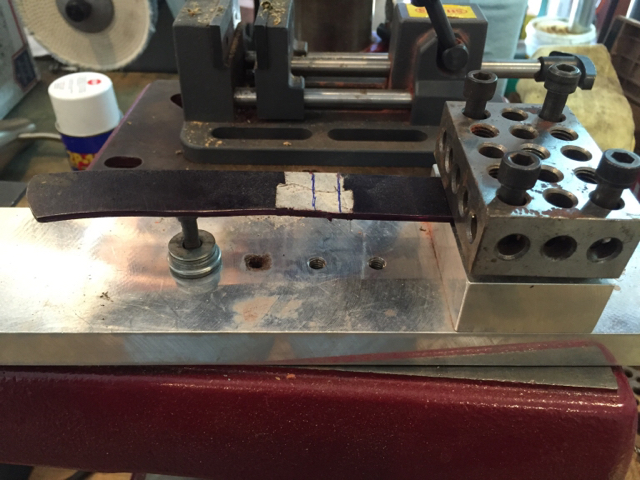
You can enhance the fixture with a tapped hole and screw to support the tang. Obviously I made one of these as well but I no longer use this method. You can also use 123 blocks as shown. .
c04d45dc52025dce664d095f14f6152f.jpg


Sent from my iPhone using Tapatalk
 
You can enhance the fixture with a tapped hole and screw to support the tang. Obviously I made one of these as well but I no longer use this method. You can also use 123 blocks as shown. .
c04d45dc52025dce664d095f14f6152f.jpg


Harbeer, Your tapped screw is a big improvement to the jig that I use. I have been using wedges and clamps but your solution is much better. Thank you, Larry PS I am told that some knife makers drill a larger hole for pins than necessary and do not use a jig at all. Is that what you are doing now? Larry
 
Larry I use a very different method since I peen my pins, Mine would be less precise than using any fixture and is more suited for efficient production.
I don't use any fixture now and my hole can be oversize since I peen the pins.
I'l have to do a short WIP on my next batch to show and explain it best.

Larry, add several tapped holes in line as I did for the greatest flexibility in using your fixture. and maybe try a nut at the top or a wing nut upside down for quick adjustment

regards
 
Last edited:
Hey good questions. I have done a few tapered tangs and also struggled (in my head) with the geometry and angle of the holes and pins.

Here's how I do it.

1) drill pin holes before you taper the tang.
2) taper the tang lengthwise while using a welders magnet.
3) to fit the scales, I place the tang on top of one of the scales. I put it flat on my drill press in a vise. Then i place a pin through one of the pin holes so it sticks up. Then I shim the back of the scale, until the pin that sticks up is at 90° to the bottom of the vise. Clamp your scale in place with the shim underneath. Then remove your pin, and drill the holes through your scale. This will create the correct angle in your scales.
4) flip the knife over and do the second scale in the same manner.

I use full thickness scales then shape them once they're on the knife. Make sure your pins aren't a press fit through the tang and scales, or you'll have a hell of a time fitting it all together.

Hope that helps you.

Pretty similar to the way I do it, except I calculate the thickness of the shim needed like this:
1. measure the blade thickness at the front of the scales and at the end of the tang with calipers.
2. subtract and divide by 2 will give you the shim thickness needed. I usually use a drill bit closest to the calculated thickness to shim the tang end.
this only works with uniform scale material. If the handle material is bone or something, then I clamp at the ricasso to a 1-2-3 block as shown above.

randy
 
Thank you all. Most excellent info.

I am going to have to let that percolate for a day or two. Then get back into the shop and tinker with it.
 
I forge my tapers in so I have to drill the taperd tang, using a standard drill press vise I open it a few inches lay the knife with scale clamped, and use a drill bit for a shim to match the degree of taper under the tang to make it level to drill, very cave man but it works for me
 
I'm with Chad, forging the tang taper leads to drilling it shimmed. It works well. Often I find that a popsicle stick is very close to the right thickness for a shim, so that's what I mostly use. Sometimes you'll get a fraction of a degree difference in everything when fitting up, which wont be enough to matter. I use corbys whenever possible, and I use a 4 flute endmill in my hand tapper to ream out the counterbores to final size. This leaves a nicely sized hole that the bolt heads will fit into and turn without binding, even with tapered tang fitups, and still tight enough that no glue is visible around the bolts.
 
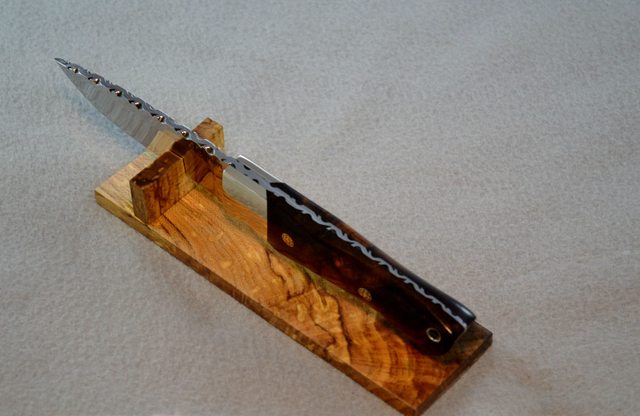
The first time I saw something like that Jig set up was from Nick Wheeler. Of course mine is not so engineered :) and it is cobbled together when I need it but it works well.

I take a flat piece of stock mount a flat piece of aluminum or even oak on top large enough to give me the clearance I need. In the picture the bolsters give enough clearance do additional piece was needed. Then I add shims and use tape for a snug support.

Once clamped tight this will level out the blade and when you drill your holes will be perpendicular to the long axis of the blade. I ca glue one side on temporarily and drill the holes, then flip it over and mount the other side and drill through the original holes through to the other side.

Viola the holes line up perfect for pins or corbys


GyjvpRc.jpg
 
i clamp my ricasso in a file guide, then clamp the file guide in a drill press vise with the ricasso flat on the vise jaw. back up the end of the handle with a piece of wood so it wont bend downward.
 
Back
Top